


OCCUPATION AND HEALTH ›› 2026, Vol. 42 ›› Issue (8): 1045-1049.
• Treatise • Previous Articles Next Articles
ZHANG Meng1, LIU Yan1, ZHAO Haitao1, WANG Qiqi2, YANG Huali1( )
)
Received:2026-02-02
Revised:2026-02-20
Online:2026-04-15
Published:2026-05-18
Contact:
YANG Huali,E-mail:jstyhl@163.com
CLC Number:
ZHANG Meng, LIU Yan, ZHAO Haitao, WANG Qiqi, YANG Huali. Research on job burnout models of outpatient nurses and medical guides based on structural equation model. [J]OCCUPATION AND HEALTH, 2026, 42(8): 1045-1049.
| 项目 | 人数[人(%)] | 情绪耗竭 | 去人格化 | 低个人成就感 |
|---|---|---|---|---|
| 性别 | ||||
| 男 | 33(18.33) | 2.00(1.20,4.00) | 1.00(0.25,2.25) | 1.67(0.50,2.50) |
| 女 | 147(81.67) | 2.20(1.20,3.40) | 1.50(0.50,3.00) | 1.67(0.17,3.00) |
| Z值 | 0.065 | 1.671 | 0.076 | |
| P值 | 0.798 | 0.196 | 0.783 | |
| 年龄(岁) | ||||
| 0~<30 | 23(12.77) | 1.60(1.00,2.80) | 0.75(0.25,2.00) | 2.00(1.00,3.00) |
| 30~<40 | 73(40.56) | 2.40(1.40,4.60) | 1.50(1.00,4.50) | 1.83(0.33,3.00) |
| 40~<50 | 66(36.67) | 2.00(1.20,3.00) | 1.50(0.50,2.50) | 1.25(0.00,2.67) |
| ≥50 | 18(10.00) | 1.90(1.20,3.40) | 1.63(0.75,3.00) | 1.50(0.67,2.83) |
| H值 | 3.104 | 4.754 | 3.831 | |
| P值 | 0.376 | 0.191 | 0.280 | |
| 工作年限(年) | ||||
| 0~<5 | 28(15.56) | 1.30(0.70,3.90) | 0.63(0.00,2.00) | 1.42(0.00,2.59) |
| 5~<10 | 22(12.22) | 1.80(1.20,2.20) | 0.63(0.00,1.75) | 1.92(0.33,2.83) |
| ≥10 | 130(72.22) | 2.30(1.40,3.60) | 1.75(0.75,3.00) | 1.67(0.33,3.00) |
| H值 | 5.551 | 10.135 | 0.620 | |
| P值 | 0.062 | 0.006 | 0.734 | |
| 婚姻状况 | ||||
| 未婚 | 33(18.33) | 1.80(1.00,4.80) | 1.00(0.25,3.00) | 2.00(1.00,3.33) |
| 已婚 | 139(77.22) | 2.00(1.40,3.40) | 1.50(0.50,3.00) | 1.50(0.00,2.83) |
| 离异 | 8(4.45) | 2.80(2.20,3.20) | 2.63(1.75,3.13) | 2.58(1.75,3.34) |
| H值 | 1.765 | 3.078 | 6.140 | |
| P值 | 0.414 | 0.215 | 0.046 | |
| 文化程度 | ||||
| 高中及以下 | 5(2.78) | 2.00(1.20,6.00) | 3.25(0.25,6.00) | 0.00(0.00,2.00) |
| 大学专科 | 50(27.78) | 1.90(1.20,3.20) | 1.25(0.25,2.25) | 1.00(0.00,2.33) |
| 大学本科 | 109(60.56) | 2.20(1.20,3.60) | 1.50(0.50,3.00) | 1.67(0.33,3.00) |
| 硕士及以上 | 16(8.89) | 2.50(1.60,4.40) | 2.00(1.25,4.88) | 2.17(1.75,3.25) |
| H值 | 1.661 | 4.804 | 6.708 | |
| P值 | 0.646 | 0.187 | 0.082 | |
| 专业 | ||||
| 临床医学类 | 59(32.78) | 2.00(1.40,3.40) | 2.00(0.75,3.00) | 1.67(0.33,3.00) |
| 医学技术类 | 35(19.44) | 2.40(1.40,3.40) | 1.50(0.50,2.25) | 1.83(0.00,3.00) |
| 预防医学类 | 2(1.11) | 3.80(2.20,5.40) | 3.50(2.20,5.00) | 2.42(1.00,3.83) |
| 非医学专业 | 84(46.67) | 2.20(1.10,4.10) | 1.25(0.25,2.88) | 1.67(0.17,2.92) |
| H值 | 1.708 | 3.313 | 0.881 | |
| P值 | 0.635 | 0.346 | 0.830 | |
| 家庭人均年收入 (万元) | ||||
| 0~<3 | 22(12.22) | 2.10(1.20,3.40) | 1.00(0.25,3.00) | 1.59(0.50,3.00) |
| 3~<5 | 29(16.11) | 2.00(1.40,3.20) | 1.25(0.00,2.25) | 1.17(0.00,2.33) |
| 5~<10 | 53(29.45) | 2.20(1.40,4.20) | 2.00(0.50,3.75) | 1.83(0.17,2.83) |
| ≥10 | 76(42.22) | 2.00(1.20,3.20) | 1.50(0.75,2.88) | 1.67(0.25,3.00) |
| H值 | 0.574 | 2.708 | 0.358 | |
| P值 | 0.902 | 0.439 | 0.949 |
| 项目 | 人数[人(%)] | 情绪耗竭 | 去人格化 | 低个人成就感 |
|---|---|---|---|---|
| 性别 | ||||
| 男 | 33(18.33) | 2.00(1.20,4.00) | 1.00(0.25,2.25) | 1.67(0.50,2.50) |
| 女 | 147(81.67) | 2.20(1.20,3.40) | 1.50(0.50,3.00) | 1.67(0.17,3.00) |
| Z值 | 0.065 | 1.671 | 0.076 | |
| P值 | 0.798 | 0.196 | 0.783 | |
| 年龄(岁) | ||||
| 0~<30 | 23(12.77) | 1.60(1.00,2.80) | 0.75(0.25,2.00) | 2.00(1.00,3.00) |
| 30~<40 | 73(40.56) | 2.40(1.40,4.60) | 1.50(1.00,4.50) | 1.83(0.33,3.00) |
| 40~<50 | 66(36.67) | 2.00(1.20,3.00) | 1.50(0.50,2.50) | 1.25(0.00,2.67) |
| ≥50 | 18(10.00) | 1.90(1.20,3.40) | 1.63(0.75,3.00) | 1.50(0.67,2.83) |
| H值 | 3.104 | 4.754 | 3.831 | |
| P值 | 0.376 | 0.191 | 0.280 | |
| 工作年限(年) | ||||
| 0~<5 | 28(15.56) | 1.30(0.70,3.90) | 0.63(0.00,2.00) | 1.42(0.00,2.59) |
| 5~<10 | 22(12.22) | 1.80(1.20,2.20) | 0.63(0.00,1.75) | 1.92(0.33,2.83) |
| ≥10 | 130(72.22) | 2.30(1.40,3.60) | 1.75(0.75,3.00) | 1.67(0.33,3.00) |
| H值 | 5.551 | 10.135 | 0.620 | |
| P值 | 0.062 | 0.006 | 0.734 | |
| 婚姻状况 | ||||
| 未婚 | 33(18.33) | 1.80(1.00,4.80) | 1.00(0.25,3.00) | 2.00(1.00,3.33) |
| 已婚 | 139(77.22) | 2.00(1.40,3.40) | 1.50(0.50,3.00) | 1.50(0.00,2.83) |
| 离异 | 8(4.45) | 2.80(2.20,3.20) | 2.63(1.75,3.13) | 2.58(1.75,3.34) |
| H值 | 1.765 | 3.078 | 6.140 | |
| P值 | 0.414 | 0.215 | 0.046 | |
| 文化程度 | ||||
| 高中及以下 | 5(2.78) | 2.00(1.20,6.00) | 3.25(0.25,6.00) | 0.00(0.00,2.00) |
| 大学专科 | 50(27.78) | 1.90(1.20,3.20) | 1.25(0.25,2.25) | 1.00(0.00,2.33) |
| 大学本科 | 109(60.56) | 2.20(1.20,3.60) | 1.50(0.50,3.00) | 1.67(0.33,3.00) |
| 硕士及以上 | 16(8.89) | 2.50(1.60,4.40) | 2.00(1.25,4.88) | 2.17(1.75,3.25) |
| H值 | 1.661 | 4.804 | 6.708 | |
| P值 | 0.646 | 0.187 | 0.082 | |
| 专业 | ||||
| 临床医学类 | 59(32.78) | 2.00(1.40,3.40) | 2.00(0.75,3.00) | 1.67(0.33,3.00) |
| 医学技术类 | 35(19.44) | 2.40(1.40,3.40) | 1.50(0.50,2.25) | 1.83(0.00,3.00) |
| 预防医学类 | 2(1.11) | 3.80(2.20,5.40) | 3.50(2.20,5.00) | 2.42(1.00,3.83) |
| 非医学专业 | 84(46.67) | 2.20(1.10,4.10) | 1.25(0.25,2.88) | 1.67(0.17,2.92) |
| H值 | 1.708 | 3.313 | 0.881 | |
| P值 | 0.635 | 0.346 | 0.830 | |
| 家庭人均年收入 (万元) | ||||
| 0~<3 | 22(12.22) | 2.10(1.20,3.40) | 1.00(0.25,3.00) | 1.59(0.50,3.00) |
| 3~<5 | 29(16.11) | 2.00(1.40,3.20) | 1.25(0.00,2.25) | 1.17(0.00,2.33) |
| 5~<10 | 53(29.45) | 2.20(1.40,4.20) | 2.00(0.50,3.75) | 1.83(0.17,2.83) |
| ≥10 | 76(42.22) | 2.00(1.20,3.20) | 1.50(0.75,2.88) | 1.67(0.25,3.00) |
| H值 | 0.574 | 2.708 | 0.358 | |
| P值 | 0.902 | 0.439 | 0.949 |
| 项目 | 人数[人(%)] | 焦虑自评得分 | 社会支持评定得分 |
|---|---|---|---|
| 性别 | |||
| 男 | 33(18.33) | 49.00(40.00,56.00) | 36.00(31.00,44.00) |
| 女 | 147(81.67) | 46.00(36.00,56.00) | 39.00(34.00,45.00) |
| Z值 | 0.244 | 1.780 | |
| P值 | 0.621 | 0.182 | |
| 年龄(岁) | |||
| 0~<30 | 23(12.77) | 41.00(33.00,49.00) | 36.00(32.00,39.00) |
| 30~<40 | 73(40.56) | 50.00(41.00,59.00) | 37.00(31.00,45.00) |
| 40~<50 | 66(36.67) | 44.00(36.00,54.00) | 40.00(36.00,46.00) |
| ≥50 | 18(10.00) | 50.50(41.00,58.00) | 40.50(33.00,42.00) |
| H值 | 7.148 | 7.720 | |
| P值 | 0.067 | 0.052 | |
| 工作年限(年) | |||
| 0~<5 | 28(15.56) | 41.00(34.00,49.50) | 38.50(34.50,45.00) |
| 5~<10 | 22(12.22) | 39.50(33.00,50.00) | 37.50(33.00,45.00) |
| ≥10 | 130(72.22) | 49.00(40.00,56.00) | 39.50(33.00,44.00) |
| H值 | 8.836 | 0.036 | |
| P值 | 0.012 | 0.982 | |
| 婚姻状况 | |||
| 未婚 | 33(18.33) | 44.00(38.00,54.00) | 34.00(26.00,38.00) |
| 已婚 | 139(77.22) | 48.00(36.00,56.00) | 40.00(35.00,45.00) |
| 离异 | 8(4.45) | 54.50(49.50,62.00) | 33.50(25.00,43.00) |
| H值 | 2.683 | 21.519 | |
| P值 | 0.261 | <0.001 | |
| 文化程度 | |||
| 高中及以下 | 5(2.78) | 48.00(44.00,56.00) | 42.00(40.00,45.00) |
| 大学专科 | 50(27.78) | 45.00(36.00,56.00) | 40.50(34.00,44.00) |
| 大学本科 | 109(60.56) | 49.00(36.00,56.00) | 38.00(32.00,45.00) |
| 硕士及以上 | 16(8.89) | 47.00(40.00,53.00) | 38.50(35.00,40.50) |
| H值 | 0.291 | 1.545 | |
| P值 | 0.962 | 0.672 | |
| 专业 | |||
| 临床医学类 | 59(32.78) | 49.00(40.00,56.00) | 39.00(35.00,43.00) |
| 医学技术类 | 35(19.44) | 45.00(39.00,54.00) | 40.00(35.00,46.00) |
| 预防医学类 | 2(1.11) | 52.50(46.00,59.00) | 32.00(26.00,38.00) |
| 非医学专业 | 84(46.67) | 46.00(35.50,58.00) | 38.00(31.50,45.00) |
| H值 | 0.909 | 2.417 | |
| P值 | 0.823 | 0.490 | |
| 家庭人均年收 入(万元) | |||
| 0~<3 | 22(12.22) | 49.50(40.00,66.00) | 35.50(27.00,41.00) |
| 3~<5 | 29(16.11) | 44.00(35.00,55.00) | 37.00(33.00,47.00) |
| 5~<10 | 53(29.45) | 46.00(38.00,56.00) | 39.00(34.00,43.00) |
| ≥10 | 76(42.22) | 47.00(38.50,56.00) | 40.00(34.50,45.00) |
| H值 | 1.968 | 5.584 | |
| P值 | 0.579 | 0.134 |
| 项目 | 人数[人(%)] | 焦虑自评得分 | 社会支持评定得分 |
|---|---|---|---|
| 性别 | |||
| 男 | 33(18.33) | 49.00(40.00,56.00) | 36.00(31.00,44.00) |
| 女 | 147(81.67) | 46.00(36.00,56.00) | 39.00(34.00,45.00) |
| Z值 | 0.244 | 1.780 | |
| P值 | 0.621 | 0.182 | |
| 年龄(岁) | |||
| 0~<30 | 23(12.77) | 41.00(33.00,49.00) | 36.00(32.00,39.00) |
| 30~<40 | 73(40.56) | 50.00(41.00,59.00) | 37.00(31.00,45.00) |
| 40~<50 | 66(36.67) | 44.00(36.00,54.00) | 40.00(36.00,46.00) |
| ≥50 | 18(10.00) | 50.50(41.00,58.00) | 40.50(33.00,42.00) |
| H值 | 7.148 | 7.720 | |
| P值 | 0.067 | 0.052 | |
| 工作年限(年) | |||
| 0~<5 | 28(15.56) | 41.00(34.00,49.50) | 38.50(34.50,45.00) |
| 5~<10 | 22(12.22) | 39.50(33.00,50.00) | 37.50(33.00,45.00) |
| ≥10 | 130(72.22) | 49.00(40.00,56.00) | 39.50(33.00,44.00) |
| H值 | 8.836 | 0.036 | |
| P值 | 0.012 | 0.982 | |
| 婚姻状况 | |||
| 未婚 | 33(18.33) | 44.00(38.00,54.00) | 34.00(26.00,38.00) |
| 已婚 | 139(77.22) | 48.00(36.00,56.00) | 40.00(35.00,45.00) |
| 离异 | 8(4.45) | 54.50(49.50,62.00) | 33.50(25.00,43.00) |
| H值 | 2.683 | 21.519 | |
| P值 | 0.261 | <0.001 | |
| 文化程度 | |||
| 高中及以下 | 5(2.78) | 48.00(44.00,56.00) | 42.00(40.00,45.00) |
| 大学专科 | 50(27.78) | 45.00(36.00,56.00) | 40.50(34.00,44.00) |
| 大学本科 | 109(60.56) | 49.00(36.00,56.00) | 38.00(32.00,45.00) |
| 硕士及以上 | 16(8.89) | 47.00(40.00,53.00) | 38.50(35.00,40.50) |
| H值 | 0.291 | 1.545 | |
| P值 | 0.962 | 0.672 | |
| 专业 | |||
| 临床医学类 | 59(32.78) | 49.00(40.00,56.00) | 39.00(35.00,43.00) |
| 医学技术类 | 35(19.44) | 45.00(39.00,54.00) | 40.00(35.00,46.00) |
| 预防医学类 | 2(1.11) | 52.50(46.00,59.00) | 32.00(26.00,38.00) |
| 非医学专业 | 84(46.67) | 46.00(35.50,58.00) | 38.00(31.50,45.00) |
| H值 | 0.909 | 2.417 | |
| P值 | 0.823 | 0.490 | |
| 家庭人均年收 入(万元) | |||
| 0~<3 | 22(12.22) | 49.50(40.00,66.00) | 35.50(27.00,41.00) |
| 3~<5 | 29(16.11) | 44.00(35.00,55.00) | 37.00(33.00,47.00) |
| 5~<10 | 53(29.45) | 46.00(38.00,56.00) | 39.00(34.00,43.00) |
| ≥10 | 76(42.22) | 47.00(38.50,56.00) | 40.00(34.50,45.00) |
| H值 | 1.968 | 5.584 | |
| P值 | 0.579 | 0.134 |
| 统计指标 | 统计值 | 判断准则 |
|---|---|---|
| χ2值 | 26.875(df=12) | χ2/df<3,拟合效果好 |
| CFI | 0.972 | >0.90,拟合效果好 |
| RMSEA | 0.083 | 0.08~0.10,拟合效果良好 |
| SRMR | 0.047 | <0.05 |
| 统计指标 | 统计值 | 判断准则 |
|---|---|---|
| χ2值 | 26.875(df=12) | χ2/df<3,拟合效果好 |
| CFI | 0.972 | >0.90,拟合效果好 |
| RMSEA | 0.083 | 0.08~0.10,拟合效果良好 |
| SRMR | 0.047 | <0.05 |
| 研究 假设 | 路径 | 效应类型 | 标准化 系数 | 显著性 |
|---|---|---|---|---|
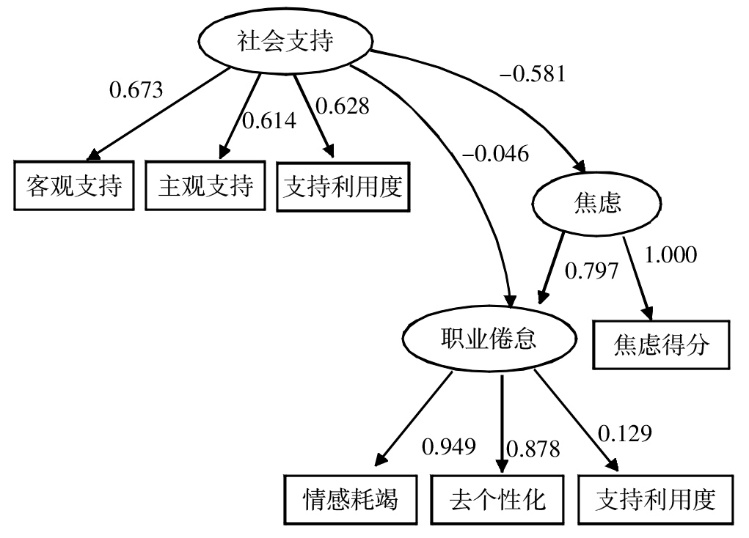
| H1 | 社会支持→焦虑 | 直接效应 | -0.581 | P<0.001,显著 |
| H2 | 焦虑→职业倦怠 | 直接效应 | 0.797 | P<0.001,显著 |
| H3 | 社会支持→职业倦怠 | 直接效应 | -0.046 | P=0.596,不显著 |
| H4 | 社会支持→焦虑→职业倦怠 | 间接效应 | -0.365 | 95%CI:-0.558~-0.243,显著 |
| 研究 假设 | 路径 | 效应类型 | 标准化 系数 | 显著性 |
|---|---|---|---|---|
| H1 | 社会支持→焦虑 | 直接效应 | -0.581 | P<0.001,显著 |
| H2 | 焦虑→职业倦怠 | 直接效应 | 0.797 | P<0.001,显著 |
| H3 | 社会支持→职业倦怠 | 直接效应 | -0.046 | P=0.596,不显著 |
| H4 | 社会支持→焦虑→职业倦怠 | 间接效应 | -0.365 | 95%CI:-0.558~-0.243,显著 |
| [1] |
MASLACH C, JACKSON S E. The measurement of experienced burnout[J]. J Occup Behav, 1981, 2(2):99-113.
DOI URL |
| [2] | 胡昕. NC医院行政管理人员职业倦怠影响因素及干预策略研究[D]. 北京: 北方工业大学, 2023. |
| [3] | 李宁, 王玉玲, 宋海楠, 等. 新入职护士一般自我效能感与焦虑抑郁状况调查及分析[J]. 解放军医学院学报, 2017, 38(6):545-547,589. |
| [4] | 张凤霞. 基于焦虑自评量表(SAS)的三甲医院护士群体心理健康状况及影响因素研究[D]. 北京: 中国医学科学院清华大学医学部北京协和医学院, 2023. |
| [5] | 肖水源. “社会支持评定量表”的理论基础与研究应用[J]. 临床精神医学杂志, 1994(2):98-100. |
| [6] |
MASLACH C, SCHAUFELI W B, LEITER M P. Job burnout[J]. Annu Rev Psychol, 2001, 52:397-422.
PMID |
| [7] |
ZUNG W W. A rating instrument for anxiety disorders[J]. Psychosomatics, 1971, 12(6):371-379.
DOI PMID |
| [8] |
DUNSTAN D A, SCOTT N. Norms for Zung's self-rating anxiety scale[J]. BMC Psychiatry, 2020, 20(1):90.
DOI PMID |
| [9] | 姚静, 左志芹, 李静, 等. 某三甲中医院门诊导医职业倦怠情况及其影响因素的研究[J]. 江苏卫生事业管理, 2019, 30(4):498-500,503. |
| [10] | 丛明慧, 刘亚萍, 张嘉峻, 等. 门诊护士职业压力、精神薪酬满意度及其与职业倦怠的关系[J]. 中国妇幼保健, 2025, 40(1):88-92. |
| [11] | 许宽宽. 门诊护理人员职业倦怠相关性因素分析[J]. 中国卫生标准管理, 2022, 13(1):8-11. |
| [12] | 杨茂琼, 张红英, 罗艳芳. 情绪劳动在三级甲等医院门诊护士工作场所心理暴力与职业倦怠中的中介作用[J]. 职业与健康, 2023, 39(13):1749-1753. |
| [13] | 陈雪峰, 傅小兰, 张侃. 中国国民心理健康发展报告(2021—2022)[M]. 北京: 社会科学文献出版社, 2023:22. |
| [14] | 卢明莉. 医务人员生活质量、人际信任和社会支持水平及相关性研究[D]. 杭州: 浙江大学, 2011. |
| [15] |
ZHANG H, YE Z, TANG L, et al. Anxiety symptoms and burnout among Chinese medical staff of intensive care unit:The moderating effect of social support[J]. BMC Psychiatry, 2020, 20(1):197.
DOI |
| [16] |
ZHOU J, YANG Y, QIU X, et al. Serial multiple mediation of organizational commitment and job burnout in the relationship between psychological capital and anxiety in Chinese female nurses:A cross-sectional questionnaire survey[J]. Int J Nurs Stud, 2018, 83:75-82.
DOI URL |
| [17] | 陆斯琦. 临床医生领悟社会支持与焦虑、抑郁相关性研究[J]. 中国职业医学, 2018, 45(1):71-74. |
| [18] | 高妍. 某三甲综合医院护理人员职业紧张对焦虑的影响及职业倦怠的中介效应[J]. 中华劳动卫生职业病杂志, 2022, 40(2):127-131. |
| [19] | 刘蝶, 邹惠祥, 王钦, 等. 组织支持感对门诊护士工作投入的影响研究—以职业倦怠为中介变量[J]. 卫生职业教育, 2024, 42(9):137-140. |
| [20] | 刘娟, 赵清. 某三级综合医院门诊护士职业倦怠、组织支持感现状及影响因素分析[J]. 湖南师范大学学报(医学版), 2022, 19(4):164-169. |
| [21] | 郭胜鹏, 靳思慧, 王虎峰. “互联网+医疗健康”服务使用情况对江西省某市基层医疗卫生机构医生职业倦怠的影响机制研究[J]. 医学与社会, 2025, 38(10):118-125. |
| [22] |
MELNYK B M, KELLY S A, STEPHENS J, et al. Interventions to improve mental health,well-being,physical health,and lifestyle behaviors in physicians and nurses:A systematic review[J]. Am J Health Promot, 2020, 34(8):929-941.
DOI URL |
| [23] |
GHAWADRA S F, LIM ABDULLAH K, CHOO W Y, et al. The effect of mindfulness-based training on stress,anxiety,depression and job satisfaction among ward nurses:A randomized control trial[J]. J Nurs Manag, 2020, 28(5):1088-1097
DOI URL |
| Viewed | ||||||
|
Full text |
|
|||||
|
Abstract |
|
|||||
 津公网安备12010202000831号 津ICP备11005889号-6
