

OCCUPATION AND HEALTH ›› 2026, Vol. 42 ›› Issue (18): 2490-2495.
• Treatise——Experiment·Monitoring and Inspection • Previous Articles Next Articles
KOU Jiulong1,2, XU Xueyu2, LI Xuedan2,3, LI Jiahui1,2, YANG Qian2, HE Ping2( )
)
Received:2025-07-25
Revised:2025-12-29
Online:2026-09-15
Published:2026-08-28
Contact:
HE Ping
CLC Number:
KOU Jiulong, XU Xueyu, LI Xuedan, LI Jiahui, YANG Qian, HE Ping. Analysis of CASP1 gene polymorphisms and loci interaction with susceptibility to silicosis in Xinjiang. [J]OCCUPATION AND HEALTH, 2026, 42(18): 2490-2495.
| 项目 | 接尘对照组(n=70) | 矽肺组(n=84) | Z/χ2值 | P值 |
|---|---|---|---|---|
| 年龄 | 53.00(49.00,57.00) | 53.00(50.00,56.75) | -0.320a | 0.749 |
| 工种 | 3.789b | 0.285 | ||
| 掘进工 | 39(55.7) | 52(61.9) | ||
| 皮带巡检工 | 15(21.4) | 14(16.7) | ||
| 采煤工 | 11(15.7) | 7(8.3) | ||
| 其他 | 5(7.1)d | 11(13.1) | ||
| 接尘工龄(年) | 14.00(10.00,23.00) | 18.00(13.00,23.75) | -1.755a | 0.079 |
| 接尘工龄(年) | 3.455b | 0.178 | ||
| 0~<20 | 44(62.9) | 46(54.8) | ||
| 20~<30 | 15(21.4) | 28(34.5) | ||
| ≥30 | 11(15.7) | 9(10.7) | ||
| 吸烟 | 6.297b | 0.012 | ||
| 是 | 41(58.6) | 65(77.4) | ||
| 否 | 29(41.4) | 19(22.6) | ||
| 饮酒 | 7.652b | 0.006 | ||
| 是 | 26(37.1) | 50(59.5) | ||
| 否 | 44(62.9) | 34(40.5) | ||
| 锻炼 | 2.553b | 0.110 | ||
| 是 | 23(32.9) | 18(21.4) | ||
| 否 | 47(67.1) | 66(78.6) | ||
| 工作环境 | 3.188c | 0.366 | ||
| 井下 | 56(80.0) | 57(67.9) | ||
| 敞开式车间 | 5(7.1) | 9(10.7) | ||
| 密闭大车间 | 5(7.1) | 12(14.3) | ||
| 露天 | 4(5.7)d | 6(7.1) | ||
| 日均工作时间(h) | 0.733b | 0.392 | ||
| 0~8 | 42(60.0) | 56(66.7) | ||
| >8 | 28(40.0) | 28(33.3) |
| 项目 | 接尘对照组(n=70) | 矽肺组(n=84) | Z/χ2值 | P值 |
|---|---|---|---|---|
| 年龄 | 53.00(49.00,57.00) | 53.00(50.00,56.75) | -0.320a | 0.749 |
| 工种 | 3.789b | 0.285 | ||
| 掘进工 | 39(55.7) | 52(61.9) | ||
| 皮带巡检工 | 15(21.4) | 14(16.7) | ||
| 采煤工 | 11(15.7) | 7(8.3) | ||
| 其他 | 5(7.1)d | 11(13.1) | ||
| 接尘工龄(年) | 14.00(10.00,23.00) | 18.00(13.00,23.75) | -1.755a | 0.079 |
| 接尘工龄(年) | 3.455b | 0.178 | ||
| 0~<20 | 44(62.9) | 46(54.8) | ||
| 20~<30 | 15(21.4) | 28(34.5) | ||
| ≥30 | 11(15.7) | 9(10.7) | ||
| 吸烟 | 6.297b | 0.012 | ||
| 是 | 41(58.6) | 65(77.4) | ||
| 否 | 29(41.4) | 19(22.6) | ||
| 饮酒 | 7.652b | 0.006 | ||
| 是 | 26(37.1) | 50(59.5) | ||
| 否 | 44(62.9) | 34(40.5) | ||
| 锻炼 | 2.553b | 0.110 | ||
| 是 | 23(32.9) | 18(21.4) | ||
| 否 | 47(67.1) | 66(78.6) | ||
| 工作环境 | 3.188c | 0.366 | ||
| 井下 | 56(80.0) | 57(67.9) | ||
| 敞开式车间 | 5(7.1) | 9(10.7) | ||
| 密闭大车间 | 5(7.1) | 12(14.3) | ||
| 露天 | 4(5.7)d | 6(7.1) | ||
| 日均工作时间(h) | 0.733b | 0.392 | ||
| 0~8 | 42(60.0) | 56(66.7) | ||
| >8 | 28(40.0) | 28(33.3) |
| 位点 | 位置 | 等位 基因 | 基因区域 | 次要等位基因频率 | Hardy-Weinberg 平衡检验P值 | |
|---|---|---|---|---|---|---|
| 矽肺组 | 接尘对照组 | |||||
| rs2282659 | chr1:104897437 | A/G | 内含子变异 | 0.15 | 0.25 | 0.447 |
| rs530537 | chr1:104898513 | T/C | 内含子变异 | 0.20 | 0.32 | 0.667 |
| rs516095 | chr1:104902938 | G/T | 内含子变异 | 0.22 | 0.26 | 0.827 |
| rs1790203 | chr1:104896613 | A/G | 内含子变异 | 0.21 | 0.26 | 1.000 |
| 位点 | 位置 | 等位 基因 | 基因区域 | 次要等位基因频率 | Hardy-Weinberg 平衡检验P值 | |
|---|---|---|---|---|---|---|
| 矽肺组 | 接尘对照组 | |||||
| rs2282659 | chr1:104897437 | A/G | 内含子变异 | 0.15 | 0.25 | 0.447 |
| rs530537 | chr1:104898513 | T/C | 内含子变异 | 0.20 | 0.32 | 0.667 |
| rs516095 | chr1:104902938 | G/T | 内含子变异 | 0.22 | 0.26 | 0.827 |
| rs1790203 | chr1:104896613 | A/G | 内含子变异 | 0.21 | 0.26 | 1.000 |
| SNP位点 | 等位 基因 | 接尘对照组 (n=70) | 矽肺组 (n=84) | OR(95%CI) | P值 |
|---|---|---|---|---|---|
| rs2282659 | A | 105(75.0) | 142(84.5) | 1.000 | 0.037 |
| G | 35(25.0) | 26(15.5) | 0.549(0.312~0.968) | ||
| rs530537 | T | 95(67.9) | 136(81.0) | 1.000 | 0.008 |
| C | 45(32.1) | 32(19.0) | 0.496(0.294~0.838) | ||
| rs516095 | G | 103(73.6) | 131(78.0) | 1.000 | 0.368 |
| T | 37(26.4) | 37(22.0) | 0.786(0.466~1.327) | ||
| rs1790203 | A | 103(73.6) | 132(78.6) | 1.000 | 0.305 |
| G | 37(26.4) | 36(21.4) | 0.759(0.449~1.285) |
| SNP位点 | 等位 基因 | 接尘对照组 (n=70) | 矽肺组 (n=84) | OR(95%CI) | P值 |
|---|---|---|---|---|---|
| rs2282659 | A | 105(75.0) | 142(84.5) | 1.000 | 0.037 |
| G | 35(25.0) | 26(15.5) | 0.549(0.312~0.968) | ||
| rs530537 | T | 95(67.9) | 136(81.0) | 1.000 | 0.008 |
| C | 45(32.1) | 32(19.0) | 0.496(0.294~0.838) | ||
| rs516095 | G | 103(73.6) | 131(78.0) | 1.000 | 0.368 |
| T | 37(26.4) | 37(22.0) | 0.786(0.466~1.327) | ||
| rs1790203 | A | 103(73.6) | 132(78.6) | 1.000 | 0.305 |
| G | 37(26.4) | 36(21.4) | 0.759(0.449~1.285) |
| 遗传模型 | 基因型 | 接尘对照组 (n=70) | 矽肺组 (n=84) | 模型1 | 模型2 | |||
|---|---|---|---|---|---|---|---|---|
| OR(95%CI) | P值 | OR(95%CI) | P值 | AIC值 | ||||
| rs2282659 | ||||||||
| 共显性模型 | AA | 39(55.7) | 58(67.9) | 1.000 | 0.031 | 1.000 | 0.082 | 208.770 |
| AG | 27(38.6) | 26(32.1) | 0.777(0.395~1.527) | 0.925(0.449~1.907) | ||||
| GG | 4(5.7) | 0(0.0) | ||||||
| 显性模型 | AA | 39(55.8) | 58(69.0) | 1.000 | 0.088 | 1.000 | 0.562 | 211.440 |
| AG+GG | 31(44.2) | 26(31.0) | 0.670 (0.346~1.296) | 0.811(0.399~1.646) | ||||
| 隐性模型 | AA+AG | 66(94.3) | 84(100.0) | 1.000 | 0.041 | 1.000 | 0.026 | 206.815 |
| GG | 4(5.7) | 0(0.0) | ||||||
| 超显性模型 | AA+GG | 43(61.4) | 58(69.0) | 1.000 | 0.322 | 1.000 | 0.988 | 211.776 |
| AG | 27(38.6) | 26(31.0) | 0.853 (0.436~1.666) | 1.005(0.490~2.061) | ||||
| 加性模型 | 0.594 (0.311~0.968) | 0.036 | 0.581(0.301~1.112) | 0.288 | 210.646 | |||
| rs530537 | ||||||||
| 共显性模型 | TT | 30(42.9) | 55(65.5) | 1.000 | 0.018 | 1.000 | 0.088 | 208.925 |
| TC | 35(50.0) | 26(31.0) | 0.405(0.206~0.796) | 0.462(0.226~0.946) | ||||
| CC | 5(7.1) | 3(3.5) | 0.327 (0.073~1.465) | 0.454(0.091~2.252) | ||||
| 显性模型 | TT | 30(42.9) | 55(65.5) | 1.000 | 0.005 | 1.000 | 0.028 | 206.926 |
| TC+CC | 40(57.1) | 29(34.5) | 0.396 (0.206~0.760) | 0.461(0.231~0.922) | ||||
| 隐性模型 | TT+TC | 65(92.9) | 81(96.4) | 1.000 | 0.320 | 1.000 | 0.560 | 211.436 |
| CC | 5(7.1) | 3(3.6) | 0.482 (0.111~2.090) | 0.628(0.130~3.042) | ||||
| 超显性模型 | TT+CC | 35(50.0) | 58(69.0) | 1.000 | 0.016 | 1.000 | 0.048 | 207.882 |
| TC | 35(50.0) | 26(31.0) | 0.448 (0.232~0.866) | 0.495(0.245~0.999) | ||||
| 加性模型 | 0.468 (0.267~0.818) | 0.008 | 0.541(0.299~0.976) | 0.039 | 207.494 | |||
| rs516095 | ||||||||
| 共显性模型 | GG | 37(52.9) | 51(60.7) | 1.000 | 0.618 | 1.000 | 0.885 | 213.532 |
| GT | 29(41.4) | 29(34.5) | 0.726 (0.373~1.413) | 0.836(0.412~1.699) | ||||
| TT | 4(5.7) | 4(4.8) | 0.726 (0.170~3.090) | 0.917(0.194~4.338) | ||||
| 显性模型 | GG | 37(52.9) | 51(60.7) | 1.000 | 0.327 | 1.000 | 0.630 | 211.545 |
| GT+TT | 33(47.1) | 33(39.3) | 0.726 (0.382~1.378) | 0.846(0.428~1.673) | ||||
| 隐性模型 | GG+GT | 66(94.3) | 80(95.2) | 1.000 | 0.327 | 1.000 | 0.983 | 211.776 |
| TT | 4(5.7) | 4(4.8) | 0.825 (0.199~3.426) | 0..983(0.213~4.543) | ||||
| 超显性模型 | GG+TT | 41(58.6) | 55(65.5) | 1.000 | 0.379 | 1.000 | 0.630 | 211.544 |
| GT | 29(41.4) | 29(34.5) | 0.746 (0.387~1.435) | 0.842(0.420~1.692) | ||||
| 加性模型 | 0.780 (0.457~1.330) | 0.361 | 0.888(0.503~1.568) | 0.683 | 211.609 | |||
| rs1790203 | ||||||||
| 共显性模型 | AA | 37(52.9) | 52(61.9) | 1.000 | 0.527 | 1.000 | 0.837 | 213.421 |
| GA | 29(41.4) | 28(33.3) | 0.687 (0.352~1.341) | 0.806(0.396~1.640) | ||||
| GG | 4(5.7) | 4(4.8) | 0.712 (0.167~3.029) | 0.94(0.191~4.273) | ||||
| 显性模型 | AA | 37(52.9) | 52(61.9) | 1.000 | 0.258 | 1.000 | 0.563 | 211.441 |
| GA+GG | 33(47.1) | 32(38.1) | 0.690 (0.363~1.313) | 0.817(0.412~1.619) | ||||
| 隐性模型 | AA+GA | 66(94.3) | 80(95.2) | 1.000 | 0.791 | 1.000 | 0.983 | 211.776 |
| GG | 4(5.7) | 4(4.8) | 0.825 (0.199~3.426) | 0.983(0.213~4.543) | ||||
| 超显性模型 | AA+GG | 41(58.6) | 56(66.7) | 1.000 | 0.301 | 1.000 | 0.560 | 211.438 |
| GA | 29(41.4) | 28(33.3) | 0.707 (0.366~1.364) | 0.812(0.403~1.635) | ||||
| 加性模型 | 0.753 (0.441~1.287) | 0.300 | 0.867(0.491~1.533) | 0.625 | 211.537 | |||
| 遗传模型 | 基因型 | 接尘对照组 (n=70) | 矽肺组 (n=84) | 模型1 | 模型2 | |||
|---|---|---|---|---|---|---|---|---|
| OR(95%CI) | P值 | OR(95%CI) | P值 | AIC值 | ||||
| rs2282659 | ||||||||
| 共显性模型 | AA | 39(55.7) | 58(67.9) | 1.000 | 0.031 | 1.000 | 0.082 | 208.770 |
| AG | 27(38.6) | 26(32.1) | 0.777(0.395~1.527) | 0.925(0.449~1.907) | ||||
| GG | 4(5.7) | 0(0.0) | ||||||
| 显性模型 | AA | 39(55.8) | 58(69.0) | 1.000 | 0.088 | 1.000 | 0.562 | 211.440 |
| AG+GG | 31(44.2) | 26(31.0) | 0.670 (0.346~1.296) | 0.811(0.399~1.646) | ||||
| 隐性模型 | AA+AG | 66(94.3) | 84(100.0) | 1.000 | 0.041 | 1.000 | 0.026 | 206.815 |
| GG | 4(5.7) | 0(0.0) | ||||||
| 超显性模型 | AA+GG | 43(61.4) | 58(69.0) | 1.000 | 0.322 | 1.000 | 0.988 | 211.776 |
| AG | 27(38.6) | 26(31.0) | 0.853 (0.436~1.666) | 1.005(0.490~2.061) | ||||
| 加性模型 | 0.594 (0.311~0.968) | 0.036 | 0.581(0.301~1.112) | 0.288 | 210.646 | |||
| rs530537 | ||||||||
| 共显性模型 | TT | 30(42.9) | 55(65.5) | 1.000 | 0.018 | 1.000 | 0.088 | 208.925 |
| TC | 35(50.0) | 26(31.0) | 0.405(0.206~0.796) | 0.462(0.226~0.946) | ||||
| CC | 5(7.1) | 3(3.5) | 0.327 (0.073~1.465) | 0.454(0.091~2.252) | ||||
| 显性模型 | TT | 30(42.9) | 55(65.5) | 1.000 | 0.005 | 1.000 | 0.028 | 206.926 |
| TC+CC | 40(57.1) | 29(34.5) | 0.396 (0.206~0.760) | 0.461(0.231~0.922) | ||||
| 隐性模型 | TT+TC | 65(92.9) | 81(96.4) | 1.000 | 0.320 | 1.000 | 0.560 | 211.436 |
| CC | 5(7.1) | 3(3.6) | 0.482 (0.111~2.090) | 0.628(0.130~3.042) | ||||
| 超显性模型 | TT+CC | 35(50.0) | 58(69.0) | 1.000 | 0.016 | 1.000 | 0.048 | 207.882 |
| TC | 35(50.0) | 26(31.0) | 0.448 (0.232~0.866) | 0.495(0.245~0.999) | ||||
| 加性模型 | 0.468 (0.267~0.818) | 0.008 | 0.541(0.299~0.976) | 0.039 | 207.494 | |||
| rs516095 | ||||||||
| 共显性模型 | GG | 37(52.9) | 51(60.7) | 1.000 | 0.618 | 1.000 | 0.885 | 213.532 |
| GT | 29(41.4) | 29(34.5) | 0.726 (0.373~1.413) | 0.836(0.412~1.699) | ||||
| TT | 4(5.7) | 4(4.8) | 0.726 (0.170~3.090) | 0.917(0.194~4.338) | ||||
| 显性模型 | GG | 37(52.9) | 51(60.7) | 1.000 | 0.327 | 1.000 | 0.630 | 211.545 |
| GT+TT | 33(47.1) | 33(39.3) | 0.726 (0.382~1.378) | 0.846(0.428~1.673) | ||||
| 隐性模型 | GG+GT | 66(94.3) | 80(95.2) | 1.000 | 0.327 | 1.000 | 0.983 | 211.776 |
| TT | 4(5.7) | 4(4.8) | 0.825 (0.199~3.426) | 0..983(0.213~4.543) | ||||
| 超显性模型 | GG+TT | 41(58.6) | 55(65.5) | 1.000 | 0.379 | 1.000 | 0.630 | 211.544 |
| GT | 29(41.4) | 29(34.5) | 0.746 (0.387~1.435) | 0.842(0.420~1.692) | ||||
| 加性模型 | 0.780 (0.457~1.330) | 0.361 | 0.888(0.503~1.568) | 0.683 | 211.609 | |||
| rs1790203 | ||||||||
| 共显性模型 | AA | 37(52.9) | 52(61.9) | 1.000 | 0.527 | 1.000 | 0.837 | 213.421 |
| GA | 29(41.4) | 28(33.3) | 0.687 (0.352~1.341) | 0.806(0.396~1.640) | ||||
| GG | 4(5.7) | 4(4.8) | 0.712 (0.167~3.029) | 0.94(0.191~4.273) | ||||
| 显性模型 | AA | 37(52.9) | 52(61.9) | 1.000 | 0.258 | 1.000 | 0.563 | 211.441 |
| GA+GG | 33(47.1) | 32(38.1) | 0.690 (0.363~1.313) | 0.817(0.412~1.619) | ||||
| 隐性模型 | AA+GA | 66(94.3) | 80(95.2) | 1.000 | 0.791 | 1.000 | 0.983 | 211.776 |
| GG | 4(5.7) | 4(4.8) | 0.825 (0.199~3.426) | 0.983(0.213~4.543) | ||||
| 超显性模型 | AA+GG | 41(58.6) | 56(66.7) | 1.000 | 0.301 | 1.000 | 0.560 | 211.438 |
| GA | 29(41.4) | 28(33.3) | 0.707 (0.366~1.364) | 0.812(0.403~1.635) | ||||
| 加性模型 | 0.753 (0.441~1.287) | 0.300 | 0.867(0.491~1.533) | 0.625 | 211.537 | |||
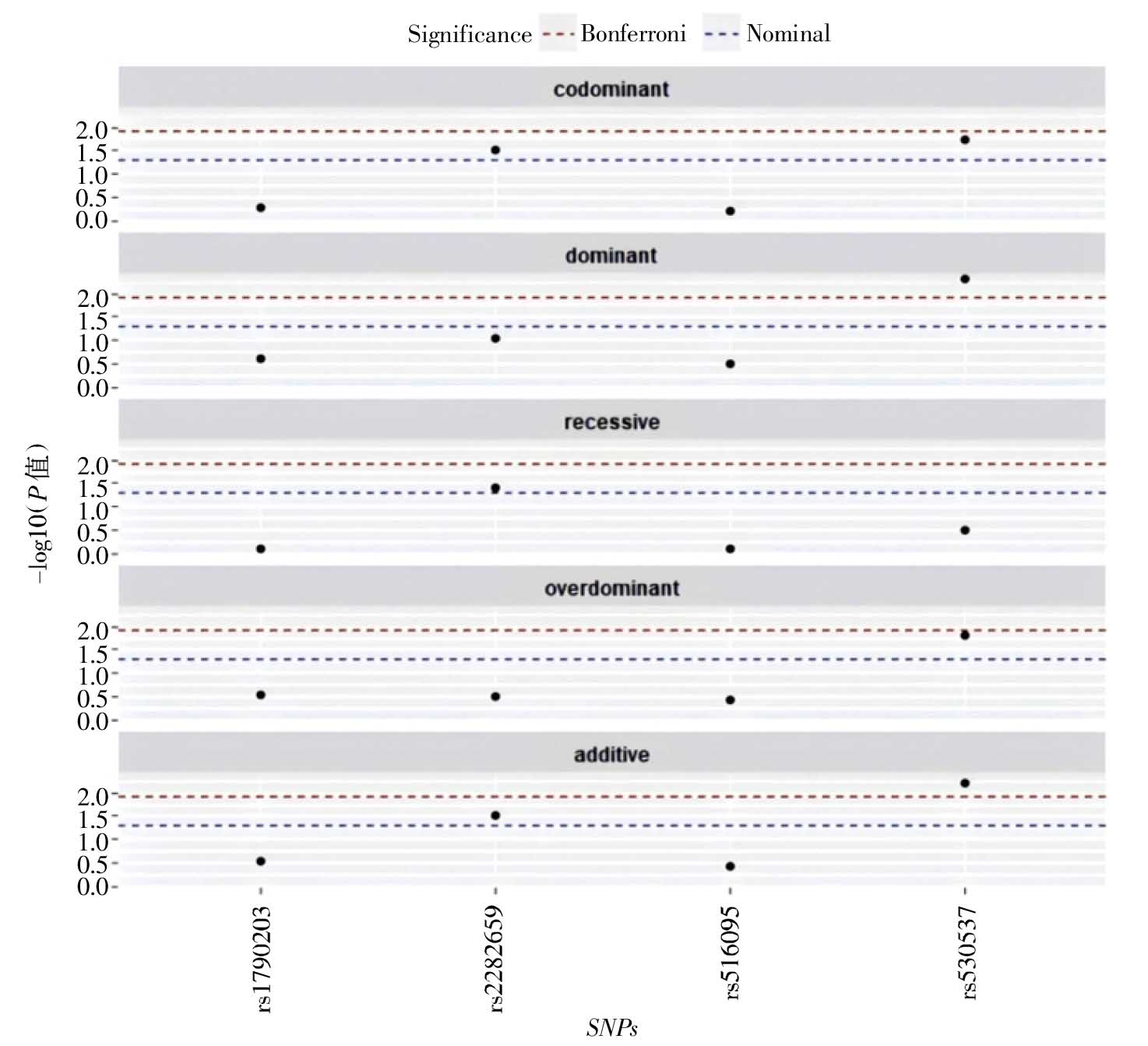
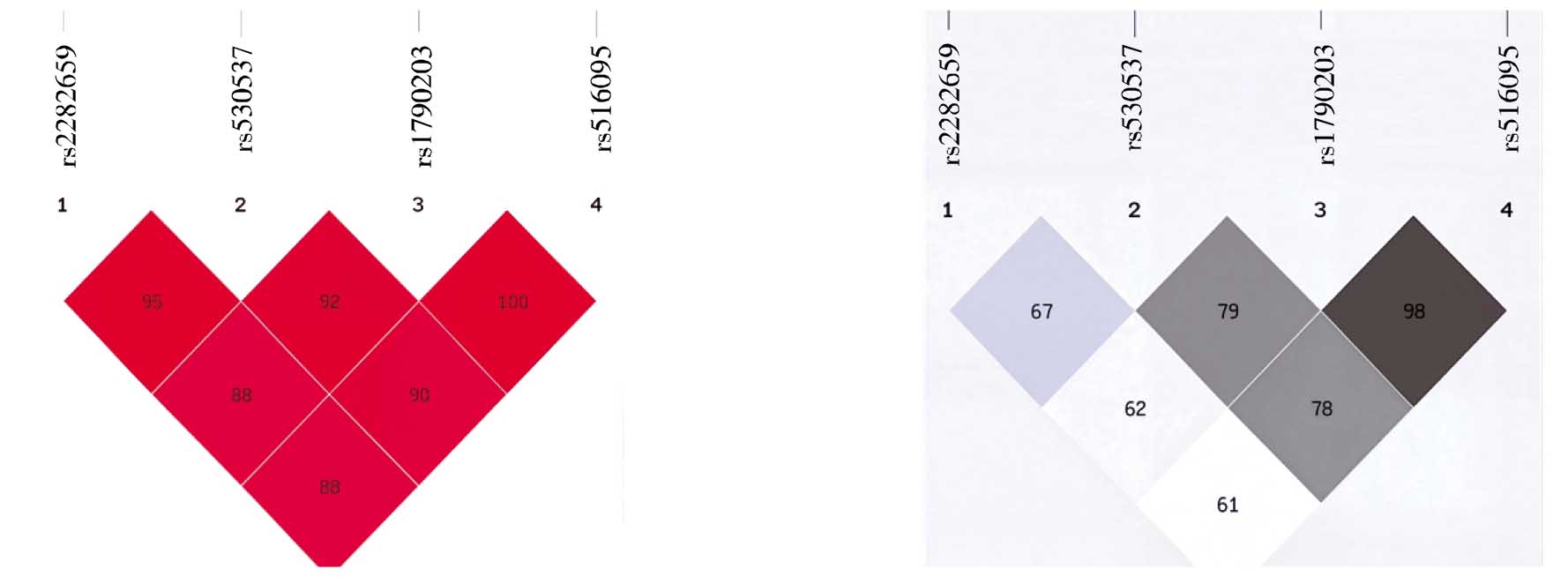
| 单倍型a | 接尘对照组 频率b(n=84) | 矽肺组频 率b(n=70) | χ2值 | P值 | OR(95%CI) |
|---|---|---|---|---|---|
| ACTG | 7(0.050) | 7(0.042) | 0.194 | 0.660 | 0.790(0.272~2.920) |
| ATGA | 94(0.671) | 131(0.780) | 3.011 | 0.083 | 1.610(0.940~2.756) |
| GCTG | 30(0.214) | 25(0.149) | 2.708 | 0.099 | 0.610(0.340~1.095) |
| 单倍型a | 接尘对照组 频率b(n=84) | 矽肺组频 率b(n=70) | χ2值 | P值 | OR(95%CI) |
|---|---|---|---|---|---|
| ACTG | 7(0.050) | 7(0.042) | 0.194 | 0.660 | 0.790(0.272~2.920) |
| ATGA | 94(0.671) | 131(0.780) | 3.011 | 0.083 | 1.610(0.940~2.756) |
| GCTG | 30(0.214) | 25(0.149) | 2.708 | 0.099 | 0.610(0.340~1.095) |
| 模型 | 训练样本 准确度 | 验证样本 准确度 | 符号检验 (P值) | 交叉验证 一致性 |
|---|---|---|---|---|
| rs530537 | 0.613 0 | 0.605 7 | 9(0.010 7) | 10/10 |
| rs2282659,rs530537 | 0.627 4 | 0.601 5 | 8(0.054 7) | 10/10 |
| rs2282659,rs530537,rs1790203 | 0.632 7 | 0.597 5 | 9(0.010 7) | 10/10 |
| rs2282659,rs5305,rs1790203,rs516095 | 0.632 7 | 0.594 7 | 9(0.010 7) | 10/10 |
| 模型 | 训练样本 准确度 | 验证样本 准确度 | 符号检验 (P值) | 交叉验证 一致性 |
|---|---|---|---|---|
| rs530537 | 0.613 0 | 0.605 7 | 9(0.010 7) | 10/10 |
| rs2282659,rs530537 | 0.627 4 | 0.601 5 | 8(0.054 7) | 10/10 |
| rs2282659,rs530537,rs1790203 | 0.632 7 | 0.597 5 | 9(0.010 7) | 10/10 |
| rs2282659,rs5305,rs1790203,rs516095 | 0.632 7 | 0.594 7 | 9(0.010 7) | 10/10 |
| [1] |
WANG J, ZENG X, XUE W, et al. Transcriptomic profiling of lung fibroblasts in silicosis:Regulatory roles of Nrf2 agonists in a mouse model[J]. Int Immunopharmacol, 2024, 143(1):113273.
DOI URL |
| [2] | 毛翎, 彭莉君, 王焕强, 等. 尘肺病治疗中国专家共识(2024年版)[J]. 环境与职业医学, 2024, 41(1):1-21. |
| [3] | 国家卫生健康委员会. 2023年我国卫生健康事业发展统计公报[EB/OL]. (2024-08-29)[2025-07-22]. https://www.gov.cn/lianbo/bumen/202408/content_6971241.htm. |
| [4] |
KIM R Y, PINKERTON J W, ESSILFIE A T, et al. Role for NLRP3 Inflammasome-mediated,IL-1β-Dependent Responses in Severe,Steroid-Resistant Asthma[J]. Am J Respir Crit Care Med, 2017, 196(3):283-297.
DOI URL |
| [5] |
FANG Y, TIAN S, PAN Y, et al. Pyroptosis:A new frontier in cancer[J]. Biomed Pharmacother, 2020, 121(2020):109595.
DOI URL |
| [6] |
KIM J J, JO E K. NLRP3 Inflammasome and Host Protection against Bacterial Infection[J]. J Korean Med Sci, 2013, 28(10):1415-1423.
DOI URL |
| [7] |
KIM R Y, PINKERTONI J W, GIBSON P G, et al. Inflammasomes in COPD and neutrophilic asthma[J]. Thorax, 2015, 70(12):1199-1201.
DOI PMID |
| [8] |
SWAROOP K V, SHAKTI S, et al. Understanding the pathogenesis of occupational coal and silica dust-associated lung disease[J]. Eur Respir Rev, 2022, 31(165):210250.
DOI URL |
| [9] |
HOY R F, CHAMBERS D C. Silica-related diseases in the modern world[J]. Allergy, 2020, 75(11):2805-2817.
DOI URL |
| [10] |
CHENG Z, ZHANG Y, ZHAO R, et al. A novel circRNA-SNP may increase susceptibility to silicosis[J]. Ecotoxicol Environ Saf, 2022, 242:113855.
DOI URL |
| [11] |
CHAIR S Y, CHAN J Y W, LAW B M H, et al. Genetic susceptibility in pneumoconiosis in China:A systematic review[J]. Int Arch Occup Environ Health, 2022, 96(1):45-56.
DOI |
| [12] |
PONTILLO A, GIRARDELLI M, KAMADA A J, et al. Polimorphisms in Inflammasome Genes Are Involved in the Predisposition to Systemic Lupus Erythematosus[J]. Autoimmunity, 2012, 45(4):271-278.
DOI PMID |
| [13] |
LIU Y, JIA X, YANG Z, et al. Association of caspase-1 gene polymorphisms with rheumatoid arthritis risk in a Chinese Han population[J]. Cytokine, 2023, 162:156101.
DOI URL |
| [14] | 中华人民共和国国家卫生健康委员会. 工作场所粉尘危害预防控制指南:GBZ/T 340-2025[S].北京: 中国标准出版社, 2025:1-13. |
| [15] | 中华人民共和国国家卫生健康委员会. 职业性尘肺的诊断:GBZ 70-2015[S]. 北京: 中国标准出版社, 2015:1-13 |
| [16] | 袁辉, 胡晓远, 郝伟, 等. 2008-2018年新疆煤炭行业职业性尘肺病新发病例分析[J]. 职业与健康, 2022, 38(3):289-293. |
| [17] | 黄莉敏, 周韶炜, 陈子丹, 等. 快进型矽肺临床特点及治疗预后的系统性综述[J]. 中华劳动卫生职业病杂志, 2025, 43(6):401-409. |
| [18] | 梁晓娇, 阿依奴尔·克里木江, 陈丽萍. 尘肺发病机制及标志物的研究[J]. 临床医学进展, 2024, 14(8):1386-1393. |
| [19] |
TAN S, CHEN S. The mechanism and effect of autophagy,apoptosis,and pyroptosis on the progression of silicosis[J]. Int J Mol Sci, 2021, 22(15):8110.
DOI URL |
| [20] |
LI P, ALLEN H, BANERJEE S, et al. Mice deficient in IL-1β-converting enzyme are defective in production of mature IL-1β and resistant to endotoxic shock[J]. Cell, 1995, 80:401-411
DOI URL |
| [21] | 陈勇军. Caspase-1调控单核-巨噬细胞分化的效应及机制[D]. 南京: 南京大学, 2012. |
| [22] | ARAKI C, YOSHIMURA M, FUKUMITSU Y, et al. The evidence of genetic polymorphisms of genes involved in the P2RX7 signaling pathway as predictive biomarkers for response and loss of response to infliximab against Crohn's disease[J]. IMM, 2016, 3(6):1-15. |
| [23] |
DE SOUZA J L, dE FARIAS GUERRA M V, DE MESQUITA T G R, et al. Caspase-1 Variants and Plasma IL-1β in Patients with Leishmania guyanensis Cutaneous Leishmaniasis in the Amazonas[J]. Int J Mol Sci, 2024, 25(22):12438.
DOI URL |
| [24] |
MILLER A K, TAVERA G, DOMINGUEZ R L, et al. Ornithine decarboxylase(ODC1) gene variant(rs2302615) is associated with gastric cancer independently of Helicobacter pylori CagA serostatus[J]. Oncogene, 2021, 40(40):5963-5969.
DOI |
| [25] |
YING C, XUEYUN F, YULAN J, et al. Association between polymorphisms of interleukin-17A and interleukin-17F genes and silicosis susceptibility in Chinese Han people[J]. Asian Pac J Cancer Prev, 2014, 15(20):8775-8778.
DOI URL |
| [26] | DENG G X, YIN R X, GUAN Y Z, et al. Association of the NCAN-TM6SF2-CILP2-PBX4-SUGP1-MAU2 SNPs and gene-gene and gene-environment interactions with serum lipid levels[J]. Aging(Albany NY), 2020, 12(12):11893-11913. |
| [1] | GENG Jian, HUANG Xiaoxia, ZHANG Chunyan, WANG Pangyu, WANG Xianang. Research progress on biomarker detection techniques for occupational silicosis [J]. OCCUPATION AND HEALTH, 2026, 42(9): 1277-1283. |
| [2] | PAN Weiyi, XIE Shen, LU Caixia, ZHANG Wangjian, HUANG Yongshun. Impact of low-level welding fume exposure on arrhythmia among workers in Guangdong Province and analysis of related factors [J]. OCCUPATION AND HEALTH, 2026, 42(7): 865-870. |
| [3] | LI Jiahui, HE Ping, LI Xuedan, KOU Jiulong, YANG Chengxin. Changes in pulmonary function and blood routine indicators in silicosis patients at different stages and their association with inflammatory cytokine levels [J]. OCCUPATION AND HEALTH, 2026, 42(16): 2172-2177. |
| [4] | ZHANG Yan, CHEN Yaohua. Clinical application analysis of selected serum biomarkers in the diagnosis of silicosis [J]. OCCUPATION AND HEALTH, 2026, 42(16): 2189-2193. |
| [5] | SONG Quanquan, LIU Shuqin, SUN Wu, WANG Xiuzhen, LI qian, ZHANG Shuyu. Experimental study on the effect of temperature and PM2.5 exposure on alveolar macrophages in mice [J]. OCCUPATION AND HEALTH, 2025, 41(7): 899-903. |
| [6] | WANG Weiping, BAI Yu, FENG Yong, CHENG Wanran, YANG Tian, DENG Pengfei. Research progress on HLA gene polymorphism and immune efficacy and safety of hepatitis B vaccine [J]. OCCUPATION AND HEALTH, 2024, 40(6): 856-859. |
| [7] | HU Jie, HU Zaifang, ZHOU Guowei, ZHANG Li, ZHEN Guoxin. Investigation on status of patients with occupational pneumoconiosis in a district of Beijing City [J]. OCCUPATION AND HEALTH, 2024, 40(5): 609-612. |
| [8] | LI Wenfeng, WANG Yang, ZHANG Dandan, LI Fang, DUAN Yani, CUI Yushan. Impact of high fluoride exposure on hyperglycemia in Tianjin [J]. OCCUPATION AND HEALTH, 2024, 40(23): 3254-3258. |
| [9] | HE Jin, WANG Beibei, QIU Mengru, WANG Li, LIU Baoyan, LIU Yan. Analysis on clinical characteristic in silicosis patients with obstructive sleep apnea-hypopnea syndrome [J]. OCCUPATION AND HEALTH, 2024, 40(15): 2017-2020. |
| [10] | GAO Wei, JIAO Keying, HE Xinlei, HAO Han. Application of bioinformatics in screening natural drug ingredients for the treatment of silicosis from the perspective of ferroptosis [J]. OCCUPATION AND HEALTH, 2024, 40(14): 1889-1894. |
| [11] | WEI Hong, WANG Changyong, LIU Bing, WANG Ying. Analysis on epidemiological characteristics of occupational pneumoconiosis in Tai'an City from 2006 to 2022 [J]. OCCUPATION AND HEALTH, 2024, 40(13): 1758-1763. |
| [12] | JIN Xin. Analysis on epidemiological characteristics of newly diagnosed pneumoconiosis in Changzhi City from 2015-2020 [J]. OCCUPATION AND HEALTH, 2024, 40(1): 119-121. |
| [13] | MO Aowei, SHAO Luocheng, CHEN Lixia, LIU Jiale, HU Wenjian, TAO Huihui. Effects of SiO2 exposure on expression of pro-fibrotic factor TGF-β1 and pulmonary fibrosis in lung tissue of silicosis model mice [J]. OCCUPATION AND HEALTH, 2023, 39(18): 2456-2460. |
| [14] |
HOU Yu-tao, ZHANG Shuo, HOU Yuan-yuan, YANG Zhen-hao, GUO Si-jie, XU Chun-shan.
Role of interaction anxiousness and alexithymia between mobile phone addiction and life satisfaction of freshmen
[J]. OCCUPATION AND HEALTH, 2021, 37(1): 88-91.
|
| Viewed | ||||||
|
Full text |
|
|||||
|
Abstract |
|
|||||
 津公网安备12010202000831号 津ICP备11005889号-6