OCCUPATION AND HEALTH ›› 2026, Vol. 42 ›› Issue (10): 1343-1347.

• Treatise • Previous Articles     Next Articles

Intervention effect of sea buckthorn flavonoids on SREBP-1α signaling pathway in non-alcoholic fatty liver disease mice

ZHENG Kaibin, LIU Cong, NI Xianglin, WU Haowen, LI Zepeng, LUO Yueji()   

  1. The First Clinical College of Changsha Medical UniversityChangshaHunan 410000, China
  • Received:2025-07-25 Revised:2025-08-12 Online:2026-05-15 Published:2026-06-02
  • Contact: LUO Yueji
  • About author:LUO Yueji,E-mail:41741836@qq.com

Abstract:

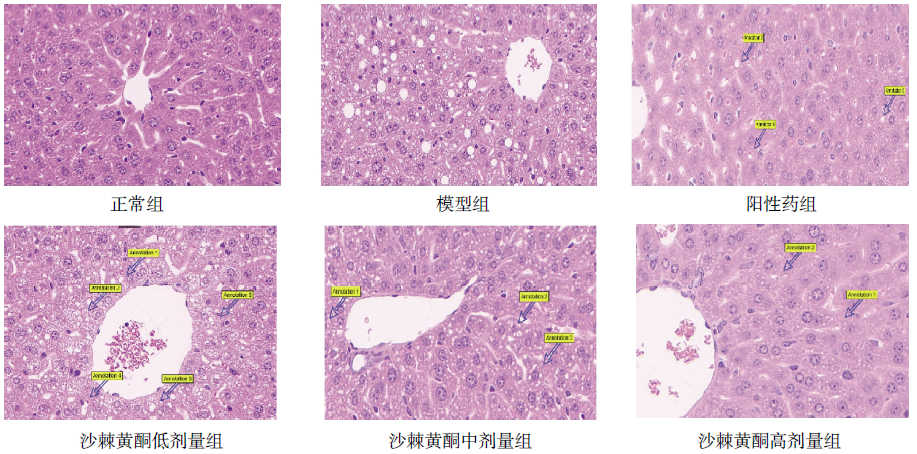
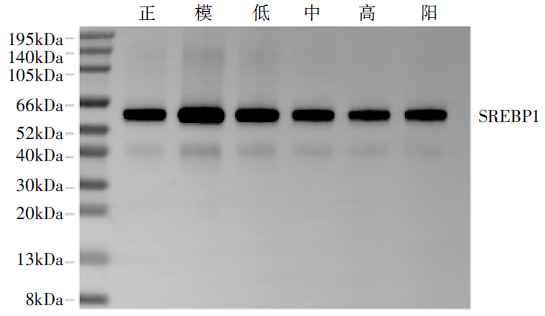
Objective To analyze the therapeutic effect and mechanism of sea buckthorn flavonoids on non-alcoholic fatty liver disease(NAFLD) model mice though the sterol regulatory element binding protein-1(SREBP-1) signaling pathway,and demonstrate its safety and reliability. Methods Sixty healthy adult male KM mice were randomly divided into a normal group,a model group,a positive drug group,a low-dose group of sea buckthorn flavonoids,a medium dose group of sea buckthorn flavonoids,and a high-dose group of sea buckthorn flavonoids. A non-alcoholic fatty liver model was established by administering high-fat diet for 12 weeks. The positive drug group was orally administered with bicyclol,while the low,medium,and high dose groups of sea buckthorn flavonoids were orally administered with 100,200 and 300 mg/kg of sea buckthorn flavonoids,respectively. After continuous administration for 5 weeks,the body mass,serum total cholesterol(TC),triglycerides(TG),low-density lipoprotein cholesterol(LDL-C),and high-density lipoprotein cholesterol(HDL-C) of each group of mice were measured,and liver tissue HE staining was performed. The Western blot method was used to detect the gene and protein expression of sterol regulatory element binding protein-1 in the liver tissues of mice in each group. Results The HE staining results showed significant hepatic steatosis,ballooning degeneration,and inflammatory cell infiltration in the liver slices of the model group. However,compared with the model group,the hepatic steatosis,ballooning degeneration,and inflammatory cell infiltration in the low,medium,and high dose groups of sea buckthorn flavonoids were significantly alleviated. From the results of blood lipid indicators,it can be seen that compared with the normal group[(1.36±0.10),(0.50±0.13),(1.54±0.12),(1.90±0.10)mmol/L],the TC,TG,and LDL-C levels in the model group were significantly increased[(2.03±0.15),(1.73±0.09),(1.73±0.12)mmol/L],while HDL-C levels were significantly reduced[(1.50±0.11)mmol/L](all P<0.01).At the same time,compared with the model group,the TC,TG,and LDL-C indicators of the groups of sea buckthorn flavonoids showed a decreasing trend,while the HDL-C indicators showed an increasing trend,with the high-dose group of sea buckthorn flavonoids showing the most significant trend. The expression level of SREBP-1 protein in the model group mice was 1.30±0.07. Compared with the model group,the expression levels of SREBP-1 protein in the low,medium,and high dose groups of sea buckthorn flavonoids were 1.15±0.07,0.86±0.05 and 0.48±0.07,respectively. The expression of SREBP-1 gene and protein in the liver tissue in mice of the groups of sea buckthorn flavonoids were significantly decreased(all P<0.01). Conclusion Sea buckthorn flavonoids can alleviate fat accumulation in the liver of high-fat diet induced NAFLD model mice by reducing the expression of SREBP-1 signaling pathway related genes and proteins,and play a role in treating NAFLD.

Key words: Sea buckthorn flavonoids, Non-alcoholic fatty liver disease, Liver protection, Cholesterol regulatory element binding protein, Fatty degeneration

CLC Number: