OCCUPATION AND HEALTH ›› 2026, Vol. 42 ›› Issue (12): 1664-1669.
• Treatise—School Health • Previous Articles Next Articles
LI Yanpinga, SUN Xiaoyuanb
Received:2025-03-27
Revised:2025-09-04
Online:2026-06-15
Published:2026-06-18
CLC Number:
LI Yanping, SUN Xiaoyuan. Research on e-Health literacy and healthy lifestyles among medical students based on the m-eHEALS scale. [J]OCCUPATION AND HEALTH, 2026, 42(12): 1664-1669.
| 项目 | 最小值 | 最大值 | 得分( |
|---|---|---|---|
| 电子健康素养总分 | 25 | 59 | 42.47±6.55 |
| 自我知觉 | 1 | 5 | 3.53±0.63 |
| 信息获取 | 1 | 5 | 3.65±0.59 |
| 互动评判 | 1 | 5 | 3.40±0.60 |
| 健康生活方式总分 | 22 | 55 | 37.75±5.52 |
| 运动锻炼 | 1 | 5 | 2.96±0.86 |
| 规律生活 | 1 | 5 | 3.35±0.58 |
| 心理健康 | 1 | 5 | 3.53±0.59 |
| 项目 | 最小值 | 最大值 | 得分( |
|---|---|---|---|
| 电子健康素养总分 | 25 | 59 | 42.47±6.55 |
| 自我知觉 | 1 | 5 | 3.53±0.63 |
| 信息获取 | 1 | 5 | 3.65±0.59 |
| 互动评判 | 1 | 5 | 3.40±0.60 |
| 健康生活方式总分 | 22 | 55 | 37.75±5.52 |
| 运动锻炼 | 1 | 5 | 2.96±0.86 |
| 规律生活 | 1 | 5 | 3.35±0.58 |
| 心理健康 | 1 | 5 | 3.53±0.59 |
| 项目 | 人数[人(%)] | 得分 | t/F值 | P值 | |
|---|---|---|---|---|---|
| 性别 | 2.920a | 0.089 | |||
| 女 | 200(66.01) | 42.93±6.42 | |||
| 男 | 103(33.99) | 41.57±6.72 | |||
| 年级 | 1.454b | 0.227 | |||
| 大一 | 69(22.77) | 43.13±6.32 | |||
| 大二 | 116(38.28) | 42.33±6.26 | |||
| 大三 | 69(22.77) | 41.27±6.66 | |||
| 大四、大五 | 49(16.18) | 44.04±8.23 | |||
| 生源所在地 | 1.614b | 0.201 | |||
| 城市生源 | 67(22.11) | 43.66±6.60 | |||
| 县镇生源 | 56(18.48) | 42.59±6.20 | |||
| 农村生源 | 180(59.41) | 41.98±6.60 | |||
| 父亲文化程度 | 2.973b | 0.041 | |||
| 大专/本科 | 59(19.48) | 43.75±7.03 | |||
| 高中/职高/中专 | 55(18.15) | 41.89±7.29 | |||
| 初中 | 123(40.59) | 42.24±6.34 | |||
| 小学及以下 | 66(21.78) | 42.23±5.79 | |||
| 母亲文化程度 | 3.610b | 0.022 | |||
| 大专/本科 | 41(13.54) | 44.37±6.87 | |||
| 高中/职高/中专 | 51(16.83) | 42.90±6.30 | |||
| 初中 | 108(35.64) | 42.03±6.44 | |||
| 小学及以下 | 103(33.99) | 41.95±6.59 | |||
| 健康观 | 3.981b | 0.013 | |||
| 健康更重要 | 193(63.70) | 42.91±6.36 | |||
| 同样重要 | 99(32.67) | 41.91±6.80 | |||
| 学习更重要 | 11(3.63) | 39.45±6.65 | |||
| 健康自评 | 4.416b | 0.008 | |||
| 非常好 | 33(10.89) | 44.87±6.34 | |||
| 较好 | 142(46.86) | 42.51±6.38 | |||
| 一般 | 102(33.66) | 41.66±6.49 | |||
| 较差 | 26(8.58) | 40.26±7.42 | |||
| 专业 | 1.368b | 0.245 | |||
| 临床医学 | 68(22.45) | 43.38±6.57 | |||
| 护理学 | 78(25.74) | 41.92±6.30 | |||
| 预防医学 | 60(19.80) | 43.45±6.97 | |||
| 康复治疗学 | 39(12.87) | 42.33±6.39 | |||
| 其他(含公共事业管理、中医、麻醉等专业) | 58(19.14) | 41.19±6.41 | |||
| 日上网时长(h) | 2.572b | 0.039 | |||
| 0~<1 | 10(3.31) | 40.70±6.70 | |||
| 1~<3 | 51(16.83) | 44.00±6.95 | |||
| 3~<5 | 128(42.24) | 42.56±6.39 | |||
| 5~<8 | 85(28.05) | 42.66±6.40 | |||
| ≥8 | 29(9.57) | 39.38±6.14 | |||
| 互联网医疗使用及评价 | |||||
| 使用频率 | 4.998b | 0.001 | |||
| 从不 | 63(20.79) | 40.60±6.15 | |||
| 偶尔 | 114(37.62) | 41.48±6.03 | |||
| 一般 | 79(26.07) | 44.03±6.57 | |||
| 经常 | 41(13.53) | 44.31±6.86 | |||
| 总是 | 6(1.99) | 47.50±9.14 | |||
| 满意度a | 9.630b | <0.001 | |||
| 非常不满意 | 1(0.33) | 36.00 | |||
| 不满意 | 4(1.32) | 38.50±4.35 | |||
| 一般 | 136(44.88) | 41.04±6.28 | |||
| 满意 | 90(29.70) | 45.72±6.10 | |||
| 非常满意 | 9(2.97) | 46.89±4.62 | |||
| 信任度 | 9.623b | <0.001 | |||
| 完全不信任 | 11(3.63) | 37.73±6.69 | |||
| 不太有信心 | 52(17.16) | 41.17±6.31 | |||
| 一般 | 142(46.86) | 41.47±6.10 | |||
| 有一定信心 | 86(28.38) | 44.45±6.35 | |||
| 非常有信心 | 12(3.96) | 49.92±5.20 | |||
| 项目 | 人数[人(%)] | 得分 | t/F值 | P值 | |
|---|---|---|---|---|---|
| 性别 | 2.920a | 0.089 | |||
| 女 | 200(66.01) | 42.93±6.42 | |||
| 男 | 103(33.99) | 41.57±6.72 | |||
| 年级 | 1.454b | 0.227 | |||
| 大一 | 69(22.77) | 43.13±6.32 | |||
| 大二 | 116(38.28) | 42.33±6.26 | |||
| 大三 | 69(22.77) | 41.27±6.66 | |||
| 大四、大五 | 49(16.18) | 44.04±8.23 | |||
| 生源所在地 | 1.614b | 0.201 | |||
| 城市生源 | 67(22.11) | 43.66±6.60 | |||
| 县镇生源 | 56(18.48) | 42.59±6.20 | |||
| 农村生源 | 180(59.41) | 41.98±6.60 | |||
| 父亲文化程度 | 2.973b | 0.041 | |||
| 大专/本科 | 59(19.48) | 43.75±7.03 | |||
| 高中/职高/中专 | 55(18.15) | 41.89±7.29 | |||
| 初中 | 123(40.59) | 42.24±6.34 | |||
| 小学及以下 | 66(21.78) | 42.23±5.79 | |||
| 母亲文化程度 | 3.610b | 0.022 | |||
| 大专/本科 | 41(13.54) | 44.37±6.87 | |||
| 高中/职高/中专 | 51(16.83) | 42.90±6.30 | |||
| 初中 | 108(35.64) | 42.03±6.44 | |||
| 小学及以下 | 103(33.99) | 41.95±6.59 | |||
| 健康观 | 3.981b | 0.013 | |||
| 健康更重要 | 193(63.70) | 42.91±6.36 | |||
| 同样重要 | 99(32.67) | 41.91±6.80 | |||
| 学习更重要 | 11(3.63) | 39.45±6.65 | |||
| 健康自评 | 4.416b | 0.008 | |||
| 非常好 | 33(10.89) | 44.87±6.34 | |||
| 较好 | 142(46.86) | 42.51±6.38 | |||
| 一般 | 102(33.66) | 41.66±6.49 | |||
| 较差 | 26(8.58) | 40.26±7.42 | |||
| 专业 | 1.368b | 0.245 | |||
| 临床医学 | 68(22.45) | 43.38±6.57 | |||
| 护理学 | 78(25.74) | 41.92±6.30 | |||
| 预防医学 | 60(19.80) | 43.45±6.97 | |||
| 康复治疗学 | 39(12.87) | 42.33±6.39 | |||
| 其他(含公共事业管理、中医、麻醉等专业) | 58(19.14) | 41.19±6.41 | |||
| 日上网时长(h) | 2.572b | 0.039 | |||
| 0~<1 | 10(3.31) | 40.70±6.70 | |||
| 1~<3 | 51(16.83) | 44.00±6.95 | |||
| 3~<5 | 128(42.24) | 42.56±6.39 | |||
| 5~<8 | 85(28.05) | 42.66±6.40 | |||
| ≥8 | 29(9.57) | 39.38±6.14 | |||
| 互联网医疗使用及评价 | |||||
| 使用频率 | 4.998b | 0.001 | |||
| 从不 | 63(20.79) | 40.60±6.15 | |||
| 偶尔 | 114(37.62) | 41.48±6.03 | |||
| 一般 | 79(26.07) | 44.03±6.57 | |||
| 经常 | 41(13.53) | 44.31±6.86 | |||
| 总是 | 6(1.99) | 47.50±9.14 | |||
| 满意度a | 9.630b | <0.001 | |||
| 非常不满意 | 1(0.33) | 36.00 | |||
| 不满意 | 4(1.32) | 38.50±4.35 | |||
| 一般 | 136(44.88) | 41.04±6.28 | |||
| 满意 | 90(29.70) | 45.72±6.10 | |||
| 非常满意 | 9(2.97) | 46.89±4.62 | |||
| 信任度 | 9.623b | <0.001 | |||
| 完全不信任 | 11(3.63) | 37.73±6.69 | |||
| 不太有信心 | 52(17.16) | 41.17±6.31 | |||
| 一般 | 142(46.86) | 41.47±6.10 | |||
| 有一定信心 | 86(28.38) | 44.45±6.35 | |||
| 非常有信心 | 12(3.96) | 49.92±5.20 | |||
| 项目 | 使用频率 | 满意度 | 信任度 | 自我知觉 | 信息获取 | 互动评判 | 电子健康素养总分 | 健康生活行为总分 |
|---|---|---|---|---|---|---|---|---|
| 使用频率 | 1.000 | |||||||
| 满意度 | 0.221a | 1.000 | ||||||
| 信任度 | 0.301a | 0.499a | 1.000 | |||||
| 自我知觉 | 0.257a | 0.370a | 0.309a | 1.000 | ||||
| 信息获取 | 0.205a | 0.360a | 0.273a | 0.717a | 1.000 | |||
| 互动评判 | 0.195a | 0.259a | 0.250a | 0.666a | 0.739a | 1.000 | ||
| 电子健康素养总分 | 0.239a | 0.364a | 0.305a | 0.858a | 0.933a | 0.895a | 1.000 | |
| 健康生活方式总分 | 0.151a | 0.323a | 0.291a | 0.423a | 0.529a | 0.448a | 0.527a | 1.000 |
| 项目 | 使用频率 | 满意度 | 信任度 | 自我知觉 | 信息获取 | 互动评判 | 电子健康素养总分 | 健康生活行为总分 |
|---|---|---|---|---|---|---|---|---|
| 使用频率 | 1.000 | |||||||
| 满意度 | 0.221a | 1.000 | ||||||
| 信任度 | 0.301a | 0.499a | 1.000 | |||||
| 自我知觉 | 0.257a | 0.370a | 0.309a | 1.000 | ||||
| 信息获取 | 0.205a | 0.360a | 0.273a | 0.717a | 1.000 | |||
| 互动评判 | 0.195a | 0.259a | 0.250a | 0.666a | 0.739a | 1.000 | ||
| 电子健康素养总分 | 0.239a | 0.364a | 0.305a | 0.858a | 0.933a | 0.895a | 1.000 | |
| 健康生活方式总分 | 0.151a | 0.323a | 0.291a | 0.423a | 0.529a | 0.448a | 0.527a | 1.000 |
| 模型拟合 指标 | χ2值 | χ2/df | GFI | AGFI | IFI | TLI | CFI | RMSEA |
|---|---|---|---|---|---|---|---|---|
| 参考标准 | 愈小愈好 | <3.0 | >0.900 | >0.900 | >0.900 | >0.900 | >0.900 | <0.080 |
| 实测结果 | 11.875 | 1.979 | 0.987 | 0.955 | 0.992 | 0.979 | 0.992 | 0.057 |
| 模型拟合 指标 | χ2值 | χ2/df | GFI | AGFI | IFI | TLI | CFI | RMSEA |
|---|---|---|---|---|---|---|---|---|
| 参考标准 | 愈小愈好 | <3.0 | >0.900 | >0.900 | >0.900 | >0.900 | >0.900 | <0.080 |
| 实测结果 | 11.875 | 1.979 | 0.987 | 0.955 | 0.992 | 0.979 | 0.992 | 0.057 |
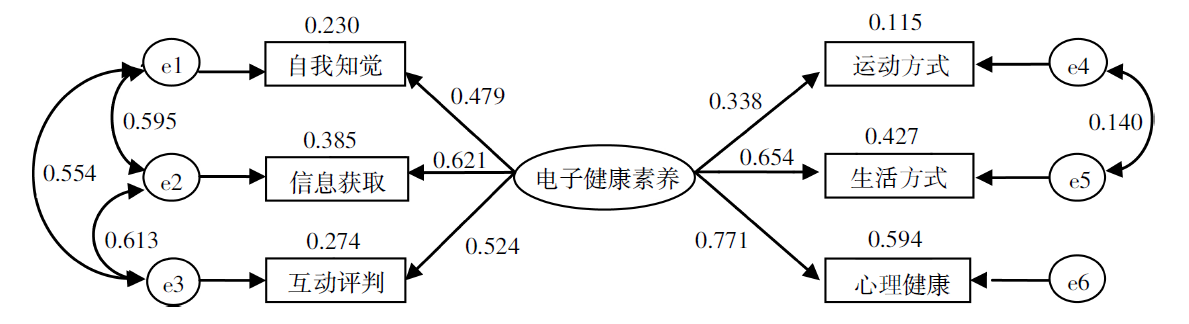
| 路径 | B值 | 95%CI | P | |
|---|---|---|---|---|
| 电子健康素养→运动锻炼 | 0.338 | 0.132 | 0.234~0.431 | <0.01 |
| 电子健康素养→规律生活 | 0.654 | 0.169 | 0.511~0.773 | <0.01 |
| 电子健康素养→心理健康 | 0.771 | 0.219 | 0.635~0.897 | <0.01 |
| 路径 | B值 | 95%CI | P | |
|---|---|---|---|---|
| 电子健康素养→运动锻炼 | 0.338 | 0.132 | 0.234~0.431 | <0.01 |
| 电子健康素养→规律生活 | 0.654 | 0.169 | 0.511~0.773 | <0.01 |
| 电子健康素养→心理健康 | 0.771 | 0.219 | 0.635~0.897 | <0.01 |
| [1] | 梁超, 宋振鹏, 汤立许. 数智赋能主动健康管理:实践样态? 建构策略与驱动路径[J]. 武汉体育学院学报, 2024, 58(4):72-81. |
| [2] |
NORMAN C D, SKINNER H A. eHealth literacy:Essential skills for consumer health in a networked world[J]. J Med Internet Res, 2006, 8(2):e9.
DOI URL |
| [3] |
NORMAN C D, SKINNER H A. eHEALS:The eHealth literacy scale[J]. J Med Internet Res, 2006, 8(4):e27.
DOI URL |
| [4] | 王刚, 高皓宇, 李英华. 国内外电子健康素养研究现状[J]. 中国健康教育, 2017, 33(6):556-558. |
| [5] | 吴颖敏, 张媚, 朱良艳. 消费者电子健康素养评估及在移动医疗中的应用[J]. 消费经济, 2017, 33(1):90-96. |
| [6] | 高云, 赵俊峰, 徐丽丽, 等. COSMIN操作指南对中文版电子健康素养量表的评价[J]. 中国老年学杂志, 2020, 40(9):1968-1973. |
| [7] | 王冬. 大学生健康生活方式评价量表研制及初步应用研究[D]. 广州: 南方医科大学, 2009. |
| [8] | 王冬, 许宏, 吴娴波. 大学生健康生活方式评价量表的考评及修订[J]. 中国学校卫生, 2011, 32(7):790-792. |
| [9] | 焦建鹏, 王冬. 基于结构方程模型的大学生健康生活方式评价量表的修订[J]. 中国卫生统计, 2013, 30(5):654-657. |
| [10] | 李华, 朱玲轩. 宏观因素影响下的税收征管效率地区异质性探究——基于税收征管效率的MIMIC模型[J]. 公共财政研究, 2018(5):4-21. |
| [11] | 王丹. 基于King’s达标理论药学服务沟通模型研究[D]. 武汉: 华中科技大学, 2019. |
| [12] | 吴琼, 赵光红, 龚娟, 等. 武汉市大学生电子健康素养与健康生活方式现状及相关性分析[J]. 医学与社会, 2022, 35(8):78-83. |
| [13] | 李少杰, 崔光辉, 徐慧兰. 大学生网络社会支持、电子健康素养与健康相关行为的路径分析[J]. 中国卫生统计, 2022, 39(1):118-121. |
| [14] | 崔光辉, 尹永田, 王铭洲, 等. 医学生电子健康素养与健康生活方式的关系[J]. 中国学校卫生, 2020, 41(6):936-938 |
| [15] | 汤凯璇, 田原, 刘怡然, 等. 网络媒介对医学生电子健康素养的效应分析及提升路径[J]. 职业与健康, 2023, 39(11):1559-1563. |
| [16] | 吕如雪, 阿迪拉·阿不来提, 热依汗古丽·艾米都拉, 等. 健康中国背景下医学生心理健康与压力源分析[J]. 医学研究杂志, 2024, 53(2):91-95. |
| [17] | 陈莉, 江悦妍, 王志敏, 等. 电子健康素养研究热点与前沿的可视化分析[J]. 职业与健康, 2021, 37(16):2257-2260. |
| [18] |
黄凤仪, 宋慧军. 河北某高校医学生健康信息素养调查分析[J]. 医学研究与教育, 2020, 37(2):63-69.
DOI |
| [19] | 刘丹丹, 杨悦, 姚业祥, 等. 齐齐哈尔市居民电子健康素养水平及影响因素分析[J]. 职业与健康, 2024, 40(9):1235-1239. |
| [20] | 郭琦, 郭昀. 医学生网络依赖与媒介素质教育[J]. 中国高等医学教育, 2007(8):3-4,29. |
| [21] | 王心瑶, 郝艳华, 吴群红, 等. 新媒体对哈尔滨市某医科大学学生健康风险认知的影响[J]. 医学与社会, 2018, 31(2):18-20,34. |
| [22] | 张雪文, 仇蕾洁, 杨雅妮, 等. 互联网+医疗视角下医学生网络就医行为及就医意愿研究[J]. 中国预防医学杂志, 2018, 19(3):223-227 |
| [23] | 浦锐, 乔宇, 陈思远, 等. 大学生对“互联网+医疗”认知利用及满意度调查与分析[J]. 医学信息学杂志, 2019, 40(10):61-65. |
| [24] | 袁梦淑, 潘柏豪, 刘昭颖, 等. 医学生对未来“互联网+”医疗的认知[J]. 卫生职业教育, 2017, 35(18):105-106. |
| Viewed | ||||||
|
Full text |
|
|||||
|
Abstract |
|
|||||
 津公网安备12010202000831号 津ICP备11005889号-6