


OCCUPATION AND HEALTH ›› 2026, Vol. 42 ›› Issue (15): 2022-2026.
• Treatise—Occupational Health and Occupational Diseases • Previous Articles Next Articles
HUANG Zhen, ZHANG Bingxu, ZHAO Chunlei
Received:2025-09-17
Revised:2025-11-27
Online:2026-08-01
Published:2026-07-16
CLC Number:
HUANG Zhen, ZHANG Bingxu, ZHAO Chunlei. Survival analysis of occupational pneumoconiosis patients in a district of Tianjin City from 1983 to 2023. [J]OCCUPATION AND HEALTH, 2026, 42(15): 2022-2026.
| 开始时间 (月) | 初期 人数 | 期内退出 人数 | 风险暴露 人数 | 期间终结 人数 | 生存 比例 | 期末累积 生存比例 |
|---|---|---|---|---|---|---|
| 0 | 360 | 1 | 359.50 | 3.00 | 0.99 | 0.99 |
| 24 | 356 | 16 | 348.00 | 3.00 | 0.99 | 0.98 |
| 48 | 337 | 23 | 325.50 | 1.00 | 1.00 | 0.98 |
| 72 | 313 | 25 | 300.50 | 2.00 | 0.99 | 0.97 |
| 96 | 286 | 31 | 270.50 | 1.00 | 1.00 | 0.97 |
| 120 | 254 | 40 | 234.00 | 3.00 | 0.99 | 0.96 |
| 144 | 211 | 44 | 189.00 | 1.00 | 0.99 | 0.95 |
| 168 | 166 | 23 | 154.50 | 4.00 | 0.97 | 0.93 |
| 192 | 139 | 16 | 131.00 | 1.00 | 0.99 | 0.92 |
| 216 | 122 | 18 | 113.00 | 3.00 | 0.97 | 0.90 |
| 240 | 101 | 12 | 95.00 | 0.00 | 1.00 | 0.90 |
| 264 | 89 | 7 | 85.50 | 2.00 | 0.98 | 0.88 |
| 288 | 80 | 9 | 75.50 | 3.00 | 0.96 | 0.84 |
| 312 | 68 | 5 | 65.50 | 0.00 | 1.00 | 0.84 |
| 336 | 63 | 15 | 55.50 | 3.00 | 0.95 | 0.80 |
| 360 | 45 | 3 | 43.50 | 1.00 | 0.98 | 0.78 |
| 384 | 41 | 5 | 38.50 | 3.00 | 0.92 | 0.72 |
| 408 | 33 | 2 | 32.00 | 2.00 | 0.94 | 0.67 |
| 432 | 29 | 4 | 27.00 | 5.00 | 0.81 | 0.55 |
| 456 | 20 | 10 | 15.00 | 3.00 | 0.80 | 0.44 |
| 480 | 7 | 5 | 4.50 | 2.00 | 0.56 | 0.24 |
| 开始时间 (月) | 初期 人数 | 期内退出 人数 | 风险暴露 人数 | 期间终结 人数 | 生存 比例 | 期末累积 生存比例 |
|---|---|---|---|---|---|---|
| 0 | 360 | 1 | 359.50 | 3.00 | 0.99 | 0.99 |
| 24 | 356 | 16 | 348.00 | 3.00 | 0.99 | 0.98 |
| 48 | 337 | 23 | 325.50 | 1.00 | 1.00 | 0.98 |
| 72 | 313 | 25 | 300.50 | 2.00 | 0.99 | 0.97 |
| 96 | 286 | 31 | 270.50 | 1.00 | 1.00 | 0.97 |
| 120 | 254 | 40 | 234.00 | 3.00 | 0.99 | 0.96 |
| 144 | 211 | 44 | 189.00 | 1.00 | 0.99 | 0.95 |
| 168 | 166 | 23 | 154.50 | 4.00 | 0.97 | 0.93 |
| 192 | 139 | 16 | 131.00 | 1.00 | 0.99 | 0.92 |
| 216 | 122 | 18 | 113.00 | 3.00 | 0.97 | 0.90 |
| 240 | 101 | 12 | 95.00 | 0.00 | 1.00 | 0.90 |
| 264 | 89 | 7 | 85.50 | 2.00 | 0.98 | 0.88 |
| 288 | 80 | 9 | 75.50 | 3.00 | 0.96 | 0.84 |
| 312 | 68 | 5 | 65.50 | 0.00 | 1.00 | 0.84 |
| 336 | 63 | 15 | 55.50 | 3.00 | 0.95 | 0.80 |
| 360 | 45 | 3 | 43.50 | 1.00 | 0.98 | 0.78 |
| 384 | 41 | 5 | 38.50 | 3.00 | 0.92 | 0.72 |
| 408 | 33 | 2 | 32.00 | 2.00 | 0.94 | 0.67 |
| 432 | 29 | 4 | 27.00 | 5.00 | 0.81 | 0.55 |
| 456 | 20 | 10 | 15.00 | 3.00 | 0.80 | 0.44 |
| 480 | 7 | 5 | 4.50 | 2.00 | 0.56 | 0.24 |
| 项目 | 病例数 | 单因素COX回归 | ||
|---|---|---|---|---|
| Wald χ2值 | P值 | HR(95%CI) | ||
| 性别 | ||||
| 男 | 333 | 0.373 | 0.541 | 1.442(0.446~4.666) |
| 女 | 27 | |||
| 企业经济类型 | ||||
| 国有企业 | 151 | 7.295 | 0.063 | 3.454(0.437~27.291) |
| 集体企业 | 15 | 1.853(0.113~30.434) | ||
| 私有企业 | 93 | 6.406(0.847~48.455) | ||
| 外资企业 | 101 | |||
| 企业规模 | ||||
| 小型 | 67 | 4.445 | 0.108 | 0.421(0.143~1.238) |
| 中型 | 110 | 1.171(0.572~2.399) | ||
| 大型 | 183 | |||
| 是否晋期 | ||||
| 否 | 295 | 0.040 | 0.841 | 0.939(0.508~1.735) |
| 是 | 65 | |||
| 伤残分级 | ||||
| ≥Ⅳ | 87 | 0.073 | 0.787 | 1.086(0.599~1.968) |
| <Ⅳ | 273 | |||
| 接尘工龄(年) | ||||
| >40 | 338 | 1.346 | 0.246 | 2.629(1.218~5.678) |
| 0~≤40 | 22 | |||
| 工伤保险 | ||||
| 无 | 72 | 33.322 | <0.001 | 6.502(3.443~12.277) |
| 有 | 288 | |||
| 尘肺病类型 | ||||
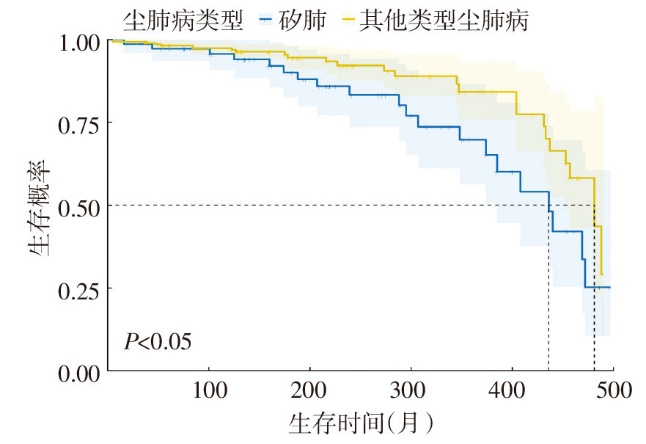
| 矽肺 | 72 | 4.327 | 0.034 | 1.867(1.037~3.363) |
| 其他类型尘肺病 | 288 | |||
| 合并症 | ||||
| 有 | 76 | 35.048 | <0.001 | 7.040(3.689~13.432) |
| 无 | 284 | |||
| 首诊年龄(岁) | ||||
| ≥60 | 53 | 49.114 | <0.001 | 51.440(13.964~189.498) |
| 50~<60 | 156 | 7.490(2.436~23.027) | ||
| 40~<50 | 126 | 2.271(0.672~7.674) | ||
| 0~<40 | 25 | |||
| 项目 | 病例数 | 单因素COX回归 | ||
|---|---|---|---|---|
| Wald χ2值 | P值 | HR(95%CI) | ||
| 性别 | ||||
| 男 | 333 | 0.373 | 0.541 | 1.442(0.446~4.666) |
| 女 | 27 | |||
| 企业经济类型 | ||||
| 国有企业 | 151 | 7.295 | 0.063 | 3.454(0.437~27.291) |
| 集体企业 | 15 | 1.853(0.113~30.434) | ||
| 私有企业 | 93 | 6.406(0.847~48.455) | ||
| 外资企业 | 101 | |||
| 企业规模 | ||||
| 小型 | 67 | 4.445 | 0.108 | 0.421(0.143~1.238) |
| 中型 | 110 | 1.171(0.572~2.399) | ||
| 大型 | 183 | |||
| 是否晋期 | ||||
| 否 | 295 | 0.040 | 0.841 | 0.939(0.508~1.735) |
| 是 | 65 | |||
| 伤残分级 | ||||
| ≥Ⅳ | 87 | 0.073 | 0.787 | 1.086(0.599~1.968) |
| <Ⅳ | 273 | |||
| 接尘工龄(年) | ||||
| >40 | 338 | 1.346 | 0.246 | 2.629(1.218~5.678) |
| 0~≤40 | 22 | |||
| 工伤保险 | ||||
| 无 | 72 | 33.322 | <0.001 | 6.502(3.443~12.277) |
| 有 | 288 | |||
| 尘肺病类型 | ||||
| 矽肺 | 72 | 4.327 | 0.034 | 1.867(1.037~3.363) |
| 其他类型尘肺病 | 288 | |||
| 合并症 | ||||
| 有 | 76 | 35.048 | <0.001 | 7.040(3.689~13.432) |
| 无 | 284 | |||
| 首诊年龄(岁) | ||||
| ≥60 | 53 | 49.114 | <0.001 | 51.440(13.964~189.498) |
| 50~<60 | 156 | 7.490(2.436~23.027) | ||
| 40~<50 | 126 | 2.271(0.672~7.674) | ||
| 0~<40 | 25 | |||
| 项目 | 病例数 | 多因素COX回归 | ||
|---|---|---|---|---|
| Wald χ2值 | P值 | HR(95%CI) | ||
| 工伤保险 | ||||
| 无 | 72 | 10.439 | <0.001 | 3.766(1.685~8.417) |
| 有 | 288 | |||
| 尘肺病类型 | ||||
| 矽肺 | 72 | 1.454 | 0.228 | 1.487(0.780~2.834) |
| 其他类型尘肺病 | 288 | |||
| 合并症 | ||||
| 有 | 284 | 6.405 | <0.001 | 2.888(1.270~6.567) |
| 无 | 76 | |||
| 首诊年龄(岁) | ||||
| ≥60 | 53 | 43.689 | <0.001 | 63.625(16.114~251.225) |
| 50~<60 | 156 | 8.641(2.518~29.661) | ||
| 40~<50 | 126 | 4.174(1.130~15.424) | ||
| 0~<40 | 25 | |||
| 项目 | 病例数 | 多因素COX回归 | ||
|---|---|---|---|---|
| Wald χ2值 | P值 | HR(95%CI) | ||
| 工伤保险 | ||||
| 无 | 72 | 10.439 | <0.001 | 3.766(1.685~8.417) |
| 有 | 288 | |||
| 尘肺病类型 | ||||
| 矽肺 | 72 | 1.454 | 0.228 | 1.487(0.780~2.834) |
| 其他类型尘肺病 | 288 | |||
| 合并症 | ||||
| 有 | 284 | 6.405 | <0.001 | 2.888(1.270~6.567) |
| 无 | 76 | |||
| 首诊年龄(岁) | ||||
| ≥60 | 53 | 43.689 | <0.001 | 63.625(16.114~251.225) |
| 50~<60 | 156 | 8.641(2.518~29.661) | ||
| 40~<50 | 126 | 4.174(1.130~15.424) | ||
| 0~<40 | 25 | |||
| [1] | 中华预防医学会劳动卫生与职业病分会职业性肺部疾病学组. 尘肺病治疗中国专家共识(2018年版)[J]. 环境与职业医学, 2018, 35(8):677-689. |
| [2] | 国家卫生健康委员会. 2023年我国卫生健康事业发展统计公报[R/OL].(2024-08-29)[2025-08-29]. https://www.nhc.gov.cn/wjw/c100178/202408/1de460738f81464280e9ed3277630e33/files/1734002454304_67772.pdf. |
| [3] | 朱晓俊, 肖培, 王丹, 等. 1990—2017年中国人群尘肺病的疾病负担分析[J]. 中国工业医学杂志, 2019, 32(5):341-346. |
| [4] | 李霞, 朱长才, 熊峰. 尘肺患者疾病负担病例对照研究[J]. 中华疾病控制杂志, 2018, 22(5):464-466,471. |
| [5] | 张曌慧, 黄磊, 石璐, 等. 中国人群尘肺病疾病负担的系统评价[J]. 中国循证医学杂志, 2021, 21(3):276-283. |
| [6] | 张磊, 朱磊, 李志恒, 等. 煤工尘肺住院患者疾病负担及其影响因素分析[J]. 北京大学学报(医学版), 2014, 46(2):226-231. |
| [7] | 叶孟良, 王永义, 王润华. 重庆市尘肺病疾病负担研究[J]. 现代预防医学, 2011, 38(5):840-842. |
| [8] | 中华人民共和国国家卫生健康委员会. 关于印发《职业病分类和目录》的通知[J]. 中华人民共和国国家卫生健康委员会公报, 2024(12):24-26. |
| [9] | 中华人民共和国卫生部. 尘肺病诊断标准:GBZ70—2002[S]. 北京: 法律出版社,2002:1-11. |
| [10] | 国家卫生计生委. 尘肺病诊断标准:GBZ70—2009[S]. 北京: 人民卫生出版社,2009:1-10. |
| [11] | 国家卫生计生委. 尘肺病诊断标准:GBZ70—2015[S]. 北京: 中国标准出版社,2016:1-13. |
| [12] | 董景武. 疾病和有关健康问题的国际统计分类:第十次修订本,第一卷[M]. 北京: 人民卫生出版社,2008:545. |
| [13] | FAN C, WANG Y, CHEN J, et al. Early diagnosis and survival outcomes in silicosis:A retrospective cohort study of 11,809 patients in Guangdong Province,China(1956-2020)[J]. Front Public Health, 2025, 13:1587161. |
| [14] | 李健, 周慧. 天津滨海新区产业循环经济发展模式研究[J]. 现代管理科学, 2009(7):63-64,114. |
| [15] | 徐佩玉. 中国打响尘肺病防治攻坚战[N]. 人民日报海外版,2019-05-14(003). |
| [16] | 商维维, 阴旅宁, 杜利利, 等. 2012—2022年四川省职业病发病情况分析[J]. 现代预防医学, 2023, 50(16):2926-2930,2999. |
| [17] | 陈仁强, 李文华, 黄静, 等. 寿命表法及Cox回归分析608例尘肺病患者发病特征与生存情况[J]. 职业卫生与应急救援, 2021, 39(6):615-619. |
| [18] | 李文, 廖雪梅, 罗琳, 等. 2006—2019年重庆市渝北区尘肺病报告病例特征及生存分析[J]. 环境与职业医学, 2021, 38(8):872-876. |
| [19] | 吴茜, 孟凡利, 荆茹, 等. 广东省1980—2019年职业性尘肺病患者生存分析[J]. 中国职业医学, 2023, 50(2):140-144,149. |
| [20] | 李美雄, 叶绍色, 李忠学, 等. 尘肺病患者住院服务利用情况及影响因素分析[J]. 中国职业医学, 2021, 48(4):5. |
| [21] | 李颖, 刘贵钱, 严薇, 等. 不同保险类型尘肺病患者的诊断结果及并发症分析[J]. 中华劳动卫生职业病杂志, 2020, 38(10):3. |
| [22] | 陈双平, 胡艳敏, 张峰. 2019—2023年浙江省宁海县尘肺病患者的生存分析[J]. 上海预防医学, 2024, 36(8):765-770. |
| [23] | CHEN H L, LI C H, ZHAI P Y, et al. Survival and disease burden analyses of occupational pneumoconiosis during 1958-2021 in Huangshi City,China:A retrospective cohort study[J]. BMC Public Health, 2024, 24(1):1437. |
| [24] | 孙贵范. 职业卫生与职业医学[M]. 8版. 北京: 人民卫生出版社,2019:184-185. |
| [25] | 黄真, 张炳旭. 2019年天津市滨海新区粉尘作业人员职业健康结果分析[J]. 公共卫生与预防医学, 2021, 32(6):142-145. |
| [26] | ZOU H, SHI Z, ZHANG Y, et al. Epidemiological characteristics and survival analysis on patients with occupational pneumoconiosis in Zhejiang Province from 1987 to 2019[J]. Front Public Health, 2022, 10:1006391. |
| [1] | TANG Jinyu, LI Chunchun, ZHOU Yichao. Analysis of occupational disease incidence in Wujin District of Changzhou City from 2006 to 2023 [J]. OCCUPATION AND HEALTH, 2026, 42(3): 296-300. |
| [2] | GE Yonghong, TAO Tao, YIN Xiaojuan, QI Tianping, ZHANG Xiaojuan, LI Honghua. Epidemiological characteristics analysis of pneumoconiosis in Qilihe District of Lanzhou City from 1964 to 2023 [J]. OCCUPATION AND HEALTH, 2026, 42(13): 1836-1840. |
| [3] | KUANG Jingru, HUANG Ming, ZHANG Ying, LIANG Weihui. Analysis on level and influencing factors of serum tumor markers in occupational pneumoconiosis [J]. OCCUPATION AND HEALTH, 2026, 42(11): 1463-1469. |
| [4] | TANG Xueping, XU Juan'e, TU Menghan, LIU Yuehong. Trend analysis of newly emerging occupational diseases in Quanzhou City from 2008 to 2023 based on Joinpoint regression model [J]. OCCUPATION AND HEALTH, 2025, 41(16): 2176-2180. |
| [5] | PEI Yanan, HAO Baoyun. Analysis of the epidemiological characteristics of pertussis in Binhai New Area,Tianjin from 2013 to 2023 [J]. OCCUPATION AND HEALTH, 2025, 41(15): 2087-2092. |
| [6] | LING Yuchen, PAN Yinjun, LIU Xiaoxiao, LU Chenru, ZHAO Hongcheng. Follow-up and epidemiological analysis of occupational pneumoconiosis patients in Qingpu District of Shanghai City from 1965 to 2022 [J]. OCCUPATION AND HEALTH, 2024, 40(7): 979-982. |
| [7] | HU Jie, HU Zaifang, ZHOU Guowei, ZHANG Li, ZHEN Guoxin. Investigation on status of patients with occupational pneumoconiosis in a district of Beijing City [J]. OCCUPATION AND HEALTH, 2024, 40(5): 609-612. |
| [8] | ZHU Yunfang, LIU Yue, YANG Cangjiang, WEN Hongmei, SHI Qingping, CHEN Yang. Analysis of breast cancer survival rate among population in Yunnan Province [J]. OCCUPATION AND HEALTH, 2024, 40(24): 3406-3410. |
| [9] | LIU Liping, LI Xin, LI Zhijuan, ZHANG Xiaohong, HOU Liming. Analysis on epidemiological characteristics of occupational pneumoconiosis in Xinzhou City from 2016 to 2022 [J]. OCCUPATION AND HEALTH, 2024, 40(19): 2603-2606. |
| [10] | SONG Yingli, YANG Yanxiang, LI Tengfang, DUAN Dechang, ZOU Zhixiang, LIAO Yong. Analysis on epidemiological characteristics of new occupational pneumoconiosis cases of mining and dressing industry of tungsten-molybdenum ore in Ganzhou City from 2006 to 2022 [J]. OCCUPATION AND HEALTH, 2024, 40(13): 1734-1737. |
| [11] | LIU Youshuang, ZHANG Yaying, LIU Yuhua, HAN Xue. Analysis on epidemiological characteristics of occupational pneumoconiosis in Yangpu District of Shanghai City from 1955-2022 [J]. OCCUPATION AND HEALTH, 2024, 40(11): 1459-1462. |
| [12] | LU Li-yun, SUN Xiao-chen, SU Dong-hong, JIANG Cheng, LI Ning, WANG Xiao-fang. Analysis on current situation and trend of newly reported occupational diseases in Zibo City from 2011-2021 [J]. OCCUPATION AND HEALTH, 2023, 39(6): 741-746. |
| [13] | WANG Guohai, CAO Xuelin, LU Minxia, FU Qiang, JIN Song, HAN Lei. Analysis on epidemiological characteristics of occupational pneumoconiosis in Changzhou City from 1963-2020 [J]. OCCUPATION AND HEALTH, 2023, 39(17): 2322-2326. |
| Viewed | ||||||
|
Full text |
|
|||||
|
Abstract |
|
|||||
 津公网安备12010202000831号 津ICP备11005889号-6
