


OCCUPATION AND HEALTH ›› 2026, Vol. 42 ›› Issue (6): 733-737.
• Treatise • Previous Articles Next Articles
CHEN Linlin1,2, ZHANG Liuzhuo2, ZHU Dexiang2, WANG Xizhi2, MENG Xiaojing1, ZHANG Ming1,2( )
)
Received:2025-12-11
Revised:2025-12-16
Online:2026-03-15
Published:2026-04-03
Contact:
ZHANG Ming
CLC Number:
CHEN Linlin, ZHANG Liuzhuo, ZHU Dexiang, WANG Xizhi, MENG Xiaojing, ZHANG Ming. Study on the relationship between urinary mercury exposure and nonalcoholic fatty liver disease among industrial workers in a city of Guangdong Province. [J]OCCUPATION AND HEALTH, 2026, 42(6): 733-737.
| 项目 | NAFLD组(n=82) | 对照组 (n=187) | χ2/t值 | P值 |
|---|---|---|---|---|
| 性别[人(%)] | 0.114a | |||
| 男 | 78(95.1) | 166(88.8) | ||
| 女 | 4(4.9) | 21(11.2) | ||
| 年龄[( | 36.3±1.0 | 31.7±0.7 | 3.642b | <0.001 |
| 总工龄[( | 7.5±0.9 | 5.9±0.6 | 1.629b | 0.105 |
| 接害工龄[( | 7.2±0.9 | 5.4±0.6 | 1.717b | 0.087 |
| 吸烟[人(%)] | 0.113c | 0.738 | ||
| 是 | 11(13.4) | 28(15.0) | ||
| 否 | 71(86.6) | 159(85.0) | ||
| BMI[人(%)] | <0.001a | |||
| 正常 | 7(8.5) | 104(55.6) | ||
| 超重 | 36(43.9) | 58(31.0) | ||
| 肥胖 | 33(40.2) | 13(7.0) | ||
| 高血压[人(%)] | 1.892c | 0.168 | ||
| 是 | 11(13.4) | 15(8.0) | ||
| 否 | 71(86.6) | 172(92.0) | ||
| 糖尿病[人(%)] | 2.648c | 0.104 | ||
| 是 | 22(26.8) | 34(18.2) | ||
| 否 | 53(73.2) | 137(81.8) | ||
| ALT[( | 46.9±4.6 | 25.4±1.5 | 4.444b | <0.001 |
| GGT[( | 39.1±2.9 | 27.6±1.7 | 3.610b | <0.001 |
| HDL[( | 1.2±0.3 | 1.3±0.2 | 2.015b | <0.001 |
| LDL[( | 3.2±0.6 | 2.8±0.7 | 2.659b | <0.001 |
| 糖化血红蛋白[( | 6.6±0.5 | 5.8±0.4 | 1.254b | <0.001 |
| 空腹血糖[( | 5.7±1.1 | 5.3±0.7 | 2.711b | <0.001 |
| 三酰甘油[( | 2.5±0.3 | 1.4±0.1 | 3.447b | <0.001 |
| 胆固醇[( | 5.0±0.2 | 4.5±0.1 | 2.681b | <0.001 |
| 尿汞[( | 1.0±0.5 | 0.8±0.5 | 2.870b | <0.001 |
| 项目 | NAFLD组(n=82) | 对照组 (n=187) | χ2/t值 | P值 |
|---|---|---|---|---|
| 性别[人(%)] | 0.114a | |||
| 男 | 78(95.1) | 166(88.8) | ||
| 女 | 4(4.9) | 21(11.2) | ||
| 年龄[( | 36.3±1.0 | 31.7±0.7 | 3.642b | <0.001 |
| 总工龄[( | 7.5±0.9 | 5.9±0.6 | 1.629b | 0.105 |
| 接害工龄[( | 7.2±0.9 | 5.4±0.6 | 1.717b | 0.087 |
| 吸烟[人(%)] | 0.113c | 0.738 | ||
| 是 | 11(13.4) | 28(15.0) | ||
| 否 | 71(86.6) | 159(85.0) | ||
| BMI[人(%)] | <0.001a | |||
| 正常 | 7(8.5) | 104(55.6) | ||
| 超重 | 36(43.9) | 58(31.0) | ||
| 肥胖 | 33(40.2) | 13(7.0) | ||
| 高血压[人(%)] | 1.892c | 0.168 | ||
| 是 | 11(13.4) | 15(8.0) | ||
| 否 | 71(86.6) | 172(92.0) | ||
| 糖尿病[人(%)] | 2.648c | 0.104 | ||
| 是 | 22(26.8) | 34(18.2) | ||
| 否 | 53(73.2) | 137(81.8) | ||
| ALT[( | 46.9±4.6 | 25.4±1.5 | 4.444b | <0.001 |
| GGT[( | 39.1±2.9 | 27.6±1.7 | 3.610b | <0.001 |
| HDL[( | 1.2±0.3 | 1.3±0.2 | 2.015b | <0.001 |
| LDL[( | 3.2±0.6 | 2.8±0.7 | 2.659b | <0.001 |
| 糖化血红蛋白[( | 6.6±0.5 | 5.8±0.4 | 1.254b | <0.001 |
| 空腹血糖[( | 5.7±1.1 | 5.3±0.7 | 2.711b | <0.001 |
| 三酰甘油[( | 2.5±0.3 | 1.4±0.1 | 3.447b | <0.001 |
| 胆固醇[( | 5.0±0.2 | 4.5±0.1 | 2.681b | <0.001 |
| 尿汞[( | 1.0±0.5 | 0.8±0.5 | 2.870b | <0.001 |
| 分类 | OR(95%CI) | P值 | P趋势值 |
|---|---|---|---|
| 连续变量 | |||
| 模型Ⅰ | 1.847(1.175~2.963) | 0.009 | |
| 模型Ⅱ | 1.834(1.148~2.995) | 0.013 | |
| 模型Ⅲ | 2.385(1.391~4.245) | 0.002 | |
| 分组变量 | 0.486 | ||
| 低暴露组 | |||
| 中等暴露组 | 2.200(1.143~4.319) | 0.020 | |
| 高暴露组 | 1.320(0.682~2.591) | 0.413 |
| 分类 | OR(95%CI) | P值 | P趋势值 |
|---|---|---|---|
| 连续变量 | |||
| 模型Ⅰ | 1.847(1.175~2.963) | 0.009 | |
| 模型Ⅱ | 1.834(1.148~2.995) | 0.013 | |
| 模型Ⅲ | 2.385(1.391~4.245) | 0.002 | |
| 分组变量 | 0.486 | ||
| 低暴露组 | |||
| 中等暴露组 | 2.200(1.143~4.319) | 0.020 | |
| 高暴露组 | 1.320(0.682~2.591) | 0.413 |
| 年龄(岁) | OR(95%CI) | P值 |
|---|---|---|
| 20~<30 | 2.053(0.947~4.772) | 0.077 |
| 30~<40 | 2.408(1.131~5.578) | 0.029 |
| 40~60 | 0.961(0.712~3.004) | 0.942 |
| 年龄(岁) | OR(95%CI) | P值 |
|---|---|---|
| 20~<30 | 2.053(0.947~4.772) | 0.077 |
| 30~<40 | 2.408(1.131~5.578) | 0.029 |
| 40~60 | 0.961(0.712~3.004) | 0.942 |
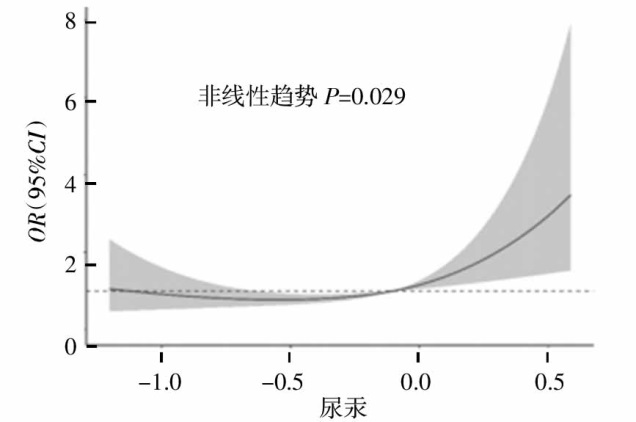
| [1] | 范建高, 徐小元, 南月敏, 等. 代谢相关(非酒精性)脂肪性肝病防治指南(2024年版)[J]. 实用肝脏病杂志, 2024, 27(4):494-510. |
| [2] | 中华医学会肝病学分会脂肪肝和酒精性肝病学组, 中国医师协会脂肪性肝病专家委员会. 非酒精性脂肪性肝病防治指南(2018更新版)[J]. 传染病信息, 2018, 31(5):393-402,420. |
| [3] |
RIAZI K, AZHARI H, CHARETTE J H, et al. The prevalence and incidence of NAFLD worldwide:A systematic review and meta-analysis[J]. Lancet Gastroenterol Hepatol, 2022, 7(9):851-861.
DOI URL |
| [4] |
WANG F, FAN J, ZHANG Z, et al. The global burden of liver disease:The major impact of China[J]. Hepatology, 2014, 60(6):2099-2108.
DOI URL |
| [5] |
李三三, 周钰博, 吕珍, 等. 高尿酸与肥胖的交互作用对非酒精性脂肪肝病患病率的影响[J]. 广州医药, 2024, 55(8):843-851.
DOI |
| [6] | 陈朦朦, 吕冠华. 非酒精性脂肪肝发病的影响因素及预防调摄[J]. 实用中医内科杂志, 2024, 38(6):96-100. |
| [7] |
SUN J, CHEN Y, WANG T, et al. Cadmium promotes nonalcoholic fatty liver disease by inhibiting intercellular mitochondrial transfer[J]. Cell Mol Biol Lett, 2023, 28(1):87.
DOI PMID |
| [8] |
NGUYEN H D, KIM M S. Cadmium,lead,and mercury mixtures interact with non-alcoholic fatty liver diseases[J]. Environ Pollut, 2022, 309:119780.
DOI URL |
| [9] |
BATTAGLIA V, COMPAGNONE A, BANDINO A, et al. Cobalt induces oxidative stress in isolated liver mitochondria responsible for permeability transition and intrinsic apoptosis in hepatocyte primary cultures[J]. Inter J Biochem Cell Biol, 2009, 41(3):586-594.
DOI URL |
| [10] |
TINKOV A A, ASCHNER M, SANTAMARIA A, et al. Dissecting the role of cadmium,lead,arsenic,and mercury in non-alcoholic fatty liver disease and non-alcoholic steatohepatitis[J]. Environ Res, 2023, 238:117134.
DOI URL |
| [11] |
RUPA S A, PATWARY M A M, MATIN M M, et al. Interaction of mercury species with proteins:Towards possible mechanism of mercurial toxicology[J]. Toxicol Res, 2023, 12(3):355-368.
DOI URL |
| [12] |
MADABENI A, NOGARA P A, BORTOLI M, et al. Effect of methylmercury binding on the peroxide-reducing potential of cysteine and selenocysteine[J]. Inorga Chem, 2021, 60(7):4646-4656.
DOI URL |
| [13] |
AKARSU S A, GÜR C, KÜÇÜKLER S, et al. Protective effects of syringic acid against oxidative damage,apoptosis,autophagy,inflammation,testicular histopathologic disorders,and impaired sperm quality in the testicular tissue of rats induced by mercuric chloride[J]. Environ Toxicol, 2024, 39(10):4803-4814.
DOI URL |
| [14] |
NGUYEN H D, KIM M S. Effects of chemical mixtures on liver function biomarkers in the Korean adult population:Thresholds and molecular mechanisms for non-alcoholic fatty liver disease involved[J]. Environ Sci Pollut Res, 2022, 29(52):78555-78587.
DOI |
| [15] | 屈若迪. 煤矿工人混合金属暴露与非酒精性脂肪肝患病风险的相关性研究[D]. 太原: 山西医科大学, 2024. |
| [16] | 唐婷, 朱常青, 丘丛玺, 等. 某汽车企业工人非酒精性脂肪肝患病:低剂量重金属暴露与相关因素的作用[J]. 环境与职业医学, 2024, 41(10):1124-1129. |
| [17] | 中国高血压防治指南修订委员会, 高血压联盟(中国), 中华医学会心血管病学分会, 等. 中国高血压防治指南(2018年修订版)[J]. 中国心血管杂志, 2019, 24(1):24-56. |
| [18] | 中华医学会糖尿病学分会. 中国2型糖尿病防治指南(2020年版)(上)[J]. 中国实用内科杂志,2021,41(8):668-695. |
| [19] | 中华医学会糖尿病学分会. 中国2型糖尿病防治指南(2020年版)(下)[J]. 中国实用内科杂志, 2021, 41(9):757-784. |
| [20] | 中国肥胖问题工作组. 中国成人超重和肥胖症预防与控制指南(节录)[J]. 营养学报, 2004, 26(1):1-4. |
| [21] | 史艳艳, 梁永福. 中青年体检人群非酒精性脂肪肝病检出现状及健康管理需求调查[J]. 黑龙江医药科学, 2022, 45(6):161-162. |
| [22] | 何丽, 戴东璟, 岳萌. 中青年体检人群非酒精性脂肪肝患病率及与生活方式的相关性分析[J]. 实用预防医学, 2023, 30(12):1502-1505. |
| [23] | 石卓跃, 杨颖, 韩金慧, 等. 健康体检人群非酒精性脂肪肝患病现状及共病相关性分析[J]. 中国煤炭工业医学杂志, 2024, 27(3):307-312. |
| [24] | 李慧霞, 蔡艳, 杨才, 等. 云南省红河州多民族人群脂代谢与非酒精性脂肪肝现状研究[J]. 临床内科杂志, 2023, 40(4):256-261. |
| [25] |
LIU Z, LI H, ZHENG Y, et al. Association of lipoprotein-associated phospholipase a2 with the prevalence of nonalcoholic fatty liver disease:A result from the APAC study[J]. Sci Rep, 2018, 8(1):10127.
DOI |
| [26] | 尉梦瑶, 陈华国, 赵超, 等. 环境中常见重金属致肝毒性的研究进展[J]. 环境与职业医学, 2021, 38(4):425-430. |
| [27] | STRATAKIS N, GOLDEN-MASON L, MARGETAKI K, et al. In utero exposure to mercury is associated with increased susceptibility to liver injury and inflammation in childhood[J]. Hepatology(Baltimore,Md.), 2021, 74(3):1546-1559. |
| [28] |
CHEN R, XU Y, XU C, et al. Associations between mercury exposure and the risk of nonalcoholic fatty liver disease(NAFLD) in US adolescents[J]. Environ Sci Pollution Res Inter, 2019, 26(30):31384-31391.
DOI |
| [29] |
LEE M R, LIM Y H, LEE B E, et al. Blood mercury concentrations are associated with decline in liver function in an elderly population:A panel study[J]. Environ Health, 2017, 16(1):17.
DOI URL |
| [30] | CHUNG J W, ACHARYA D, SINGH J K, et al. Association of blood mercury level with liver enzymes in Korean adults:An Analysis of 2015-2017 Korean National Environmental Health Survey[J].Inter J Environ Res Public Health, 2023, 20(4):3290. |
| [31] |
LEE S, CHO S R, JEONG I, et al. Mercury exposure and associations with hyperlipidemia and elevated liver enzymes:A Nationwide Cross-Sectional Survey[J]. Toxics, 2020, 8(3):47.
DOI URL |
| [32] |
YANG Y J, YANG E J, PARK K, et al. Association between blood mercury levels and non-alcoholic fatty liver disease in non-obese populations:The Korean National Environmental Health Survey(KoNEHS) 2012-2014[J]. Inter J Environ Res Public Health, 2021, 18(12):6412.
DOI URL |
| [33] |
MA Y, SHI Y, LI L, et al. Toxicological effects of mercury chloride on laying performance,egg quality,serum biochemistry,and histopathology of liver and kidney in laying hens[J]. Biol Trace Ele Res, 2018, 185(2):465-474.
DOI |
| [34] |
LIU W, XU Z, LI H, et al. Protective effects of curcumin against mercury-induced hepatic injuries in rats,involvement of oxidative stress antagonism,and Nrf2-ARE pathway activation[J]. Human Exper Toxicol, 2017, 36(9):949-966.
DOI URL |
| [35] | HOUSTON M C. Role of mercury toxicity in hypertension,cardiovascular disease,and stroke[J]. J Clin Hyper, 2011, 13(8):621-627. |
| [1] | LI Aili, LI Fengxia, CHAI Zhongqiu, ZHANG Lihong, YANG Guoliang, MA Qian. Study on molecular mechanism of Weiling Tang in treatment of non-alcoholic fatty liver based on network pharmacology [J]. OCCUPATION AND HEALTH, 2025, 41(5): 611-616. |
| [2] | HUANG Yantao, LIANG Shanfan, FAN Yunyan, TANG Qiong, CHEN Siyi, MENG Shuting. Concentrations and health risks of mercury in aquatic products from the tributaries of Yongjiang in Guangxi [J]. OCCUPATION AND HEALTH, 2025, 41(23): 3209-3213. |
| [3] | ZENG Yuting, HE Yingying, SUN Dexing. Visual analysis of the field of mercury poisoningin China based on CiteSpace [J]. OCCUPATION AND HEALTH, 2025, 41(20): 2838-2842. |
| [4] | SUN Pengpeng, ZHOU Tao. Effects and mechanisms of occupational mercury exposure on fibrosis in human hepatic stellate cell line(LX-2) [J]. OCCUPATION AND HEALTH, 2025, 41(11): 1462-1468. |
| [5] | LIU Ting, LIN Li, ZHOU Ruize, ZHAO Xixi, QI Yunxiao, WANG Linlin. Analysis of five pollutant element content in takeaway fast food and risk assessment of dietary exposure [J]. OCCUPATION AND HEALTH, 2025, 41(10): 1356-1360. |
| [6] | LIN Jinzhong, ZHANG Xin, DING Youming, REN Zhihong, HUANG Chan. Simultaneous determination of arsenic,mercury and selenium in water by graphite digestion and atomic fluorescence method [J]. OCCUPATION AND HEALTH, 2024, 40(7): 908-912. |
| [7] | ZHANG Jian-xin, HE Qing, ZHANG Jian-bin, LIU Jie. Interventional effect of total flavonoids of Ginkgo biloba on human embryonic kidney cytotoxicity induced by mercury poisoning and its effect on SIRT1/NLRP3 pathway [J]. OCCUPATION AND HEALTH, 2023, 39(9): 1158-1164. |
| [8] | ZHANG Hongqun, GUO Jun, FENG Yumeng. Study on occupational health risk assessment of a thermometer manufacturer [J]. OCCUPATION AND HEALTH, 2023, 39(18): 2449-2455. |
| [9] | ZHANG Xiaomei, RONG Li, MENG Xiangjuan, LIU Xiaodong. Method optimization and result presentation for the determination of mercury in urine by cold atomic absorptionmethod [J]. OCCUPATION AND HEALTH, 2023, 39(18): 2486-2489. |
| Viewed | ||||||
|
Full text |
|
|||||
|
Abstract |
|
|||||
 津公网安备12010202000831号 津ICP备11005889号-6
