


OCCUPATION AND HEALTH ›› 2026, Vol. 42 ›› Issue (7): 906-911.
• Treatise • Previous Articles Next Articles
YANG Qiuyue, SUN Shiping( ), TIAN Bingchao
Received:2025-07-01
Revised:2025-07-28
Online:2026-04-01
Published:2026-05-14
CLC Number:
YANG Qiuyue, SUN Shiping, TIAN Bingchao. Evolutionary mutation analysis of hemagglutinin gene of influenza A(H3N2) virus in Tangshan City. [J]OCCUPATION AND HEALTH, 2026, 42(7): 906-911.
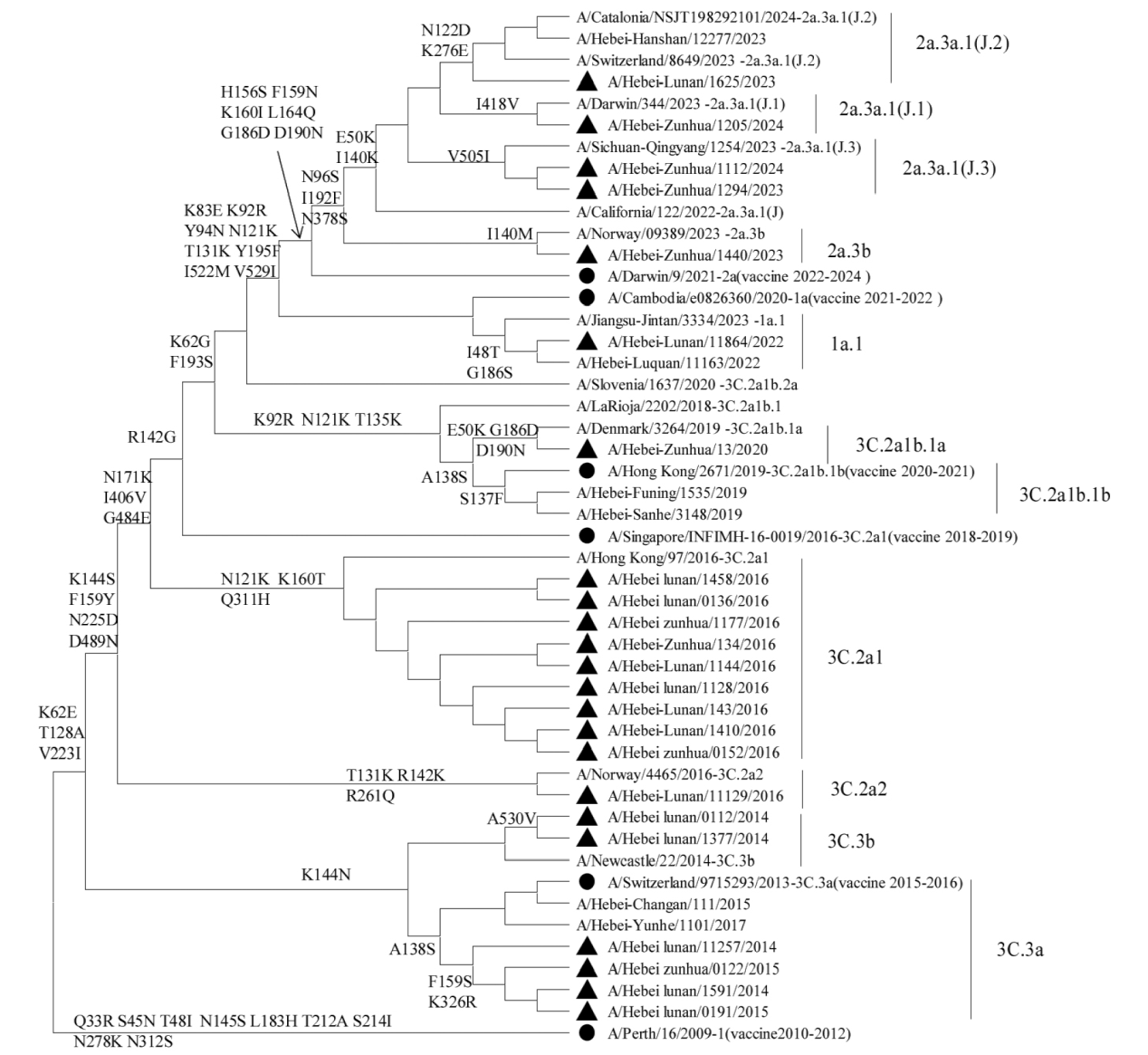
| 功能性位点 | 位置 | 唐山市甲型H3N2流感病毒毒株分支 | ||||||||
|---|---|---|---|---|---|---|---|---|---|---|
| 3C.3a (2014—2015年,n=4) | 3C.3b (2014年,n=2) | 3C.2a1 (2016年,n=9) | 3C.2a2 (2016年,n=1) | 3C.2a1b.1a (2020年,n=1) | ||||||
| 抗原表位 | A | A138S、R142G、K144N、N145S | R142G、K144N、N145S | K144S、N145S | T131K、R142K、K144S、N145S | T135K、A138S、R142G、K144S、N145S | ||||
| B | T128A、F159S、A198S | T128A、A198S | F159Y、K160T、A198S | F159Y、A198S | T128A、F159Y、K160T、G186D、D190N、F193S、A198P | |||||
| C | S45N、T48I、N278K、N312S | S45N、T48I、N278K、N312S | S45N、T48I、N278K、Q311H、N312S | S45N、T48I、N278K、Q311H、N312S | S45N、T48I、E50K、N278K、N312S | |||||
| D | F174I(2/4)、D175C(2/4)、T212A、S214I | F174I(1/2)、D175C(1/2)、T212A、S214I | N171K、T212A、S214I | T212A、S214I | N121K、N171K、T212A、S214I | |||||
| E | K62E | K62E | K62E | K62E、R261Q | K62G、K92R | |||||
| 受体结合域 | 220-loop | V223I、N225D | V223I | V223I、N225D | V223I、N225D | V223I、N225D | ||||
| 190-helix | L183H | L183H | L183H | L183H | L183H | |||||
| 潜在糖基化位点 | NSS45-47、NES122-124、NWA126-128、NGT133-135、NSS144-146 | NSS45-47、NES122-124、NWA126-128、NGT133-135、NSS144-146 | NSS45-47、NES122-124、NWT126-128、NGT133-135 | NSS45-47、NES122-124、NWT126-128、NGT133-135 | NSS45-47、NES122-124、NWA126-128、NGK133-135、NYT158-160 | |||||
| 功能性位点 | 位置 | 唐山市甲型H3N2流感病毒毒株分支 | ||||||||
| 1a.1 (2022年,n=1) | 2a.3b (2023年,n=1) | 2a.3a.1(J.1) (2024年,n=1) | 2a.3a.1(J.2) (2023年,n=1) | 2a.3a.1(J.3) (2023—2024年,n=2) | ||||||
| 抗原表位 | A | T131K、R142G、K144S、N145S | T131K、I140M、R142G、K144S、N145S | T131K、I140K、R142G、K144S、N145S | N122D、T131K、I140K、R142G、K144S、N145S | T131K、I140K、R142G、K144S、N145S | ||||
| B | F159Y、K160T、G186S、F193S、A198P | H156S、F159N、K160I、L164Q、G186D、D190N、I192F、F193S、A198S | H156S、F159N、K160I、L164Q、G186D、D190N、I192F、F193S、A198S | H156S、F159N、K160I、L164Q、G186D、D190N、I192F、F193S、A198S | H156S、F159N、K160I、L164Q、G186D、D190N、I192F、F193S、A198S | |||||
| C | S45N、N278K、N312S | S45N、T48I、D53N、N278K、N312S | S45N、T48I、E50K、D53N、N278K、N312S | S45N、T48I、E50K、D53N、K276E、N278K、N312S | S45N、T48I、E50K、D53N、N278K、N312S | |||||
| D | N121K、T212A、S214I | N96S、N121K、N171K、T212A、S214I | N96S、N121K、N171K、T212A、S214I | N96S、N121K、N171K、T212A、S214I | N96S、N121K、N171K、T212A、S214I | |||||
| E | K62G、K83E、K92R、Y94N | K62G、K83E、K92R、Y94N | K62G、K83E、K92R、Y94N | K62G、K83E、K92R、Y94N | K62G、K83E、K92R、Y94N | |||||
| 受体结合域 | 220-loop | V223I、N225D | V223I、N225D | N225D | N225D | N225D | ||||
| 190-helix | L183H、Y195F | L183H、Y195F | L183H、Y195F | L183H、Y195F | L183H、Y195F | |||||
| 潜在糖基化位点 | NSS45-47、NES122-124、NWT126-128、NGT133-135、NYT158-160 | NSS45-47、NSS94-96、NES122-124、NWT126-128、NGT133-135 | NSS45-47、NSS94-96、NES122-124、NWT126-128、NGT133-135 | NSS45-47、NSS94-96、DES122-124、NWT126-128、NGT133-135 | NSS45-47、NSS94-96、NES122-124、NWT126-128、NGT133-135 | |||||
| 功能性位点 | 位置 | 唐山市甲型H3N2流感病毒毒株分支 | ||||||||
|---|---|---|---|---|---|---|---|---|---|---|
| 3C.3a (2014—2015年,n=4) | 3C.3b (2014年,n=2) | 3C.2a1 (2016年,n=9) | 3C.2a2 (2016年,n=1) | 3C.2a1b.1a (2020年,n=1) | ||||||
| 抗原表位 | A | A138S、R142G、K144N、N145S | R142G、K144N、N145S | K144S、N145S | T131K、R142K、K144S、N145S | T135K、A138S、R142G、K144S、N145S | ||||
| B | T128A、F159S、A198S | T128A、A198S | F159Y、K160T、A198S | F159Y、A198S | T128A、F159Y、K160T、G186D、D190N、F193S、A198P | |||||
| C | S45N、T48I、N278K、N312S | S45N、T48I、N278K、N312S | S45N、T48I、N278K、Q311H、N312S | S45N、T48I、N278K、Q311H、N312S | S45N、T48I、E50K、N278K、N312S | |||||
| D | F174I(2/4)、D175C(2/4)、T212A、S214I | F174I(1/2)、D175C(1/2)、T212A、S214I | N171K、T212A、S214I | T212A、S214I | N121K、N171K、T212A、S214I | |||||
| E | K62E | K62E | K62E | K62E、R261Q | K62G、K92R | |||||
| 受体结合域 | 220-loop | V223I、N225D | V223I | V223I、N225D | V223I、N225D | V223I、N225D | ||||
| 190-helix | L183H | L183H | L183H | L183H | L183H | |||||
| 潜在糖基化位点 | NSS45-47、NES122-124、NWA126-128、NGT133-135、NSS144-146 | NSS45-47、NES122-124、NWA126-128、NGT133-135、NSS144-146 | NSS45-47、NES122-124、NWT126-128、NGT133-135 | NSS45-47、NES122-124、NWT126-128、NGT133-135 | NSS45-47、NES122-124、NWA126-128、NGK133-135、NYT158-160 | |||||
| 功能性位点 | 位置 | 唐山市甲型H3N2流感病毒毒株分支 | ||||||||
| 1a.1 (2022年,n=1) | 2a.3b (2023年,n=1) | 2a.3a.1(J.1) (2024年,n=1) | 2a.3a.1(J.2) (2023年,n=1) | 2a.3a.1(J.3) (2023—2024年,n=2) | ||||||
| 抗原表位 | A | T131K、R142G、K144S、N145S | T131K、I140M、R142G、K144S、N145S | T131K、I140K、R142G、K144S、N145S | N122D、T131K、I140K、R142G、K144S、N145S | T131K、I140K、R142G、K144S、N145S | ||||
| B | F159Y、K160T、G186S、F193S、A198P | H156S、F159N、K160I、L164Q、G186D、D190N、I192F、F193S、A198S | H156S、F159N、K160I、L164Q、G186D、D190N、I192F、F193S、A198S | H156S、F159N、K160I、L164Q、G186D、D190N、I192F、F193S、A198S | H156S、F159N、K160I、L164Q、G186D、D190N、I192F、F193S、A198S | |||||
| C | S45N、N278K、N312S | S45N、T48I、D53N、N278K、N312S | S45N、T48I、E50K、D53N、N278K、N312S | S45N、T48I、E50K、D53N、K276E、N278K、N312S | S45N、T48I、E50K、D53N、N278K、N312S | |||||
| D | N121K、T212A、S214I | N96S、N121K、N171K、T212A、S214I | N96S、N121K、N171K、T212A、S214I | N96S、N121K、N171K、T212A、S214I | N96S、N121K、N171K、T212A、S214I | |||||
| E | K62G、K83E、K92R、Y94N | K62G、K83E、K92R、Y94N | K62G、K83E、K92R、Y94N | K62G、K83E、K92R、Y94N | K62G、K83E、K92R、Y94N | |||||
| 受体结合域 | 220-loop | V223I、N225D | V223I、N225D | N225D | N225D | N225D | ||||
| 190-helix | L183H、Y195F | L183H、Y195F | L183H、Y195F | L183H、Y195F | L183H、Y195F | |||||
| 潜在糖基化位点 | NSS45-47、NES122-124、NWT126-128、NGT133-135、NYT158-160 | NSS45-47、NSS94-96、NES122-124、NWT126-128、NGT133-135 | NSS45-47、NSS94-96、NES122-124、NWT126-128、NGT133-135 | NSS45-47、NSS94-96、DES122-124、NWT126-128、NGT133-135 | NSS45-47、NSS94-96、NES122-124、NWT126-128、NGT133-135 | |||||
| [1] |
WENDEL I, RUBBENSTROTH D, DOEDT J, et al. The avian-origin PB1 gene segment facilitated replication and transmissibility of the H3N2/1968 pandemic influenza virus[J]. J Virol, 2015, 89(8):4170-4179.
DOI PMID |
| [2] |
SMITH D J, LAPEDES A S, DE JONG J C, et al. Mapping the antigenic and genetic evolution of influenza virus[J]. Science, 2004, 305(5682):371-376.
DOI PMID |
| [3] |
BHATT S, HOLMES E C, PYBUS O G. The genomic rate of molecular adaptation of the human influenza A virus[J]. Mol Biol Evol, 2011, 28(9):2443-2451.
DOI PMID |
| [4] |
THOMPSON A J, WU N C, CANALES A, et al. Evolution of human H3N2 influenza virus receptor specificity has substantially expanded the receptorbinding domain site[J]. Cell Host Microbe, 2024, 32(2):261-275.
DOI URL |
| [5] |
KORSUN N, ANGELOVA S, GREGORY V, et al. Antigenic and genetic characterization of influenza viruses circulating in Bulgaria during the 2015/2016 season[J]. Infect Genet Evol, 2017, 49(4):241-250.
DOI URL |
| [6] |
BROSZEIT F, BEEK RJ, UNIONE L, et al. Glycan remodeled erythrocytes facilitate antigenic characterization of recent A/H3N2 influenza viruses[J]. Nat Commun, 2021, 12(1):5449.
DOI PMID |
| [7] |
BOLTON M J, ORT J T, MCBRIDE R, et al. Antigenic and virological properties of an H3N2 variant that continues to dominate the 2021-22 Northern Hemisphere influenza season[J]. Cell Rep, 2022, 39(9):110897.
DOI URL |
| [8] |
BERNADETA D, EGLE B, ERVIN F, et al. The structure of the influenza A virus genome[J]. Nat Microbiol, 2019, 4:1781-1789.
DOI PMID |
| [9] | World Health Organization. Recommended composition of influenza virus vaccines for use in the 2017-2018 northern hemisphere influenza season[J]. Wkly Epidemiol Rec, 2017, 92(11):117-128. |
| [10] | DANIELS R, ERMETAL B, RATTIGAN A, et al. Influenza virus characterisation,summary Europe,March2020[EB/OL].(2020-04-08)[2025-03-01]. https://www.ecdc.europa.eu/en/publications-data/influenza-virus-characterisation-march-2020. |
| [11] |
World Health Organi zation, TERRY G. WHO recommendations for the viruses used in the 2013-2014 Northern Hemisphere inflfluenza vaccine:Epidemiology,antigenic and genetic characteristics of influenza A(H1N1)pdm09,A(H3N2) and B inflfluenza viruses collected from October 2012 to January 2013[J]. Vaccine, 2014, 32(37):4713-4725.
DOI URL |
| [12] | NICOLA L, RUTH H, MONICA G, et al. Influenza virus characterisation,summary Europe, December 2023[EB/OL].(2024-01-09)[2025-03-01]. https://www.ecdc.europa.eu/sites/default/files/documents/influenza-ECDC-WHO-Report-december-2023. |
| [13] | World Health Organi zation. Recommended composition of influenza virus vaccines for use in the 2024-2025 northern hemisphere influenza season[J]. Wkly Epidemiol Rec, 2024, 92(11):1-9. |
| [14] |
SKOWRONSKI D M, JANJUA N Z, DE S G, et al. Low 2012-13 influenza vaccine effectiveness associated with mutation in the egg-adapted H3N2 vaccine strain not antigenic drift in circulating viruses[J]. PLoS One, 2014, 9(3):e92153.
DOI URL |
| [15] |
YANG H, CARNEY P J, CHANG J C, et al. Structure and receptor binding preferences of recombinant human A(H3N2) virus hemagglutinins[J]. Virology, 2015, 477:18-31.
DOI PMID |
| [16] | YANMING A, LISA M AND EWA J. N-Glycosylation of seasonal influenza vaccine hemagglutinins:Implication for potency testing and immune processing[J]. J Virol, 2019, 93(2):e01693-18. |
| [17] |
ARNOLD K, BORDOLI L, KOPP J, et al. The SWISS-MODEL workspace:A web-based environment for protein structure homology modelling[J]. Bioinformatics, 2006, 22(2):195-201.
DOI URL |
| [18] |
WEIS W, BROWN J, CUSACK S, et al. Structure of the influenza virus haemagglutinin complexed with its receptor,sialic acid[J]. Nature,1988, 333(6172):426-431(1988).
DOI |
| [19] |
LIU L, WANG F, WU Y, et al. The V223I substitution in hemagglutinin reduces the binding affinity to human-type receptors while enhancing the thermal stability of the H3N2 canine influenza virus[J]. Front Microbiol, 2024, 15:1442163.
DOI URL |
| [20] |
EBRANATI E, PARIANI E, PIRALLA A, et al. Reconstruction of the evolutionary dynamics of A(H3N2) influenza viruses circulating in Italy from 2004 to 2012[J]. PLoS One, 2015, 10(9):e0137099.
DOI URL |
| [21] | 李希妍, 成艳辉, 谭敏菊, 等. 2013—2014年度中国H3N2亚型流感病毒病原学特征分析[J]. 病毒学报, 2015, 31(1):30-35. |
| [22] | WANG X, ILYUSHINA N A, LUGOVTSEV V Y, et al. Amino acids in hemagglutinin antigenic site B determine antigenic and receptor binding differences between A(H3N2)v and ancestral seasonal H3N2 influenza viruses[J]. J Virol, 2017, 91(2):e01512-16. |
| [23] | 王慎骄, 祁贤, 邓斐, 等. 2017年江苏省H3N2流感病毒血凝素与神经氨酸酶分子特征及耐药性分析[J]. 医学研究生学报, 2019, 32(12):1254-1258. |
| [24] |
陈涛, 杨静, 汪立杰, 等. 2016—2017年度中国大陆流行性感冒监测分析[J]. 中国人兽共患病学报, 2018, 34(3):193-199.
DOI |
| [25] |
HUA S, LI X Y, LIU M, et al. Antigenic variation of the human influenza A(H3N2) virus during the 2014-2015 winter season[J]. Sci China Life Sci, 2015, 58(9):882-888.
DOI URL |
| [26] |
LEI R, LIANG W, OUYANG W O, et al. Epistasis mediates the evolution of the receptor binding mode in recent human H3N2 hemagglutinin[J]. Nat Commun, 2024, 15(1):5175.
DOI PMID |
| [27] |
LIANG W, TAN T J C, WANG Y, et al. Egg-adaptive mutations of human influenza H3N2 virus are contingent on natural[J]. PLoS Pathog, 2022, 18(9):e1010875.
DOI URL |
| [28] |
MUNK K, PRITZER E, KRETZSCHMAR E, et al. Carbohydrate masking of an antigenic epitope of influenza virus hemagglutinin Independent of oligosaccharide size[J]. Glycobiology, 1992, 2(3):233-240.
DOI URL |
| [29] | BROBERG E K, SVARTSTRÖM O, RIESS M, et al. Co-circulation of seasonal influenza A(H1N1)pdm09,A(H3N2) and B/Victoria lineage viruses with further genetic diversification,EU/EEA,2022/23 influenza season[J]. Euro Surveill, 2024, 29(39):2400020. |
| [30] | NICOLA L, RUTH H, MONICA G, et al. Influenza virus characterisation,summary Europe,September 2024[EB/OL].(2024-11-27)[2025-03-01]. https://www.ecdc.europa.eu/sites/default/files/documents/WHO-EURO-2024-6189-45954-76521. |
| [1] | CHEN Yuan, ZHANG Xuan, Nigedeli Alitengsaier, LI Quanxi, Hundezi Awuxi, MA Xin. Analysis of genetic characteristics of A(H1N1)pdm09 influenza virus in Xinjiang from 2022 to 2023 [J]. OCCUPATION AND HEALTH, 2024, 40(22): 3051-3055. |
| Viewed | ||||||
|
Full text |
|
|||||
|
Abstract |
|
|||||
 津公网安备12010202000831号 津ICP备11005889号-6
