


OCCUPATION AND HEALTH ›› 2026, Vol. 42 ›› Issue (18): 2545-2550.
• Treatise——School Health • Previous Articles Next Articles
WANG Jiayu1, YU Zhenwei2, XING Ye1, LU Yu1, BAI Xue1( )
)
Received:2025-03-07
Revised:2025-09-21
Online:2026-09-15
Published:2026-08-28
Contact:
BAI Xue
CLC Number:
WANG Jiayu, YU Zhenwei, XING Ye, LU Yu, BAI Xue. Study on latent profile analysis of metacognitive abilities and influencing factors among nursing undergraduates from 14 universities in Beijing Municipality,Hubei Province,Zhejiang Province,Shanxi Province and Henan Province. [J]OCCUPATION AND HEALTH, 2026, 42(18): 2545-2550.
| 项目 | 人数[人(%)] | 得分 | t/F值 | P值 |
|---|---|---|---|---|
| 性别 | 1.511a | 0.131 | ||
| 男 | 124(16.00) | 93.19±20.43 | ||
| 女 | 651(84.00) | 90.38±18.72 | ||
| 学校类型 | 5.355b | 0.005 | ||
| 部属高校 | 68(8.77) | 92.94±20.29 | ||
| 省属高校 | 483(62.32) | 92.14±19.23 | ||
| 民办高校 | 224(28.90) | 87.36±17.75 | ||
| 年级 | 8.376b | <0.001 | ||
| 大一 | 261(33.68) | 87.05±19.46 | ||
| 大二 | 184(23.74) | 89.97±16.90 | ||
| 大三 | 175(22.58) | 92.66±18.59 | ||
| 大四/大五 | 155(20.00) | 96.15±19.76 | ||
| 是否担任学生干部 | 3.002a | 0.003 | ||
| 是 | 309(39.87) | 93.42±20.72 | ||
| 否 | 466(60.13) | 89.11±17.61 | ||
| 户口类型 | 1.675a | 0.094 | ||
| 农业户口 | 501(64.65) | 89.99±18.41 | ||
| 非农业户口 | 274(35.35) | 92.38±20.02 | ||
| 是否为独生子女 | 1.566a | 0.118 | ||
| 是 | 236(30.45) | 92.44±20.31 | ||
| 否 | 539(69.55) | 90.12±18.40 | ||
| 父母是否满意所选专业 | 0.087a | 0.931 | ||
| 是 | 615(79.35) | 90.80±19.15 | ||
| 否 | 160(20.65) | 90.95±18.52 | ||
| 是否自愿选择护理专业 | 0.462a | 0.644 | ||
| 是 | 456(58.84) | 91.09±19.01 | ||
| 否 | 319(41.16) | 90.45±19.05 | ||
| 毕业后是否有从事临床 护理工作的意愿 | 0.261a | 0.794 | ||
| 是 | 619(79.87) | 90.74±18.74 | ||
| 否 | 156(20.13) | 91.19±20.11 | ||
| 是否接受过模拟教学法 | 4.265a | <0.001 | ||
| 是 | 317(40.90) | 94.29±17.91 | ||
| 否 | 458(59.10) | 88.43±19.40 |
| 项目 | 人数[人(%)] | 得分 | t/F值 | P值 |
|---|---|---|---|---|
| 性别 | 1.511a | 0.131 | ||
| 男 | 124(16.00) | 93.19±20.43 | ||
| 女 | 651(84.00) | 90.38±18.72 | ||
| 学校类型 | 5.355b | 0.005 | ||
| 部属高校 | 68(8.77) | 92.94±20.29 | ||
| 省属高校 | 483(62.32) | 92.14±19.23 | ||
| 民办高校 | 224(28.90) | 87.36±17.75 | ||
| 年级 | 8.376b | <0.001 | ||
| 大一 | 261(33.68) | 87.05±19.46 | ||
| 大二 | 184(23.74) | 89.97±16.90 | ||
| 大三 | 175(22.58) | 92.66±18.59 | ||
| 大四/大五 | 155(20.00) | 96.15±19.76 | ||
| 是否担任学生干部 | 3.002a | 0.003 | ||
| 是 | 309(39.87) | 93.42±20.72 | ||
| 否 | 466(60.13) | 89.11±17.61 | ||
| 户口类型 | 1.675a | 0.094 | ||
| 农业户口 | 501(64.65) | 89.99±18.41 | ||
| 非农业户口 | 274(35.35) | 92.38±20.02 | ||
| 是否为独生子女 | 1.566a | 0.118 | ||
| 是 | 236(30.45) | 92.44±20.31 | ||
| 否 | 539(69.55) | 90.12±18.40 | ||
| 父母是否满意所选专业 | 0.087a | 0.931 | ||
| 是 | 615(79.35) | 90.80±19.15 | ||
| 否 | 160(20.65) | 90.95±18.52 | ||
| 是否自愿选择护理专业 | 0.462a | 0.644 | ||
| 是 | 456(58.84) | 91.09±19.01 | ||
| 否 | 319(41.16) | 90.45±19.05 | ||
| 毕业后是否有从事临床 护理工作的意愿 | 0.261a | 0.794 | ||
| 是 | 619(79.87) | 90.74±18.74 | ||
| 否 | 156(20.13) | 91.19±20.11 | ||
| 是否接受过模拟教学法 | 4.265a | <0.001 | ||
| 是 | 317(40.90) | 94.29±17.91 | ||
| 否 | 458(59.10) | 88.43±19.40 |
| 模型 | Log(L) | AIC | BIC | aBIC | Entropy | P值 | 类别概率 | |
|---|---|---|---|---|---|---|---|---|
| LMR | BLRT | |||||||
| 1 | -10 908.871 | 21 837.743 | 21 884.271 | 21 852.517 | ||||
| 2 | -10 061.957 | 20 155.913 | 20 230.359 | 20 179.551 | 0.879 | <0.001 | <0.001 | 0.620,0.380 |
| 3 | -9 554.376 | 19 152.752 | 19 255.115 | 19 185.255 | 0.915 | <0.001 | <0.001 | 0.160,0.570,0.270 |
| 4 | -9 321.539 | 18 699.077 | 18 829.357 | 18 740.444 | 0.917 | 0.007 | <0.001 | 0.128,0.501,0.305,0.067 |
| 5 | -9 218.856 | 18 505.713 | 18 663.91 | 18 555.944 | 0.926 | 0.001 | <0.001 | 0.151,0.018,0.488,0.277,0.066 |
| 模型 | Log(L) | AIC | BIC | aBIC | Entropy | P值 | 类别概率 | |
|---|---|---|---|---|---|---|---|---|
| LMR | BLRT | |||||||
| 1 | -10 908.871 | 21 837.743 | 21 884.271 | 21 852.517 | ||||
| 2 | -10 061.957 | 20 155.913 | 20 230.359 | 20 179.551 | 0.879 | <0.001 | <0.001 | 0.620,0.380 |
| 3 | -9 554.376 | 19 152.752 | 19 255.115 | 19 185.255 | 0.915 | <0.001 | <0.001 | 0.160,0.570,0.270 |
| 4 | -9 321.539 | 18 699.077 | 18 829.357 | 18 740.444 | 0.917 | 0.007 | <0.001 | 0.128,0.501,0.305,0.067 |
| 5 | -9 218.856 | 18 505.713 | 18 663.91 | 18 555.944 | 0.926 | 0.001 | <0.001 | 0.151,0.018,0.488,0.277,0.066 |
| 项目 | 低得分组 (n=99) | 中低得分组 (n=388) | 中高得分组 (n=236) | 高得分组 (n=52) | χ2值 | P值 |
|---|---|---|---|---|---|---|
| 学校类型 | 18.113 | 0.006 | ||||
| 部属高校 | 7(7.1) | 28(7.2) | 27(11.4) | 6(11.5) | ||
| 省属高校 | 56(56.6) | 231(59.5) | 159(67.4) | 37(71.2) | ||
| 民办高校 | 36(36.4) | 129(33.2) | 50(21.2) | 9(17.3) | ||
| 性别 | 6.363 | 0.095 | ||||
| 男 | 15(15.2) | 52(13.4) | 44(18.6) | 13(25.0) | ||
| 女 | 84(84.8) | 336(86.6) | 192(81.4) | 39(75.0) | ||
| 年级 | 32.813 | <0.001 | ||||
| 大一 | 45(45.5) | 144(37.1) | 59(25.0) | 13(25.0) | ||
| 大二 | 22(22.2) | 96(24.7) | 60(25.4) | 6(11.5) | ||
| 大三 | 18(18.2) | 87(22.4) | 54(22.9) | 16(30.8) | ||
| 大四/大五 | 14(14.1) | 61(15.7) | 63(26.7) | 17(32.7) | ||
| 是否担任学生干部 | 16.982 | 0.001 | ||||
| 是 | 38(38.4) | 134(34.5) | 105(44.5) | 32(61.5) | ||
| 否 | 61(61.6) | 254(65.5) | 131(55.5) | 20(38.5) | ||
| 户口所在地 | 12.506 | 0.006 | ||||
| 农业户口 | 65(65.7) | 271(69.8) | 132(55.9) | 33(63.5) | ||
| 非农业户口 | 34(34.3) | 117(30.2) | 104(44.1) | 19(36.5) | ||
| 是否为独生子女 | 8.590 | 0.035 | ||||
| 是 | 30(30.3) | 101(26.0) | 87(36.9) | 18(34.6) | ||
| 否 | 69(69.7) | 287(74.0) | 149(63.1) | 34(65.4) | ||
| 是否接受过模拟 教学法 | 23.456 | <0.001 | ||||
| 是 | 23(23.2) | 150(38.7) | 118(50.0) | 26(50.0) | ||
| 否 | 76(76.8) | 238(61.3) | 118(50.0) | 26(50.0) |
| 项目 | 低得分组 (n=99) | 中低得分组 (n=388) | 中高得分组 (n=236) | 高得分组 (n=52) | χ2值 | P值 |
|---|---|---|---|---|---|---|
| 学校类型 | 18.113 | 0.006 | ||||
| 部属高校 | 7(7.1) | 28(7.2) | 27(11.4) | 6(11.5) | ||
| 省属高校 | 56(56.6) | 231(59.5) | 159(67.4) | 37(71.2) | ||
| 民办高校 | 36(36.4) | 129(33.2) | 50(21.2) | 9(17.3) | ||
| 性别 | 6.363 | 0.095 | ||||
| 男 | 15(15.2) | 52(13.4) | 44(18.6) | 13(25.0) | ||
| 女 | 84(84.8) | 336(86.6) | 192(81.4) | 39(75.0) | ||
| 年级 | 32.813 | <0.001 | ||||
| 大一 | 45(45.5) | 144(37.1) | 59(25.0) | 13(25.0) | ||
| 大二 | 22(22.2) | 96(24.7) | 60(25.4) | 6(11.5) | ||
| 大三 | 18(18.2) | 87(22.4) | 54(22.9) | 16(30.8) | ||
| 大四/大五 | 14(14.1) | 61(15.7) | 63(26.7) | 17(32.7) | ||
| 是否担任学生干部 | 16.982 | 0.001 | ||||
| 是 | 38(38.4) | 134(34.5) | 105(44.5) | 32(61.5) | ||
| 否 | 61(61.6) | 254(65.5) | 131(55.5) | 20(38.5) | ||
| 户口所在地 | 12.506 | 0.006 | ||||
| 农业户口 | 65(65.7) | 271(69.8) | 132(55.9) | 33(63.5) | ||
| 非农业户口 | 34(34.3) | 117(30.2) | 104(44.1) | 19(36.5) | ||
| 是否为独生子女 | 8.590 | 0.035 | ||||
| 是 | 30(30.3) | 101(26.0) | 87(36.9) | 18(34.6) | ||
| 否 | 69(69.7) | 287(74.0) | 149(63.1) | 34(65.4) | ||
| 是否接受过模拟 教学法 | 23.456 | <0.001 | ||||
| 是 | 23(23.2) | 150(38.7) | 118(50.0) | 26(50.0) | ||
| 否 | 76(76.8) | 238(61.3) | 118(50.0) | 26(50.0) |
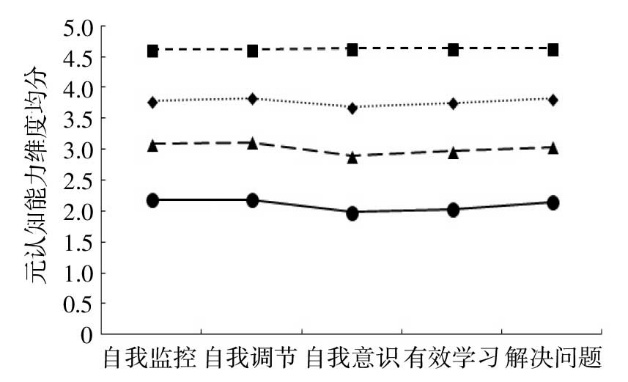
| 分组 | 元认知能力总分 | 自我监控 | 自我调节 | 自我意识 | 有效学习 | 解决问题 |
|---|---|---|---|---|---|---|
| 低得分组 | 59.25±9.79 | 2.18±0.50 | 2.19±0.50 | 1.98±0.42 | 2.03±0.41 | 2.14±0.47 |
| 中低得分组 | 84.64±5.98 | 3.07±0.36 | 3.11±0.37 | 2.88±0.41 | 2.96±0.40 | 3.04±0.35 |
| 中高得分组 | 105.69±6.32 | 3.78±0.43 | 3.83±0.37 | 3.68±0.42 | 3.75±0.48 | 3.81±0.39 |
| 高得分组 | 129.67±7.71 | 4.62±0.39 | 4.62±0.39 | 4.64±0.33 | 4.64±0.37 | 4.64±0.40 |
| F值 | 1 758.133 | 583.483 | 638.434 | 674.497 | 625.473 | 718.465 |
| P值 | <0.001 | <0.001 | <0.001 | <0.001 | <0.001 | <0.001 |
| 分组 | 元认知能力总分 | 自我监控 | 自我调节 | 自我意识 | 有效学习 | 解决问题 |
|---|---|---|---|---|---|---|
| 低得分组 | 59.25±9.79 | 2.18±0.50 | 2.19±0.50 | 1.98±0.42 | 2.03±0.41 | 2.14±0.47 |
| 中低得分组 | 84.64±5.98 | 3.07±0.36 | 3.11±0.37 | 2.88±0.41 | 2.96±0.40 | 3.04±0.35 |
| 中高得分组 | 105.69±6.32 | 3.78±0.43 | 3.83±0.37 | 3.68±0.42 | 3.75±0.48 | 3.81±0.39 |
| 高得分组 | 129.67±7.71 | 4.62±0.39 | 4.62±0.39 | 4.64±0.33 | 4.64±0.37 | 4.64±0.40 |
| F值 | 1 758.133 | 583.483 | 638.434 | 674.497 | 625.473 | 718.465 |
| P值 | <0.001 | <0.001 | <0.001 | <0.001 | <0.001 | <0.001 |
| 变量 | 赋值方式 |
|---|---|
| 学校类型 | 部属高校=1;省属高校=2;民办高校=3 |
| 年级 | 大一=1;大二=2;大三=3;大四/大五=4 |
| 是否担任学生干部 | 否=0;是=1 |
| 户口所在地 | 农业户口=1;非农业户口=2 |
| 是否为独生子女 | 否=0;是=1 |
| 是否接受过模拟教学法 | 否=0;是=1 |
| 变量 | 赋值方式 |
|---|---|
| 学校类型 | 部属高校=1;省属高校=2;民办高校=3 |
| 年级 | 大一=1;大二=2;大三=3;大四/大五=4 |
| 是否担任学生干部 | 否=0;是=1 |
| 户口所在地 | 农业户口=1;非农业户口=2 |
| 是否为独生子女 | 否=0;是=1 |
| 是否接受过模拟教学法 | 否=0;是=1 |
| 项目 | B值 | Wald χ2值 | OR值 | 95%CI | P值 | |
|---|---|---|---|---|---|---|
| 学校类型 | ||||||
| 部属高校 | 0.668 | 0.273 | 5.980 | 1.950 | 0.133~1.204 | 0.014 |
| 省属高校 | 0.421 | 0.182 | 5.356 | 1.523 | 0.064~0.777 | 0.021 |
| 年级 | ||||||
| 大一 | -0.764 | 0.217 | 12.456 | 0.466 | -1.189~-0.340 | <0.001 |
| 大二 | -0.502 | 0.211 | 5.689 | 0.605 | -0.915~-0.090 | 0.017 |
| 大三 | -0.424 | 0.209 | 4.112 | 0.654 | -0.835~-0.014 | 0.043 |
| 是否担任学生干部 | ||||||
| 否 | -0.473 | 0.142 | 11.042 | 0.623 | -0.752~-0.194 | 0.001 |
| 是否接受过模拟 教学法 | ||||||
| 否 | -0.598 | 0.142 | 17.639 | 0.550 | -0.878~-0.319 | <0.001 |
| 项目 | B值 | Wald χ2值 | OR值 | 95%CI | P值 | |
|---|---|---|---|---|---|---|
| 学校类型 | ||||||
| 部属高校 | 0.668 | 0.273 | 5.980 | 1.950 | 0.133~1.204 | 0.014 |
| 省属高校 | 0.421 | 0.182 | 5.356 | 1.523 | 0.064~0.777 | 0.021 |
| 年级 | ||||||
| 大一 | -0.764 | 0.217 | 12.456 | 0.466 | -1.189~-0.340 | <0.001 |
| 大二 | -0.502 | 0.211 | 5.689 | 0.605 | -0.915~-0.090 | 0.017 |
| 大三 | -0.424 | 0.209 | 4.112 | 0.654 | -0.835~-0.014 | 0.043 |
| 是否担任学生干部 | ||||||
| 否 | -0.473 | 0.142 | 11.042 | 0.623 | -0.752~-0.194 | 0.001 |
| 是否接受过模拟 教学法 | ||||||
| 否 | -0.598 | 0.142 | 17.639 | 0.550 | -0.878~-0.319 | <0.001 |
| [1] | 国务院办公厅.国务院办公厅关于加快医学教育创新发展的指导意见:国办发[2020]34号[EB/OL]. (2020-09-23)[2024-04-17]. https://www.gov.cn/zhengce/content/2020-09/23/content_5546373.htm. |
| [2] | 中华人民共和国教育部. 国家中长期教育改革和发展规划纲要(2010-2020年)[EB/OL]. (2010-07-29)[2025-03-07]. http://www.moe.gov.cn/jyb_xwfb/s6052/moe_838/201008/t20100802_93704.html. |
| [3] | 李允, 李如密. 培养元认知能力教学生学会学习[J]. 中国教育学刊, 1999(4):33-37. |
| [4] | 庞维国. 从自主学习的心理机制看自主学习能力培养的着力点[J]. 全球教育展望, 2002, 31(5):26-31. |
| [5] | 杨坚定. 听力教学中的元认知策略培训[J]. 外语教学, 2003(4):65-69. |
| [6] | 董奇. 元认知与思维品质关系性质的相关、实验研究[J]. 北京师范大学学报, 1990(5):51-58. |
| [7] |
尹奎, 彭坚, 张君. 潜在剖面分析在组织行为领域中的应用[J]. 心理科学进展, 2020, 28(7):1056-1070.
DOI |
| [8] | 康中和. 大学生元认知能力量表的初建[D]. 太原: 山西大学, 2005. |
| [9] |
HSU L L. Metacognitive inventory for nursing students in Taiwan:Instrument development and testing[J]. J Advanced Nurs, 2010, 66(11):2573-2581.
DOI URL |
| [10] |
余振威, 白雪, 鲁玉, 等. 护理学生元认知能力量表的汉化及信效度检验[J]. 护理学报, 2023, 30(21):13-17.
DOI |
| [11] | 蒲丛珊, 程洋, 郭辉, 等. 元认知能力在护理教育领域的研究进展[J]. 中华护理教育, 2020, 17(1):89-93. |
| [12] |
HSU L L, HSIEH S I. Factors affecting metacognition of undergraduate nursing students in a blended learning environment[J]. Int J Nurs Pract, 2014, 20(3):233-241.
DOI URL |
| [13] | 马子龙, 靳长沛, 魏迎鑫, 等. 护生认知风格和认知情绪调节对人际关系的影响[J]. 卫生职业教育, 2023, 41(22):144-147. |
| [14] | 叶娇, 王佳琳, 张媛, 等. 在校本科护生学习倦怠与元认知能力的相关分析及影响因素研究[J]. 护理研究, 2018, 32(15):2418-2423. |
| [15] | 帅惠琼, 王佳琳, 张媛, 等. 中医院校本科护生元认知能力现状及其影响因素研究[J]. 护理研究, 2018, 32(14):2228-2232. |
| [16] | 张东旭. 初中生数据分析中元认知能力现状及培养策略的研究[D]. 贵阳: 贵州师范大学, 2016. |
| [17] | 刘秀儒, 林霞, 危诚怡, 等. 本科护生元认知能力现状及其影响因素研究[J]. 护理研究, 2017, 31(26):3248-3252. |
| [18] | 张雪雁, 范秀珍, 李军, 等. 护生评判性思维能力与元认知能力关系研究[J]. 滨州医学院学报, 2014, 37(1):51-53. |
| [19] | 周海涛, 景安磊, 李子建. 大学生学习策略使用水平及其影响因素分析[J]. 中国高教研究, 2014(4):25-30. |
| [20] | 樊士德, 董思群, 陈蕾. 大学生担任学生干部对学业影响的实证研究[J]. 高等财经教育研究, 2014, 17(4):68-73. |
| [21] | 王琳, 张媛媛, 章雅青. 混合式教学模式下护理管理学课程思政的设计与实践[J]. 中华护理教育, 2023, 20(1):24-28. |
| [22] | 宋平义, 杜瑞妮, 庞芸, 等. 情景模拟教学法在本科生心肺复苏培训中的应用效果[J]. 临床医学研究与实践, 2023, 8(30):186-190. |
| [23] | 高云, 赵金梅, 曾钢, 等. 情境模拟教学法在本科精神科护理学课程中的应用[J]. 中华护理教育, 2023, 20(10):1174-1180. |
| [24] | 蒋娟, 李孜孜. 本科护生学业自我效能与学习策略现状调查与分析[J]. 护理实践与研究, 2012, 9(2):144-145. |
| Viewed | ||||||
|
Full text |
|
|||||
|
Abstract |
|
|||||
 津公网安备12010202000831号 津ICP备11005889号-6
