


OCCUPATION AND HEALTH ›› 2026, Vol. 42 ›› Issue (20): 2747-2753.
• Treatise—Occupational Health and Occupational Diseases • Previous Articles Next Articles
HUO Wenxia1, WU Ruikai2, JU Keke2( )
)
Received:2025-10-27
Revised:2026-03-15
Online:2026-10-15
Published:2026-09-14
Contact:
JU Keke,E-mail:CLC Number:
HUO Wenxia, WU Ruikai, JU Keke. Research on the current status of clinical nurses' work ability and the impact of occupational burnout and sleep quality on it in Urumqi City. [J]OCCUPATION AND HEALTH, 2026, 42(20): 2747-2753.
| 项目 | 人数[人(%)] | 得分($\bar{x}±s$) |
|---|---|---|
| 职业倦怠 | 1.81±0.86 | |
| 无倦怠 | 509(31.75) | 0.92±0.42 |
| 轻中度倦怠 | 1 038(64.75) | 2.22±0.46 |
| 重度倦怠 | 56(3.49) | 4.06±0.43 |
| 睡眠质量 | 6.77±3.71 | |
| 睡眠良好 | 970(60.51) | 4.33±2.01 |
| 睡眠障碍 | 633(39.49) | 10.51±2.36 |
| 工作能力 | 38.86±6.35 | |
| 工作能力差 | 79(4.93) | 23.37±3.36 |
| 工作能力中等 | 453(28.26) | 32.97±2.46 |
| 工作能力良好 | 659(41.11) | 40.27±1.97 |
| 工作能力极好 | 412(25.70) | 46.06±1.68 |
| 项目 | 人数[人(%)] | 得分($\bar{x}±s$) |
|---|---|---|
| 职业倦怠 | 1.81±0.86 | |
| 无倦怠 | 509(31.75) | 0.92±0.42 |
| 轻中度倦怠 | 1 038(64.75) | 2.22±0.46 |
| 重度倦怠 | 56(3.49) | 4.06±0.43 |
| 睡眠质量 | 6.77±3.71 | |
| 睡眠良好 | 970(60.51) | 4.33±2.01 |
| 睡眠障碍 | 633(39.49) | 10.51±2.36 |
| 工作能力 | 38.86±6.35 | |
| 工作能力差 | 79(4.93) | 23.37±3.36 |
| 工作能力中等 | 453(28.26) | 32.97±2.46 |
| 工作能力良好 | 659(41.11) | 40.27±1.97 |
| 工作能力极好 | 412(25.70) | 46.06±1.68 |
| 项目 | 人数[人(%)] | 工作能力 | t/F值 | P |
|---|---|---|---|---|
| 性别 | 2.311a | <0.01 | ||
| 男 | 165(10.29) | 39.94±6.59 | ||
| 女 | 1 438(89.71) | 38.74±6.31 | ||
| 年龄(岁) | 9.692b | <0.01 | ||
| 20~<30 | 823(51.34) | 39.39±6.42 | ||
| 30~<40 | 536(33.44) | 38.83±5.98 | ||
| 40~<50 | 170(10.61) | 37.77±6.21 | ||
| ≥50 | 74(4.62) | 35.73±7.35 | ||
| 文化程度 | 12.529b | <0.01 | ||
| 中专及以下 | 79(4.93) | 34.80±7.57 | ||
| 大专 | 693(43.23) | 39.00±6.75 | ||
| 本科 | 781(48.72) | 39.04±5.79 | ||
| 研究生及以上 | 50(3.12) | 40.57±4.47 | ||
| 工龄(年) | 11.586b | <0.01 | ||
| 0~<6 | 742(46.29) | 39.57±6.25 | ||
| 6~<11 | 370(23.08) | 39.47±5.90 | ||
| 11~<21 | 278(17.34) | 37.56±6.35 | ||
| 21~<31 | 155(9.67) | 37.50±6.65 | ||
| ≥31 | 58(3.62) | 35.78±7.27 | ||
| 职称 | 11.971b | <0.01 | ||
| 初级 | 1 220(76.11) | 39.25±6.28 | ||
| 中级 | 275(17.16) | 38.07±6.16 | ||
| 高级 | 108(6.74) | 36.50±6.97 | ||
| 婚姻状况 | 1.934a | >0.05 | ||
| 不在婚 | 627(39.11) | 39.24±6.31 | ||
| 在婚 | 976(60.89) | 38.62±6.37 | ||
| 月收入(元) | 0.500a | >0.05 | ||
| 0~4 000 | 693(43.23) | 38.95±6.46 | ||
| >4 000 | 910(56.77) | 38.79±6.27 | ||
| 高血压 | -5.850a | <0.01 | ||
| 是 | 67(4.18) | 34.46±6.99 | ||
| 否 | 1536(95.82) | 39.05±6.26 | ||
| 冠心病 | -6.555a | <0.01 | ||
| 是 | 23(1.43) | 32.65±7.33 | ||
| 否 | 1 575(98.25) | 39.00±6.26 | ||
| 糖尿病 | -4.753a | <0.01 | ||
| 是 | 23(1.43) | 32.65±7.33 | ||
| 否 | 1 580(98.57) | 38.95±6.30 | ||
| 轮班 | 0.458a | >0.05 | ||
| 固定白班 | 493(30.75) | 38.97±6.26 | ||
| 倒班 | 1 110(69.25) | 38.81±6.40 | ||
| 每周锻炼次数 | 19.429b | <0.01 | ||
| 0 | 506(31.57) | 37.17±6.03 | ||
| 1~<3 | 740(46.16) | 39.49±6.09 | ||
| 3~<5 | 256(15.97) | 39.61±6.99 | ||
| ≥5 | 101(6.30) | 40.81±6.49 | ||
| 职业倦怠 | -23.412a | <0.01 | ||
| 是 | 1 094(68.25) | 36.84±6.07 | ||
| 否 | 509(31.75) | 43.20±4.51 | ||
| 睡眠质量 | 17.016a | <0.01 | ||
| 睡眠良好 | 970(60.51) | 40.91±5.56 | ||
| 睡眠障碍 | 633(39.49) | 35.72±6.21 |
| 项目 | 人数[人(%)] | 工作能力 | t/F值 | P |
|---|---|---|---|---|
| 性别 | 2.311a | <0.01 | ||
| 男 | 165(10.29) | 39.94±6.59 | ||
| 女 | 1 438(89.71) | 38.74±6.31 | ||
| 年龄(岁) | 9.692b | <0.01 | ||
| 20~<30 | 823(51.34) | 39.39±6.42 | ||
| 30~<40 | 536(33.44) | 38.83±5.98 | ||
| 40~<50 | 170(10.61) | 37.77±6.21 | ||
| ≥50 | 74(4.62) | 35.73±7.35 | ||
| 文化程度 | 12.529b | <0.01 | ||
| 中专及以下 | 79(4.93) | 34.80±7.57 | ||
| 大专 | 693(43.23) | 39.00±6.75 | ||
| 本科 | 781(48.72) | 39.04±5.79 | ||
| 研究生及以上 | 50(3.12) | 40.57±4.47 | ||
| 工龄(年) | 11.586b | <0.01 | ||
| 0~<6 | 742(46.29) | 39.57±6.25 | ||
| 6~<11 | 370(23.08) | 39.47±5.90 | ||
| 11~<21 | 278(17.34) | 37.56±6.35 | ||
| 21~<31 | 155(9.67) | 37.50±6.65 | ||
| ≥31 | 58(3.62) | 35.78±7.27 | ||
| 职称 | 11.971b | <0.01 | ||
| 初级 | 1 220(76.11) | 39.25±6.28 | ||
| 中级 | 275(17.16) | 38.07±6.16 | ||
| 高级 | 108(6.74) | 36.50±6.97 | ||
| 婚姻状况 | 1.934a | >0.05 | ||
| 不在婚 | 627(39.11) | 39.24±6.31 | ||
| 在婚 | 976(60.89) | 38.62±6.37 | ||
| 月收入(元) | 0.500a | >0.05 | ||
| 0~4 000 | 693(43.23) | 38.95±6.46 | ||
| >4 000 | 910(56.77) | 38.79±6.27 | ||
| 高血压 | -5.850a | <0.01 | ||
| 是 | 67(4.18) | 34.46±6.99 | ||
| 否 | 1536(95.82) | 39.05±6.26 | ||
| 冠心病 | -6.555a | <0.01 | ||
| 是 | 23(1.43) | 32.65±7.33 | ||
| 否 | 1 575(98.25) | 39.00±6.26 | ||
| 糖尿病 | -4.753a | <0.01 | ||
| 是 | 23(1.43) | 32.65±7.33 | ||
| 否 | 1 580(98.57) | 38.95±6.30 | ||
| 轮班 | 0.458a | >0.05 | ||
| 固定白班 | 493(30.75) | 38.97±6.26 | ||
| 倒班 | 1 110(69.25) | 38.81±6.40 | ||
| 每周锻炼次数 | 19.429b | <0.01 | ||
| 0 | 506(31.57) | 37.17±6.03 | ||
| 1~<3 | 740(46.16) | 39.49±6.09 | ||
| 3~<5 | 256(15.97) | 39.61±6.99 | ||
| ≥5 | 101(6.30) | 40.81±6.49 | ||
| 职业倦怠 | -23.412a | <0.01 | ||
| 是 | 1 094(68.25) | 36.84±6.07 | ||
| 否 | 509(31.75) | 43.20±4.51 | ||
| 睡眠质量 | 17.016a | <0.01 | ||
| 睡眠良好 | 970(60.51) | 40.91±5.56 | ||
| 睡眠障碍 | 633(39.49) | 35.72±6.21 |
| 变量 | 赋值说明 |
|---|---|
| 性别 | 0=男;1=女 |
| 年龄(岁) | 1=20~<30;2=30~<40;3=40~<50;4=≥50 |
| 文化程度 | 1=中专及以下;2=大专;3=本科;4=研究生及以上 |
| 工龄(年) | 1=0~<6;2=6~<11;3=11~<21;4=21~<31;5=≥31 |
| 职称 | 1=初级;2=中级;3=高级 |
| 高血压 | 0=是;1=否 |
| 冠心病 | 0=是;1=否 |
| 糖尿病 | 0=是;1=否 |
| 每周锻炼次数(次) | 0=0;1=1~<3;2=3~<5;3=≥5 |
| 职业倦怠 | 0=否;1=是 |
| 睡眠障碍 | 0=否;1=是 |
| 变量 | 赋值说明 |
|---|---|
| 性别 | 0=男;1=女 |
| 年龄(岁) | 1=20~<30;2=30~<40;3=40~<50;4=≥50 |
| 文化程度 | 1=中专及以下;2=大专;3=本科;4=研究生及以上 |
| 工龄(年) | 1=0~<6;2=6~<11;3=11~<21;4=21~<31;5=≥31 |
| 职称 | 1=初级;2=中级;3=高级 |
| 高血压 | 0=是;1=否 |
| 冠心病 | 0=是;1=否 |
| 糖尿病 | 0=是;1=否 |
| 每周锻炼次数(次) | 0=0;1=1~<3;2=3~<5;3=≥5 |
| 职业倦怠 | 0=否;1=是 |
| 睡眠障碍 | 0=否;1=是 |
| 项目 | β值 | sx | t值 | P | 95%CI |
|---|---|---|---|---|---|
| 性别 | |||||
| 男 | 1 | ||||
| 女 | -1.034 | 0.427 | -2.420 | <0.05 | -1.872~-0.196 |
| 年龄(岁) | |||||
| 20~<30 | 1 | ||||
| 30~<40 | 0.626 | 0.401 | 1.563 | >0.05 | -0.159~1.411 |
| 40~<50 | 1.193 | 0.654 | 1.825 | >0.05 | -0.088~2.473 |
| ≥50 | 1.384 | 1.077 | 1.284 | >0.05 | -0.728~3.495 |
| 文化程度 | |||||
| 中专及以下 | 1 | ||||
| 大专 | 2.855 | 0.636 | 4.493 | <0.01 | 1.610~4.101 |
| 本科 | 3.623 | 0.642 | 5.644 | <0.01 | 2.365~4.881 |
| 研究生及以上 | 4.775 | 0.973 | 4.908 | <0.01 | 2.868~6.682 |
| 工龄(年) | |||||
| 0~<6 | 1 | ||||
| 6~<11 | 0.169 | 0.401 | 0.423 | >0.05 | -0.616~0.954 |
| 11~<21 | -1.061 | 0.517 | -2.050 | <0.05 | -2.075~-0.047 |
| 21~<31 | -1.068 | 0.663 | -1.611 | >0.05 | -2.367~0.231 |
| ≥31 | -1.494 | 1.092 | -1.369 | >0.05 | -3.634~0.646 |
| 职称 | |||||
| 初级 | 1 | ||||
| 中级 | -0.348 | 0.431 | -0.807 | >0.05 | -1.192~0.496 |
| 高级 | -1.555 | 0.698 | -2.226 | <0.05 | -2.923~-0.186 |
| 高血压 | |||||
| 是 | 1 | ||||
| 否 | 2.426 | 0.694 | 3.495 | <0.01 | 1.066~3.786 |
| 冠心病 | |||||
| 是 | 1 | ||||
| 否 | 2.948 | 1.091 | 2.701 | <0.01 | 0.809~5.086 |
| 糖尿病 | |||||
| 是 | 1 | ||||
| 否 | 2.513 | 1.173 | 2.142 | <0.05 | 0.214~4.811 |
| 每周锻炼次数 | |||||
| 0 | 1 | ||||
| 1~<3 | 0.976 | 0.305 | 3.206 | <0.01 | 0.380~1.573 |
| 3~<5 | 0.796 | 0.412 | 1.931 | >0.05 | -0.012~1.604 |
| ≥5 | 2.141 | 0.573 | 3.739 | <0.01 | 1.019~3.263 |
| 职业倦怠 | |||||
| 否 | 1 | ||||
| 是 | -5.123 | 0.293 | -17.496 | <0.01 | -5.697~-4.549 |
| 睡眠障碍 | |||||
| 否 | 1 | ||||
| 是 | -3.282 | 0.282 | -11.646 | <0.01 | -3.835~-2.730 |
| 常数项 | 33.090 | 1.581 | 20.936 | <0.01 | 29.992~36.188 |
| 项目 | β值 | sx | t值 | P | 95%CI |
|---|---|---|---|---|---|
| 性别 | |||||
| 男 | 1 | ||||
| 女 | -1.034 | 0.427 | -2.420 | <0.05 | -1.872~-0.196 |
| 年龄(岁) | |||||
| 20~<30 | 1 | ||||
| 30~<40 | 0.626 | 0.401 | 1.563 | >0.05 | -0.159~1.411 |
| 40~<50 | 1.193 | 0.654 | 1.825 | >0.05 | -0.088~2.473 |
| ≥50 | 1.384 | 1.077 | 1.284 | >0.05 | -0.728~3.495 |
| 文化程度 | |||||
| 中专及以下 | 1 | ||||
| 大专 | 2.855 | 0.636 | 4.493 | <0.01 | 1.610~4.101 |
| 本科 | 3.623 | 0.642 | 5.644 | <0.01 | 2.365~4.881 |
| 研究生及以上 | 4.775 | 0.973 | 4.908 | <0.01 | 2.868~6.682 |
| 工龄(年) | |||||
| 0~<6 | 1 | ||||
| 6~<11 | 0.169 | 0.401 | 0.423 | >0.05 | -0.616~0.954 |
| 11~<21 | -1.061 | 0.517 | -2.050 | <0.05 | -2.075~-0.047 |
| 21~<31 | -1.068 | 0.663 | -1.611 | >0.05 | -2.367~0.231 |
| ≥31 | -1.494 | 1.092 | -1.369 | >0.05 | -3.634~0.646 |
| 职称 | |||||
| 初级 | 1 | ||||
| 中级 | -0.348 | 0.431 | -0.807 | >0.05 | -1.192~0.496 |
| 高级 | -1.555 | 0.698 | -2.226 | <0.05 | -2.923~-0.186 |
| 高血压 | |||||
| 是 | 1 | ||||
| 否 | 2.426 | 0.694 | 3.495 | <0.01 | 1.066~3.786 |
| 冠心病 | |||||
| 是 | 1 | ||||
| 否 | 2.948 | 1.091 | 2.701 | <0.01 | 0.809~5.086 |
| 糖尿病 | |||||
| 是 | 1 | ||||
| 否 | 2.513 | 1.173 | 2.142 | <0.05 | 0.214~4.811 |
| 每周锻炼次数 | |||||
| 0 | 1 | ||||
| 1~<3 | 0.976 | 0.305 | 3.206 | <0.01 | 0.380~1.573 |
| 3~<5 | 0.796 | 0.412 | 1.931 | >0.05 | -0.012~1.604 |
| ≥5 | 2.141 | 0.573 | 3.739 | <0.01 | 1.019~3.263 |
| 职业倦怠 | |||||
| 否 | 1 | ||||
| 是 | -5.123 | 0.293 | -17.496 | <0.01 | -5.697~-4.549 |
| 睡眠障碍 | |||||
| 否 | 1 | ||||
| 是 | -3.282 | 0.282 | -11.646 | <0.01 | -3.835~-2.730 |
| 常数项 | 33.090 | 1.581 | 20.936 | <0.01 | 29.992~36.188 |
| 参数 | 非标准化 估计值(β) | sx | CR值 | P | 标准化参考 估计值(β) |
|---|---|---|---|---|---|
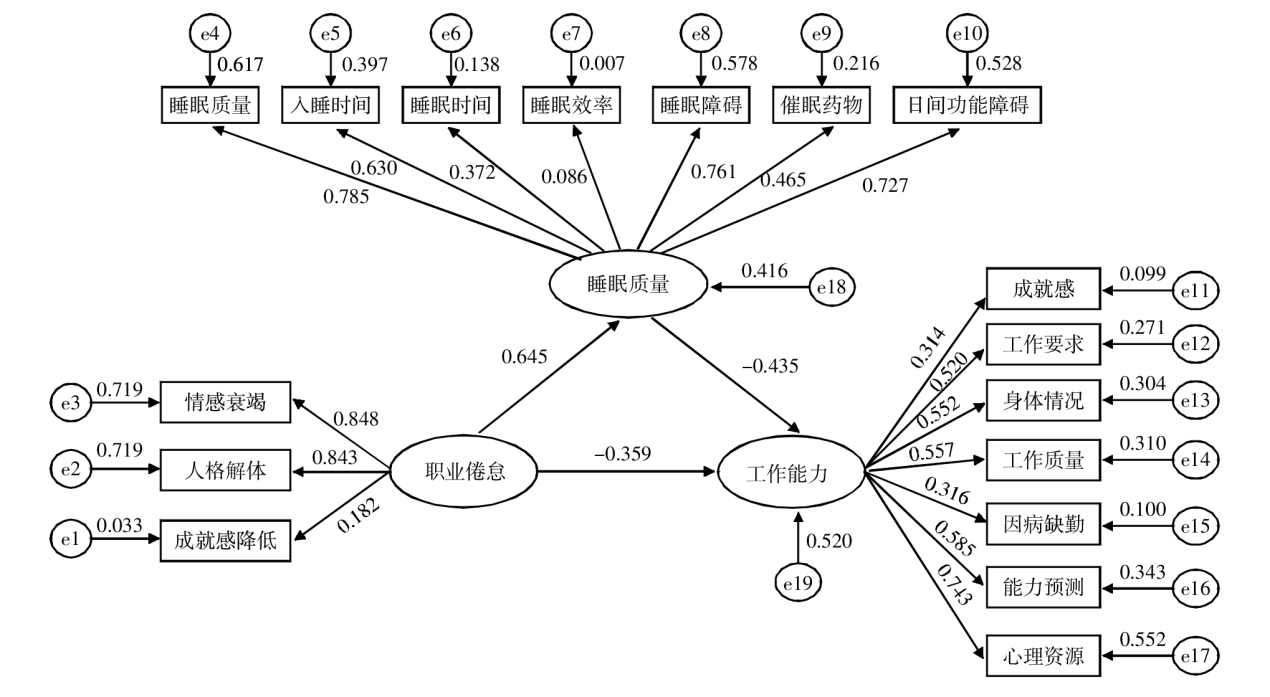
| 职业倦怠→睡眠质量 | 1.609 | 0.262 | 6.152 | <0.01 | 0.645 |
| 睡眠质量→工作能力 | -0.426 | 0.051 | -8.400 | <0.01 | -0.435 |
| 职业倦怠→工作能力 | -0.878 | 0.170 | -5.174 | <0.01 | -0.359 |
| 参数 | 非标准化 估计值(β) | sx | CR值 | P | 标准化参考 估计值(β) |
|---|---|---|---|---|---|
| 职业倦怠→睡眠质量 | 1.609 | 0.262 | 6.152 | <0.01 | 0.645 |
| 睡眠质量→工作能力 | -0.426 | 0.051 | -8.400 | <0.01 | -0.435 |
| 职业倦怠→工作能力 | -0.878 | 0.170 | -5.174 | <0.01 | -0.359 |
| [1] |
LI L, WANG X, ZHOU J, et al. Factors associated with chronotype,job burnout,and perceived stress among nurses in Chinese tertiary hospitals:A multicenter cross-sectional study[J]. Chronobiol Int, 2024, 41(7):1058-1067.
DOI URL |
| [2] |
XIA M, WANG J, BI D, et al. Predictors of job burnout among Chinese nurses:A systematic review based on big data analysis[J]. Biotechnol Genet Eng Rev, 2023, 39(2):1163-1186.
DOI URL |
| [3] | LUBBADEH T. Job burnout:A general literature review[J]. Int Rev Manag Mark, 2020, 10(3):7. |
| [4] | 张树勇, 王婷, 常起航, 等. 护士职业倦怠影响因素的研究进展[J]. 职业与健康, 2025, 41(19):2727-2730,2736. |
| [5] |
YU L, ZHOU H, LI J, et al. Shift work sleep disorder in nurses:A concept analysis[J]. BMC Nurs, 2025, 24(1):18.
DOI |
| [6] | HOKMABADI R, MAHDINIA M, HACHESU V R, et al. Investigating relationship between sleep disorders and work ability among workers in construction workshops[J]. J Health Saf Work, 2022, 12(2). |
| [7] |
LABBAFINEJAD Y, GHAFFARI M, BAHADORI B, et al. The effect of sleep disorder on the work ability of workers in a car accessories manufacturing plant[J]. Med J Islam Repub Iran, 2014, 28:111.
PMID |
| [8] | RUNDE F, XINHUAN Z, DEGANG Y. Spatial equity of healthcare resource in Xinjiang[J]. J Univ Chin Acad Sci, 2023, 40(1):69. |
| [9] |
ZHAN L, LI N, LI C, et al. Evaluation method of equalization of basic medical services from the spatial perspective:The case of Xinjiang,China[J]. ISPRS Int J Geo Inf, 2022, 11(12):612.
DOI URL |
| [10] |
WANG M, FANG H, BISHWAJIT G, et al. Evaluation of rural primary health care in western China:A cross-sectional study[J]. Int J Environ Res Public Health, 2015, 12(11):13843-13860.
DOI URL |
| [11] |
LI X, JIANG T, SUN J, et al. The relationship between occupational stress,job burnout and quality of life among surgical nurses in Xinjiang,China[J]. BMC Nurs, 2021, 20(1):181.
DOI |
| [12] | 阿提凯木·尼娅孜, 迪丽热巴·买买提热依木, 刘金宝. 新疆某医院医护人员危机脆弱性、社会支持及应对方式对心理危机的影响[J]. 职业与健康, 2023, 39(21):2959-2964. |
| [13] |
VANDENBROUCKE J P, VON ELM E, ALTMAN D G, et al. Strengthening the reporting of observational studies in epidemiology(strobe):Explanation and elaboration[J]. Int J Surg, 2014, 12(12):1500-1524.
DOI URL |
| [14] | SANDEVA G, KOLEVA K. Work ability and psychological well-being in hospital staff[J]. CBU Int Conference Proceed, 2016, 4(1):750-755. |
| [15] |
MASLACH C, JACKSON S E. The measurement of experienced burnout[J]. J Organ Behav, 1981, 2(2):99-113.
DOI URL |
| [16] |
MASLACH C, SCHAUFELI W B, LEITER M P. Job burnout[J]. Annu Rev Psychol, 2001, 52(1):397-422.
DOI URL |
| [17] | 李超平, 时勘. 分配公平与程序公平对工作倦怠的影响[J]. 心理学报, 2003(5):677-684. |
| [18] | 罗玲霞, 李婧, 吴芳, 等. 基于MBI-GS量表调查急诊科医务人员职业倦怠现状及影响因素[J]. 中南大学学报(医学版), 2024, 49(6):981-988. |
| [19] | 刘贤臣, 唐茂芹, 胡蕾, 等. 匹兹堡睡眠质量指数的信度和效度研究[J]. 中华精神科杂志, 1996, 29(2):103-107. |
| [20] | TUOMI K, ILMARINEN J, ESKELINEN L, et al. Work ability index[EB/OL].(2007-03-01)[2026-02-28]. https://www.researchgate.net/publication/31361019_The_work_ability_index_WAI. |
| [21] | 张磊, 王治明, 王绵珍, 等. 工作能力指数量表的评价研究[J]. 中国工业医学杂志, 2003, 16(1):1-5. |
| [22] | 杨廷忠, 阮哈建, 李甫中. 结构方程模型方法在流行病学研究中的应用[J]. 中华流行病学杂志, 2005, 26(4):297-300. |
| [23] |
WANG Q Q, LV W J, QIAN R L, et al. Job burnout and quality of working life among Chinese nurses:A cross-sectional study[J]. J Nurs Manag, 2019, 27(8):1835-1844.
DOI URL |
| [24] |
YANG G, PAN L Y, FU X L, et al. Burnout and job stress of anesthesiologists in the tertiary class a hospitals in northwest China:A cross-sectional design[J]. Front Med, 2023, 10:1140552.
DOI URL |
| [25] |
LU G, XIAO S, HE J, et al. Prevalence of depression and its correlation with anxiety,headache and sleep disorders among medical staff in the Hainan province of China[J]. Front Public Health, 2023, 11:1122626.
DOI URL |
| [26] |
GUMENYUK V, HOWARD R, ROTH T, et al. Sleep loss,circadian mismatch,and abnormalities in reorienting of attention in night workers with shift work disorder[J]. Sleep, 2014, 37(3):545-556.
DOI URL |
| [27] | 王姣, 张英伟, 王青青, 等. 长沙市三级甲等医院护士工作能力和心理安全感现状及其影响因素[J]. 护理研究, 2016, 30(25):3161-3164. |
| [28] |
HEUEL L, OTTO A K, WOLLESEN B. Physical exercise and ergonomic workplace interventions for nursing personnel-effects on physical and mental health:A systematic review[J]. Ger J Exerc Sport Res, 2024, 54(2):291-324.
DOI |
| [29] |
RAN L, CHEN X, PENG S, et al. Job burnout and turnover intention among Chinese primary healthcare staff:The mediating effect of satisfaction[J]. BMJ Open, 2020, 10(10):e036702.
DOI URL |
| [30] |
PARRILLA M M, KAUTIAINEN R J, KING T Z. Sleep quality and executive function in a diverse sample of healthy young adults[J]. Appl Neuropsychol Adult, 2025, 32(6):1634-1642.
DOI URL |
| [31] |
METLAINE A, SAUVET F, GOMEZ-MERINO D, et al. Sleep and biological parameters in professional burnout:A psychophysiological characterization[J]. PLoS One, 2018, 13(1):e0190607.
DOI URL |
| [32] |
ELFERING A, KOTTWITZ M U, TAMCAN Ö, et al. Impaired sleep predicts onset of low back pain and burnout symptoms:Evidence from a three-wave study[J]. Psychol Health Med, 2018, 23(10):1196-1210.
DOI URL |
| Viewed | ||||||
|
Full text |
|
|||||
|
Abstract |
|
|||||
 津公网安备12010202000831号 津ICP备11005889号-6
