职业与健康 ›› 2026, Vol. 42 ›› Issue (14): 1918-1923.

• 论著—职业卫生与职业相关疾病 • 上一篇    下一篇

北京市某区40例疑似百日咳儿童病例鼻咽拭子靶向高通量测序检测结果分析

刘雨薇1, 姬晓雯2, 王园园1, 李颖1, 彭涛1, 张彦春1()   

  1. 1 北京市顺义区疾病预防控制中心北京 101300
    2 北京迈基诺基因科技股份有限公司北京 101300
  • 收稿日期:2025-03-04 修回日期:2025-07-26 出版日期:2026-07-15 发布日期:2026-07-16
  • 通信作者: 张彦春,E-mail:1120714627@qq.com
  • 作者简介:刘雨薇,女,检验技师,主要从事细菌病原检测工作。
  • 基金资助:
    北京市顺义区级项目(Wsjkfzkyzx-2023-q-01)

Analysis of targeted next-generation sequencing results of nasopharyngeal swabs from 40 children patients of suspected pertussis in a certain district of Beijing

LIU Yuwei1, JI Xiaowen2, WANG Yuanyuan1, LI Ying1, PENG Tao1, ZHANG Yanchun1()   

  1. 1 Beijing Shunyi District Center for Disease Control and PreventionBeijing 101300, China
    2 Beijing Mygenostics Co.LTDBeijing 101300, China
  • Received:2025-03-04 Revised:2025-07-26 Online:2026-07-15 Published:2026-07-16
  • Contact: ZHANG Yanchun,E-mail:1120714627@qq.com

摘要:

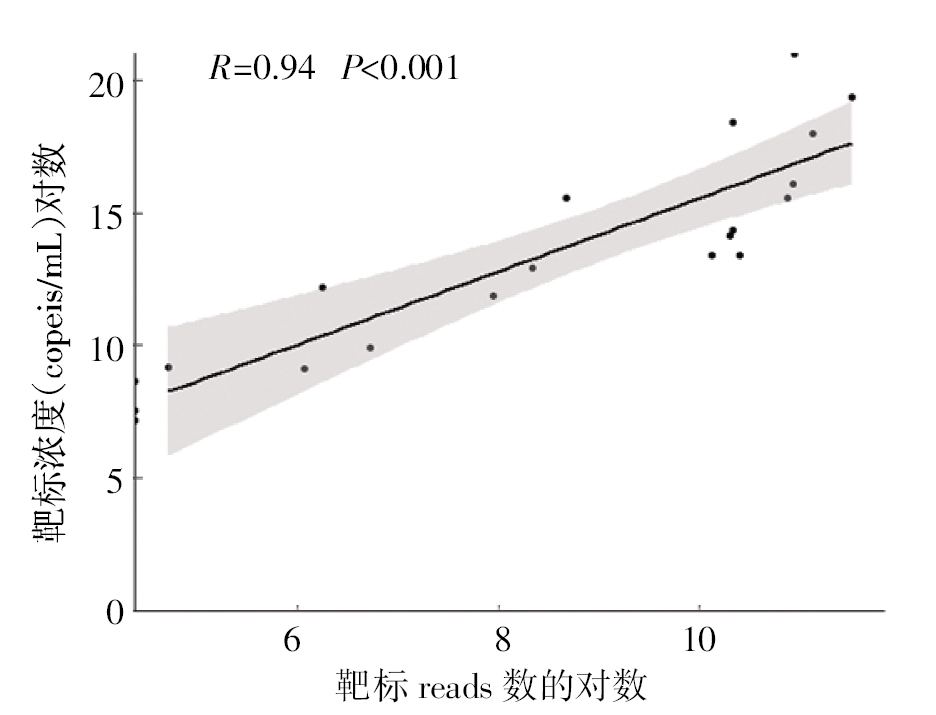
目的 使用靶向高通量测序(targeted next-generation sequencing,tNGS)了解疑似百日咳病例感染呼吸道病原谱。方法 收集2023年9—11月北京市某区疑似百日咳病例鼻咽拭子和血清标本进行百日咳鲍特菌荧光聚合酶链式反应(polymerase chainreaction,PCR)检测、百日咳鲍特菌培养、tNGS检测和百日咳鲍特菌毒素IgG抗体检测,基于tNGS检测结果分析病原谱。结果 共收集40例疑似百日咳病例的鼻咽拭子样本和血清标本,百日咳确诊阳性率为80.00%(32/40),22例可以基于病原学检测(荧光PCR或培养法)确诊,21例可以基于血清学检测确诊。17名病例tNGS检测百日咳鲍特菌靶标为阳性,均为荧光PCR检测阳性病例,单份样本检出病原数量为1~5种,且百日咳鲍特菌靶标数量排在单份样本检测多病原靶标数量的第1位或第2位;88.24%(15/17)病例均检测到2种及以上病原,以流感嗜血杆菌、金黄色葡萄球菌、肺炎链球菌、鼻病毒为优势检出。17名病例荧光PCR获得的靶标浓度和基于tNGS获得的靶标reads数呈正相关。结论 tNGS在百日咳病例病程前期分子定量识别以及呼吸道多病原识别上呈现一定优势,应关注百日咳病例混合感染源。

关键词: 靶向高通量测序, 百日咳, 咳嗽, 培养法, 荧光聚合酶链反应

Abstract:

Objective To investigate the respiratory pathogen spectrum in patients with suspected pertussis using targeted next-generation sequencing(tNGS). Methods Nasopharyngeal swabs and serum samples were collected from children patients with suspected pertussis in a district of Beijing from September to November 2023. Real-time polymerase chainreaction(PCR),bacterial culture of Bordetella pertussis,and tNGS were performed in nasopharyngeal swabs samples,and pertussis toxin IgG was performed in serum samples. The respiratory pathogen spectrum was analyzed based on tNGS results. Results A total of 40 nasopharyngeal swab and 40 serum samples from 40 patients of suspected pertussis were collected. The confirmed positive diagnosis rate of pertussis was 80.00%(32/40). 22 patients could be diagnosed by pathogen-detecting methods(real-time PCR method or B. pertussis culture),while 21 patients could be diagnosed by serological testing methods. 17 patients were positive for B. pertussis targets by tNGS,and all being real-time PCR method positive patients. Pathogens number detected per sample ranged from 1 to 5 by tNGS,with B. pertussis targets ranking first or second in the number of multiple pathogen targets detected per sample. In 88.24%(15/17) of patients,two or more pathogens were detected,with haemophilusinfluenzae,staphylococcus aureus,streptococcus pneumoniae,and rhinovirus being the dominant types of pathogens. There was a positive correlation between the target concentration obtained from real-time PCR in 17 cases and the number of target reads obtained from tNGS. Conclusion NGS shows certain advantages in molecular quantitative identification during the early stages of pertussis patients and in recognizing multiple respiratory pathogens,and attention should be given to the study of mixed infections in pertussis patients.

Key words: Targeted next-generation sequencing, Pertussis, Cough, Culture method, Real-time polymerase chain reaction

中图分类号: