职业与健康 ›› 2026, Vol. 42 ›› Issue (10): 1333-1336.

• 论著 • 上一篇    下一篇

实时荧光定量PCR检测在食源性疾病主动监测中的应用及效果评价

王同瑜, 张鹏航, 刘玉竹, 王超, 张晓媛(), 马晓晨()   

  1. 北京市疾病预防控制中心北京 100013
  • 收稿日期:2025-09-04 修回日期:2025-09-26 出版日期:2026-05-15 发布日期:2026-06-02
  • 通信作者: 张晓媛,马晓晨
  • 作者简介:王同瑜,女,主管医师,主要从事食源性疾病监测工作。
  • 基金资助:
    首都高层次公共卫生人才建设项目(2022-3-027)

Application and evaluation of RT-PCR detection in active surveillance of foodborne diseases

WANG Tongyu, ZHANG Penghang, LIU Yuzhu, WANG Chao, ZHANG Xiaoyuan(), MA Xiaochen()   

  1. Beijing Center for Disease Prevention and ControlBeijing 100013, China
  • Received:2025-09-04 Revised:2025-09-26 Online:2026-05-15 Published:2026-06-02
  • Contact: ZHANG Xiaoyuan,MA Xiaochen
  • About author:MA Xiaochen,E-mail:xiaoch-ma@126.com
    ZHANG Xiaoyuan,E-mail:zhangxiaoai_0922@163.com

摘要:

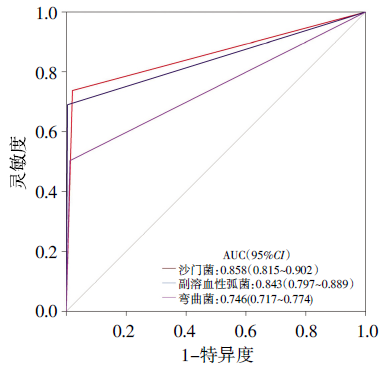
目的 为提高食源性致病菌的快速检测,探索实时荧光定量转录聚合酶链式反应法(real-time fluorescence reverse transcription polymerase chain reaction,RT-PCR)在食源性疾病主动监测中的应用并评价其效果。方法 收集2024年1—12月北京市哨点医院采集的食源性疾病主动监测患者的粪便样本,同时采用传统分离培养法和RT-PCR法检测沙门菌、副溶血性弧菌和弯曲菌,比较3种食源性致病菌RT-PCR法和传统分离培养法的检出阳性率,评价RT-PCR法在食源性致病菌检测中的应用价值。采用χ2检验、Kappa一致性检验和受试者工作特征(receiver operating characteristic,ROC)曲线等统计学方法分析检测结果的差异。结果 RT-PCR法检测沙门菌、副溶血性弧菌和弯曲菌的阳性率分别为4.31%、4.35% 和13.83%,分离培养法检测3种食源性致病菌的阳性率分别为5.13%、3.40%和8.00%,两者差异均有统计学意义(χ2=984.879、1350.890、857.971,均P<0.01)。与分离培养法相比,RT-PCR法检测沙门菌、副溶血性弧菌和弯曲菌的Kappa值分别为0.657、0.766和0.597。RT-PCR法检测沙门菌、副溶血性弧菌和弯曲菌的曲线下面积(AUC值)分别是0.858、0.843和0.746。结论 RT-PCR法检测沙门菌、副溶血性弧菌和弯曲菌的特异度高,真实性高,在食源性疾病主动监测中有应用价值,可将RT-PCR法与分离培养法联合应用,快速、准确的检测食源性致病菌,为食源性疾病事件的快速应对提供技术支撑。

关键词: 沙门菌, 副溶血性弧菌, 弯曲菌, 实时荧光定量转录聚合酶链式反应法, 食源性疾病

Abstract:

Objective To improve the rapid detection of foodborne pathogenic bacteria,the application of real-time fluorescence reverse transcription polymerase chain reaction(RT-PCR) in active surveillance of foodborne diseases was explored and its effect was evaluated. Methods Stool samples were collected from active monitoring diarrhea patients in sentinel hospitals in Beijing from January to December 2024. Salmonella,Vibrio parahaemolyticus and Campylobacter were detected by both traditional culture method and RT-PCR. The detection positive rates of three foodborne pathogenic bacteria were compared between RT-PCR and traditional culture method,and the application value of RT-PCR in foodborne pathogen detection was evaluated. Chi-square test,Kappa consistency test and receiver operating characteristic(ROC) curve were used to analyze the difference between the detection results. Results The positive rates of Salmonella,Vibrio parahaemolyticus and Campylobacter detected by RT-PCR method were 4.31%,4.35% and 13.83%,respectively. The positive rates of three foodborne pathogens detected by culture method were 5.13%,3.40% and 8.00%,respectively,and the differences in positive rates were statistically significant(χ2=984.879,1350.890,857.971,all P<0.01). Compared with the culture method,the Kappa values of Salmonella,Vibrio parahaemolyticus and Campylobacter detected by RT-PCR method were 0.657,0.766 and 0.597,respectively. The area under the curve(AUC) of Salmonella,Vibrio parahaemolyticus and Campylobacter detected by RT-PCR method were 0.858,0.843 and 0.767,respectively. Conclusion The RT-PCR method has high specificity and authenticity in detecting Salmonella,Vibrio parahaemolyticus and Campylobacter,and has practical value in active monitoring of foodborne diseases. The RT-PCR method can be combined with culture methods to detect foodborne pathogens quickly and accurately,and provide technical support for the rapid response to foodborne disease events.

Key words: Salmonella, Vibrio parahaemolyticus, Campylobacter, Real-time fluorescence reverse transcription polymerase chain reaction, Foodborne diseases

中图分类号: