职业与健康 ›› 2026, Vol. 42 ›› Issue (10): 1343-1347.

• 论著 • 上一篇    下一篇

沙棘黄酮对非酒精性脂肪肝小鼠SREBP-1α信号通路的干预作用

郑凯彬, 刘聪, 倪向霖, 伍昊文, 李泽鹏, 罗玥佶()   

  1. 长沙医学院第一临床学院湖南 长沙 410000
  • 收稿日期:2025-07-25 修回日期:2025-08-12 出版日期:2026-05-15 发布日期:2026-06-02
  • 通信作者: 罗玥佶
  • 作者简介:郑凯彬,男,在读本科生。
  • 基金资助:
    长沙医学院大学生创新创业项目(长医教〔2023〕51号-136);湖南省普通高等学校教学改革研究项目(湘教通〔2023〕352号-HNJG-20231270)

Intervention effect of sea buckthorn flavonoids on SREBP-1α signaling pathway in non-alcoholic fatty liver disease mice

ZHENG Kaibin, LIU Cong, NI Xianglin, WU Haowen, LI Zepeng, LUO Yueji()   

  1. The First Clinical College of Changsha Medical UniversityChangshaHunan 410000, China
  • Received:2025-07-25 Revised:2025-08-12 Online:2026-05-15 Published:2026-06-02
  • Contact: LUO Yueji
  • About author:LUO Yueji,E-mail:41741836@qq.com

摘要:

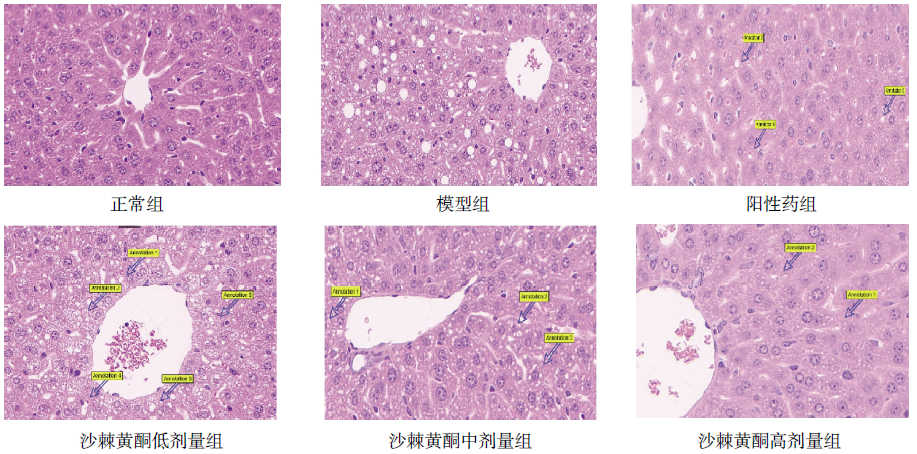
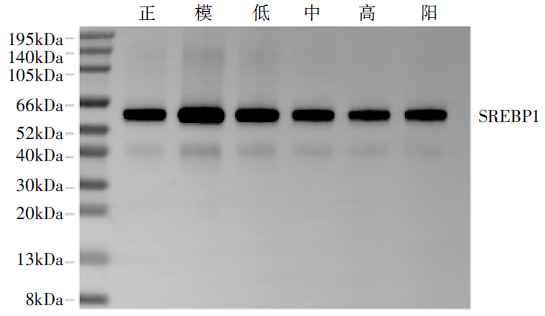
目的 分析沙棘黄酮通过固醇调节元件结合蛋白-1(sterol regulatory element binding protein-1,SREBP-1)信号通路对于非酒精性脂肪肝(non-alcoholic fatty liver disease,NAFLD)模型小鼠的治疗效果及其作用机理,同时证明其安全性和可靠性。方法 60只健康成年雄性昆明小鼠按照简单随机分配分为正常组、模型组、阳性药组、沙棘黄酮低剂量组、沙棘黄酮中剂量组、沙棘黄酮高剂量组。通过给予高脂饲料12周建立非酒精性脂肪肝模型,阳性药组灌胃双环醇,沙棘黄酮低、中、高剂量组分别灌胃沙棘黄酮100、200、300 mg/kg,连续给药5周后检测各组小鼠体质量、血清总胆固醇(total cholesterol,TC)、三酰甘油(triglyceride,TG)、低密度脂蛋白胆固醇(low density lipoprotein cholesterol,LDL-C)、高密度脂蛋白胆固醇(high-density lipoprotein cholesterol,HDL-C),并行肝组织HE染色。Western blot法检测各组小鼠肝组织中固醇调节元件结合蛋白-1基因及蛋白表达情况。结果 HE染色结果可以看出模型组小鼠肝脏切片中有明显肝细胞脂肪性、气球样变性以及炎细胞浸润,而沙棘黄酮低、中、高剂量组小鼠相较于模型组小鼠肝组织脂肪变性、气球样变性和炎细胞浸润均有明显缓解。由血脂指标结果可以看出,与正常组相比[(1.36±0.10)、(0.50±0.13)、(1.54±0.12)和(1.90±0.10)mmol/L],模型组小鼠TC、TG、LDL-C显著升高[(2.03±0.15)、(1.73±0.09)、(1.73±0.12)mmol/L],HDL-C明显减低[(1.50±0.11)mmol/L](均P<0.01),同时与模型组相比,给药组小鼠TC、TG、LDL-C指标有降低趋势,HDL-C指标有升高趋势,其中以沙棘黄酮高剂量组趋势最明显。模型组小鼠SREBP-1蛋白表达量为1.30±0.07,与模型组相比,沙棘黄酮低、中、高剂量组小鼠SREBP-1蛋白表达量分别为1.15±0.07、0.86±0.05、0.48±0.07,给药组小鼠肝组织中SREBP-1基因及蛋白质表达明显下降(均P<0.01)。结论 沙棘黄酮可通过减低SREBP-1信号通路相关基因以及蛋白质表达减轻高脂饮食诱导NAFLD模型小鼠肝脏中脂肪堆积,发挥治疗NAFLD的作用。

关键词: 沙棘黄酮, 非酒精性脂肪肝, 保肝, 胆固醇调节元件结合蛋白, 脂肪变性

Abstract:

Objective To analyze the therapeutic effect and mechanism of sea buckthorn flavonoids on non-alcoholic fatty liver disease(NAFLD) model mice though the sterol regulatory element binding protein-1(SREBP-1) signaling pathway,and demonstrate its safety and reliability. Methods Sixty healthy adult male KM mice were randomly divided into a normal group,a model group,a positive drug group,a low-dose group of sea buckthorn flavonoids,a medium dose group of sea buckthorn flavonoids,and a high-dose group of sea buckthorn flavonoids. A non-alcoholic fatty liver model was established by administering high-fat diet for 12 weeks. The positive drug group was orally administered with bicyclol,while the low,medium,and high dose groups of sea buckthorn flavonoids were orally administered with 100,200 and 300 mg/kg of sea buckthorn flavonoids,respectively. After continuous administration for 5 weeks,the body mass,serum total cholesterol(TC),triglycerides(TG),low-density lipoprotein cholesterol(LDL-C),and high-density lipoprotein cholesterol(HDL-C) of each group of mice were measured,and liver tissue HE staining was performed. The Western blot method was used to detect the gene and protein expression of sterol regulatory element binding protein-1 in the liver tissues of mice in each group. Results The HE staining results showed significant hepatic steatosis,ballooning degeneration,and inflammatory cell infiltration in the liver slices of the model group. However,compared with the model group,the hepatic steatosis,ballooning degeneration,and inflammatory cell infiltration in the low,medium,and high dose groups of sea buckthorn flavonoids were significantly alleviated. From the results of blood lipid indicators,it can be seen that compared with the normal group[(1.36±0.10),(0.50±0.13),(1.54±0.12),(1.90±0.10)mmol/L],the TC,TG,and LDL-C levels in the model group were significantly increased[(2.03±0.15),(1.73±0.09),(1.73±0.12)mmol/L],while HDL-C levels were significantly reduced[(1.50±0.11)mmol/L](all P<0.01).At the same time,compared with the model group,the TC,TG,and LDL-C indicators of the groups of sea buckthorn flavonoids showed a decreasing trend,while the HDL-C indicators showed an increasing trend,with the high-dose group of sea buckthorn flavonoids showing the most significant trend. The expression level of SREBP-1 protein in the model group mice was 1.30±0.07. Compared with the model group,the expression levels of SREBP-1 protein in the low,medium,and high dose groups of sea buckthorn flavonoids were 1.15±0.07,0.86±0.05 and 0.48±0.07,respectively. The expression of SREBP-1 gene and protein in the liver tissue in mice of the groups of sea buckthorn flavonoids were significantly decreased(all P<0.01). Conclusion Sea buckthorn flavonoids can alleviate fat accumulation in the liver of high-fat diet induced NAFLD model mice by reducing the expression of SREBP-1 signaling pathway related genes and proteins,and play a role in treating NAFLD.

Key words: Sea buckthorn flavonoids, Non-alcoholic fatty liver disease, Liver protection, Cholesterol regulatory element binding protein, Fatty degeneration

中图分类号: