职业与健康 ›› 2026, Vol. 42 ›› Issue (17): 2399-2404.

• 论著——环境与健康 • 上一篇    下一篇

天津市各级疾控中心水质检测能力调查

赵亮, 张可欣, 张磊(), 符刚, 胡海娟, 崔玉山   

  1. 天津市疾病预防控制中心天津 300011
  • 收稿日期:2026-01-09 修回日期:2026-03-16 出版日期:2026-09-01 发布日期:2026-08-14
  • 通信作者: 张磊 E-mail:yisheng375@sohu.com
  • 作者简介:赵亮,男,副主任医师,主要从事环境与健康研究工作。
  • 基金资助:
    天津市医学重点建设学科(TJYXZDXK-3-020B);天津市卫生健康科技项目(TJWJ2023MS041)

Investigation of water quality detection capability of various centers for disease control and prevention in Tianjin

ZHAO Liang, ZHANG Kexin, ZHANG Lei(), FU Gang, HU Haijuan, CUI Yushan   

  1. Tianjin Centers for Disease Control and PreventionTianjin 300011, China
  • Received:2026-01-09 Revised:2026-03-16 Online:2026-09-01 Published:2026-08-14
  • Contact: ZHANG Lei E-mail:yisheng375@sohu.com

摘要:

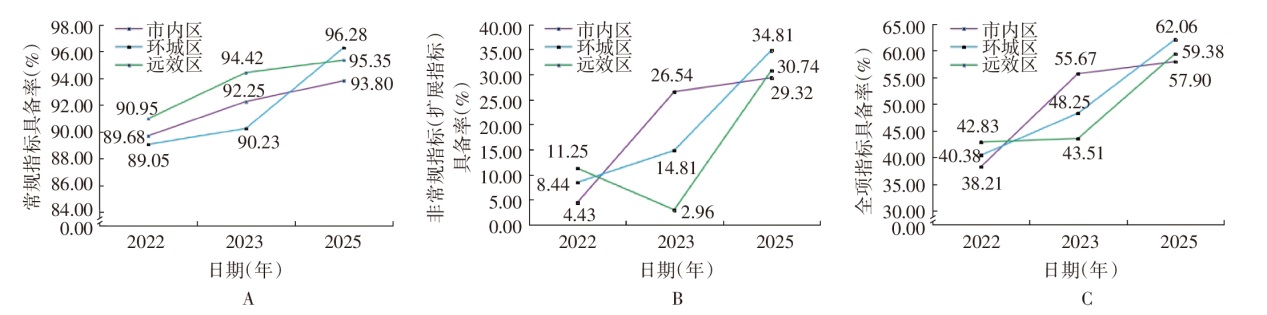
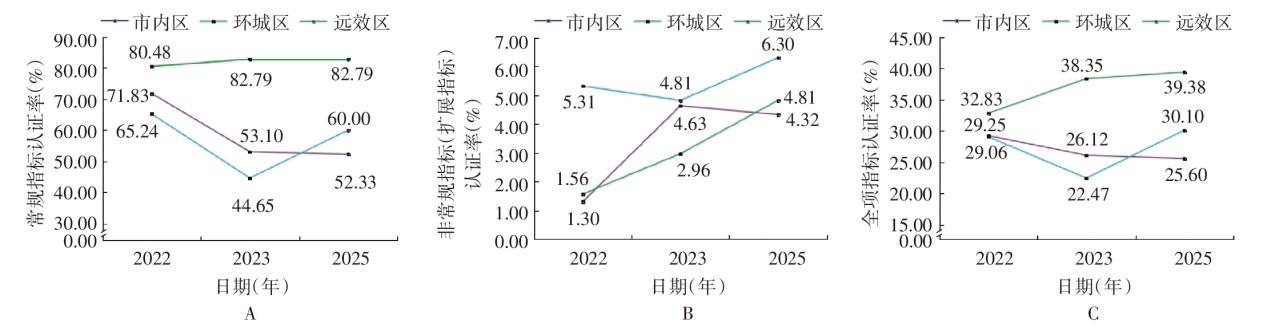
目的 了解天津市各级疾病预防控制中心(疾控)水质检测能力状况,发现新旧国标交替中存在的问题,为水质检测能力建设提供参考。方法 于2022、2023和2025年采用自行设计的调查表对天津市具备水质检测能力的17家疾控中心(省级1家,区级16家)开展调查,并对数据进行分析。结果 省级疾控中心具备全部指标的检测能力和计量认证。区级疾控中心,分为市内区(6家)、环城区(5家)和远郊区(5家)进行分组分析,2022—2025年,3组常规指标检测能力MP25P75)分别由38(36,39)、38(35,39)和38(35,39)项升至41(38,41)、41(41,42)和41(39,42)项;非常规(扩展)指标检测能力MP25P75)分别由1(1,4)、2(1,11)和1(1,16)项升至10(6,31)、19(10,27)和15(8,26)项;全项指标检测能力MP25P75)分别由40(38,43)、40(36,50)和40(39,54)项升至50(45,72)、62(51,68)和57(48,67)项。2023年3组间扩展指标检测能力差异有统计学意义(P<0.05)。同1组不同年份间,市内区非常规(扩展)和全项指标具备率、环城区常规与非常规(扩展)和全项指标具备率、远郊区非常规(扩展)和全项指标具备率差异均有统计学意义(均P<0.05),其他差异均无统计学意义(均P>0.05);计量认证差异均无统计学意义(均P>0.05)。不具备检测能力原因主要为无设备、无检测人员、无标准品和无试剂。结论 天津市各区疾控中心水质检测能力发展较均衡,2022—2025年间有较大提升,能够满足生活饮用水卫生监测的工作要求,但能力储备和能力发展较弱,开展计量认证的比例也较低。应通过保障资金投入、进行设备更新和开展技术培训等方式,确保常规指标和反映本地区水质状况的特征指标检测能力,逐步拓展扩展指标和新型污染物等指标检测能力,加强水质检测能力建设。

关键词: 生活饮用水, 检测能力, 常规指标, 非常规指标, 扩展指标, 疾病预防控制中心

Abstract:

Objective To understand the status of water quality detection ability of centers for disease control and prevention(CDCs) at all levels in Tianjin,identify existing issues during the transition between the old and new national standards,and provide references for the enhancement of water quality detection ability. Methods A self-designed questionnaires were used to investigate the water quality detection ability of 17 CDCs in 2022,2023,and 2025,including 1 at the province level and 16 at the district level,and the data were analyzed. Results The provincial CDC maintained full analytical capability for all target parameters and holded valid China Metrology Accreditation(CMA). District-level CDCs were categorized into three groups for analysis:urban districts(6),suburban districts(5),and outer suburban districts(5). From 2022 to 2025,the MP25P75) values of regular indices detection capabilities for the three groups(urban districts,suburban districts,and outer suburban districts) increased from 38(36,39),38(35,39),and 38(35,39) to 41(38,41),41(41,42),and 41(39,42) items,respectively;The non-regular (expanded) indices detection capabilities increased from 1(1,4),2(1,11),and 1(1,16) to 10(6,31),19(10,27),and 15(8,26) items,respectively;And the full indices detection capabilities increased from 40(38,43),40(36,50),and 40(39,54) to 50(45, 72),62(51,68),and 57(48,67) items,respectively. For comparisons between groups within the same year,only the expanded indices detection capabilities in 2023 showed a statistically significant difference among the three groups(P<0.05). For comparisons within the same group across different years,statistically significant differences were found in the availability rates of non-regular(expanded) and full indices for the urban districts group,in the availability rates of regular,non-regular(expanded) and full indices for the suburban districts group,and in the availability rates of non-regular(extended) and full indices for the outer suburban districts group(all P<0.05),while other differences were not statistically significant(all P>0.05). There were not statistically significant differences in CMA(all P>0.05). Four reasons for lack of detection ability were lack of equipment,lack of testing personnel,lack of standard products,and lack of reagents. Conclusion The development of water quality detection ability across various indices in Tianjin is relatively balanced. There was a significant improvement between 2022 and 2025,with current capabilities meeting the operational requirements for sanitary monitoring of drinking water. However,the capacity reserve and development of capabilities are weaker,and the proportion of CMA is also lower. It is recommended to secure funding support,undertake equipment renewal,and conduct technical training to ensure water quality detection ability for both regular indices and characteristic indices reflecting local water quality conditions. Efforts should also be made to progressively expand water quality detection ability for expanded indices and emerging contaminants,thereby strengthening the overall construction of water quality detection ability.

Key words: Drinking water, Detection capability, Regular indices, Non-regular indices, Expanded indices, Centers for disease control and prevention

中图分类号: