


职业与健康 ›› 2026, Vol. 42 ›› Issue (18): 2460-2466.
杨洁, 张晋蔚, 张玉侠, 赵远, 王致, 周海林( )
)
收稿日期:2025-10-21
修回日期:2026-02-11
出版日期:2026-09-15
发布日期:2026-08-28
通信作者:
周海林
作者简介:周海林,E-mail:zhouhl1998@163.com基金资助:
YANG Jie, ZHANG Jinwei, ZHANG Yuxia, ZHAO Yuan, WANG Zhi, ZHOU Hailin()
Received:2025-10-21
Revised:2026-02-11
Online:2026-09-15
Published:2026-08-28
Contact:
ZHOU Hailin
摘要:
目的 应用机器学习分析广州市汽车制造业工人焦虑情绪及其可能的影响因素,为改善汽车制造业工人身心健康状况,促进制造业可持续发展提供数据参考。方法 采用简单随机抽样方法,于2022年8月—2023年9月,在广州市汽车制造业领域内抽取8家单位的873名一线劳动者进行问卷调查。将受访者按7∶3的比例随机分为训练组(n=611)和验证组(n=262),应用单因素Logistic回归、Boruta回归、Lasso回归和随机森林递归特征消除(recursive feature elimination,RFE)进行特征筛选。建立6种机器学习模型,通过受试者工作特征(receiver operating characteristic,ROC)曲线下面积(area under curve,AUC)、校准曲线、决策曲线(decisioncurve analysis,DCA)对不同模型的性能进行比较,通过Shapley加性解释(shapley additive explanation,SHAP)算法对影响焦虑情绪的因素进行评估。结果 广州市汽车制造业873名一线劳动者中有284人(32.5%)存在焦虑情绪,进行特征指标筛选出性别、婚姻状况、入职岗位时间、单位性质、健康法律知识水平、健康工作方式和行为水平、职业紧张状况、睡眠状况8个特征变量纳入6种机器学习模型构建预测模型,其中LightGBM模型的 AUC 最高,为0.705,其他5个AUC由高至低为0.683、0.667、0.634、0.630和0.601,DCA 曲线中 LightGBM 模型的临床决策净获益也更大、预测效能最佳。SHAP 算法分析得出,存在睡眠障碍、存在职业紧张、单位性质为外资企业、入职岗位时间较长会增加产生焦虑的风险,高水平的健康法律知识及高水平健康工作方式和行为会降低焦虑情绪风险。结论 广州市汽车制造业工人焦虑情绪值得关注,企业可通过合理安排员工岗位和工间休息时间、改善工作环境、加强职业健康教育来降低其焦虑情绪风险,还可应用LightGBM模型协助识别其产生焦虑的危险因素,并开展早期干预。
中图分类号:
杨洁, 张晋蔚, 张玉侠, 赵远, 王致, 周海林. 873名汽车制造业工人焦虑情绪及影响因素分析. [J]职业与健康, 2026, 42(18): 2460-2466.
YANG Jie, ZHANG Jinwei, ZHANG Yuxia, ZHAO Yuan, WANG Zhi, ZHOU Hailin. Analysis of anxiety status and influencing factors among 873 automobile manufacturing workers. [J]OCCUPATION AND HEALTH, 2026, 42(18): 2460-2466.
| 项目 | 调查人数 | 焦虑组 | 无焦虑组 | χ2值 | P值 | 训练组 | 验证组 | χ2值 | P值 |
|---|---|---|---|---|---|---|---|---|---|
| 性别 | 3.244 | 0.072 | 0.210 | 0.647 | |||||
| 男 | 716(82.02) | 473(80.31) | 243(85.56) | 504(82.49) | 212(80.92) | ||||
| 女 | 157(17.98) | 116(19.69) | 41(14.44) | 107(17.51) | 50(19.08) | ||||
| 年龄(岁) | 7.449 | 0.059 | 2.098 | 0.552 | |||||
| 16~<30 | 322(36.88) | 230(39.05) | 92(32.39) | 228(37.32) | 94(35.88) | ||||
| 30~<40 | 370(42.38) | 231(39.22) | 139(48.94) | 264(43.21) | 106(40.46) | ||||
| 40~<50 | 154(17.64) | 109(18.51) | 45(15.85) | 102(16.69) | 52(19.85) | ||||
| ≥50 | 27(3.09) | 19(3.23) | 8(2.82) | 17(2.78) | 10(3.82) | ||||
| 婚姻状况 | 1.260 | 0.262 | 0.093 | 0.760 | |||||
| 已婚 | 485(55.56) | 319(54.16) | 166(58.45) | 342(55.97) | 143(54.58) | ||||
| 其他 | 388(44.44) | 270(45.84) | 118(41.55) | 269(44.03) | 119(45.42) | ||||
| 文化程度 | 1.252 | 0.263 | 1.494 | 0.222 | |||||
| 高中或以下 | 535(61.28) | 369(62.65) | 166(58.45) | 383(62.68) | 152(58.02) | ||||
| 大专或以上 | 338(38.72) | 220(37.35) | 118(41.55) | 228(37.32) | 110(41.98) | ||||
| 平均月收入(元) | 3.422 | 0.181 | 6.379 | 0.041 | |||||
| 0~<5 000 | 454(52.00) | 305(51.78) | 149(52.46) | 315(51.55) | 139(53.05) | ||||
| 5 000~<9 000 | 341(39.06) | 238(40.41) | 103(36.27) | 250(40.92) | 91(34.73) | ||||
| ≥9 000 | 78(8.93) | 46(7.81) | 32(11.27) | 46(7.53) | 32(12.21) | ||||
| 户口性质 | 2.866 | 0.413 | 2.538 | 0.468 | |||||
| 非农业户口 | 185(21.19) | 124(21.05) | 61(21.48) | 134(21.93) | 51(19.47) | ||||
| 农业户口 | 583(66.78) | 395(67.06) | 188(66.20) | 410(67.10) | 173(66.03) | ||||
| 现登记为居民户口,之前为 非农业户口 | 48(5.50) | 28(4.75) | 20(7.04) | 30(4.91) | 18(6.87) | ||||
| 现登记为居民户口,之前为 农业户口 | 57(6.53) | 42(7.13) | 15(5.28) | 37(6.06) | 20(7.63) | ||||
| 单位性质 | 19.078 | <0.001 | 3.072 | 0.381 | |||||
| 国有 | 125(14.32) | 82(13.92) | 43(15.14) | 82(13.42) | 43(16.41) | ||||
| 民营 | 234(26.80) | 184(31.24) | 50(17.61) | 160(26.19) | 74(28.24) | ||||
| 外资 | 469(53.72) | 297(50.42) | 172(60.56) | 334(54.66) | 135(51.53) | ||||
| 其他 | 45(5.15) | 26(4.41) | 19(6.69) | 35(5.73) | 10(3.82) | ||||
| 单位规模 | 8.258 | 0.016 | 0.272 | 0.873 | |||||
| 小型企业 | 55(6.30) | 41(6.96) | 14(4.93) | 39(6.38) | 16(6.11) | ||||
| 中型企业 | 709(81.21) | 463(78.61) | 246(86.62) | 498(81.51) | 211(80.53) | ||||
| 大型企业 | 109(12.49) | 85(14.43) | 24(8.45) | 74(12.11) | 35(13.36) | ||||
| 入职本岗位时间(年) | 3.298 | 0.348 | 3.383 | 0.336 | |||||
| 0~<5 | 557(63.80) | 380(64.52) | 177(62.32) | 378(61.87) | 179(68.32) | ||||
| 6~<11 | 156(17.87) | 110(18.68) | 46(16.20) | 114(18.66) | 42(16.03) | ||||
| 11~<16 | 116(13.29) | 73(12.39) | 43(15.14) | 86(14.08) | 30(11.45) | ||||
| ≥16 | 44(5.04) | 26(4.41) | 18(6.34) | 33(5.40) | 11(4.20) | ||||
| 平均每周工作时间(h) | 0.599 | 0.741 | 1.782 | 0.410 | |||||
| 0~<41 | 323(37.00) | 214(36.33) | 109(38.38) | 232(37.97) | 91(34.73) | ||||
| 41~<49 | 279(31.96) | 193(32.77) | 86(30.28) | 187(30.61) | 92(35.11) | ||||
| ≥49 | 271(31.04) | 182(30.90) | 89(31.34) | 192(31.42) | 79(30.15) | ||||
| 工作是否需要上夜班 | 2.407 | 0.121 | 1.054 | 0.305 | |||||
| 是 | 428(49.03) | 300(50.93) | 128(45.07) | 307(50.25) | 121(46.18) | ||||
| 否 | 445(50.97) | 289(49.07) | 156(54.93) | 304(49.75) | 141(53.82) | ||||
| 健康法律知识水平 | 13.380 | 0.004 | 4.130 | 0.248 | |||||
| 低水平 | 34(3.89) | 18(3.06) | 16(5.63) | 26(4.26) | 8(3.05) | ||||
| 中水平 | 200(22.91) | 120(20.37) | 80(28.17) | 141(23.08) | 59(22.52) | ||||
| 中高水平 | 375(42.96) | 256(43.46) | 119(41.90) | 271(44.35) | 104(39.69) | ||||
| 高水平 | 264(30.24) | 195(33.11) | 69(24.30) | 173(28.31) | 91(34.73) | ||||
| 健康保护基本知识水平 | 3.089 | 0.378 | 4.009 | 0.260 | |||||
| 低水平 | 35(4.01) | 20(3.40) | 15(5.28) | 26(4.26) | 9(3.44) | ||||
| 中水平 | 92(10.54) | 65(11.04) | 27(9.51) | 57(9.33) | 35(13.36) | ||||
| 中高水平 | 256(29.32) | 167(28.35) | 89(31.34) | 186(30.44) | 70(26.72) | ||||
| 高水平 | 490(56.13) | 337(57.22) | 153(53.87) | 342(55.97) | 148(56.49) | ||||
| 健康保护基本技能水平 | 3.972 | 0.264 | 4.136 | 0.247 | |||||
| 低水平 | 62(7.10) | 35(5.94) | 27(9.51) | 47(7.69) | 15(5.73) | ||||
| 中水平 | 201(23.02) | 139(23.60) | 62(21.83) | 135(22.09) | 66(25.19) | ||||
| 中高水平 | 352(40.32) | 242(41.09) | 110(38.73) | 239(39.12) | 113(43.13) | ||||
| 高水平 | 258(29.55) | 173(29.37) | 85(29.93) | 190(31.10) | 68(25.95) | ||||
| 健康工作方式和行为水平 | 18.244 | <0.001 | 4.398 | 0.222 | |||||
| 低水平 | 22(2.52) | 9(1.53) | 13(4.58) | 12(1.96) | 10(3.82) | ||||
| 中水平 | 117(13.40) | 65(11.04) | 52(18.31) | 87(14.24) | 30(11.45) | ||||
| 中高水平 | 309(35.40) | 210(35.65) | 99(34.86) | 210(34.37) | 99(37.79) | ||||
| 高水平 | 425(48.68) | 305(51.78) | 120(42.25) | 302(49.43) | 123(46.95) | ||||
| 职业紧张状况 | 34.709 | <0.001 | 2.491 | 0.115 | |||||
| 无职业紧张 | 547(62.66) | 409(69.44) | 138(48.59) | 372(60.88) | 175(66.79) | ||||
| 有职业紧张 | 326(37.34) | 180(30.56) | 146(51.41) | 239(39.12) | 87(33.21) | ||||
| 睡眠状况 | 57.506 | <0.001 | 0.013 | 0.910 | |||||
| 无睡眠障碍 | 647(74.11) | 483(82.00) | 164(57.75) | 454(74.30) | 193(73.66) | ||||
| 有睡眠障碍 | 226(25.89) | 106(18.00) | 120(42.25) | 157(25.70) | 69(26.34) |
表1 2022—2023年广州市8家汽车制造企业一线工人焦虑情况[例(%)]
| 项目 | 调查人数 | 焦虑组 | 无焦虑组 | χ2值 | P值 | 训练组 | 验证组 | χ2值 | P值 |
|---|---|---|---|---|---|---|---|---|---|
| 性别 | 3.244 | 0.072 | 0.210 | 0.647 | |||||
| 男 | 716(82.02) | 473(80.31) | 243(85.56) | 504(82.49) | 212(80.92) | ||||
| 女 | 157(17.98) | 116(19.69) | 41(14.44) | 107(17.51) | 50(19.08) | ||||
| 年龄(岁) | 7.449 | 0.059 | 2.098 | 0.552 | |||||
| 16~<30 | 322(36.88) | 230(39.05) | 92(32.39) | 228(37.32) | 94(35.88) | ||||
| 30~<40 | 370(42.38) | 231(39.22) | 139(48.94) | 264(43.21) | 106(40.46) | ||||
| 40~<50 | 154(17.64) | 109(18.51) | 45(15.85) | 102(16.69) | 52(19.85) | ||||
| ≥50 | 27(3.09) | 19(3.23) | 8(2.82) | 17(2.78) | 10(3.82) | ||||
| 婚姻状况 | 1.260 | 0.262 | 0.093 | 0.760 | |||||
| 已婚 | 485(55.56) | 319(54.16) | 166(58.45) | 342(55.97) | 143(54.58) | ||||
| 其他 | 388(44.44) | 270(45.84) | 118(41.55) | 269(44.03) | 119(45.42) | ||||
| 文化程度 | 1.252 | 0.263 | 1.494 | 0.222 | |||||
| 高中或以下 | 535(61.28) | 369(62.65) | 166(58.45) | 383(62.68) | 152(58.02) | ||||
| 大专或以上 | 338(38.72) | 220(37.35) | 118(41.55) | 228(37.32) | 110(41.98) | ||||
| 平均月收入(元) | 3.422 | 0.181 | 6.379 | 0.041 | |||||
| 0~<5 000 | 454(52.00) | 305(51.78) | 149(52.46) | 315(51.55) | 139(53.05) | ||||
| 5 000~<9 000 | 341(39.06) | 238(40.41) | 103(36.27) | 250(40.92) | 91(34.73) | ||||
| ≥9 000 | 78(8.93) | 46(7.81) | 32(11.27) | 46(7.53) | 32(12.21) | ||||
| 户口性质 | 2.866 | 0.413 | 2.538 | 0.468 | |||||
| 非农业户口 | 185(21.19) | 124(21.05) | 61(21.48) | 134(21.93) | 51(19.47) | ||||
| 农业户口 | 583(66.78) | 395(67.06) | 188(66.20) | 410(67.10) | 173(66.03) | ||||
| 现登记为居民户口,之前为 非农业户口 | 48(5.50) | 28(4.75) | 20(7.04) | 30(4.91) | 18(6.87) | ||||
| 现登记为居民户口,之前为 农业户口 | 57(6.53) | 42(7.13) | 15(5.28) | 37(6.06) | 20(7.63) | ||||
| 单位性质 | 19.078 | <0.001 | 3.072 | 0.381 | |||||
| 国有 | 125(14.32) | 82(13.92) | 43(15.14) | 82(13.42) | 43(16.41) | ||||
| 民营 | 234(26.80) | 184(31.24) | 50(17.61) | 160(26.19) | 74(28.24) | ||||
| 外资 | 469(53.72) | 297(50.42) | 172(60.56) | 334(54.66) | 135(51.53) | ||||
| 其他 | 45(5.15) | 26(4.41) | 19(6.69) | 35(5.73) | 10(3.82) | ||||
| 单位规模 | 8.258 | 0.016 | 0.272 | 0.873 | |||||
| 小型企业 | 55(6.30) | 41(6.96) | 14(4.93) | 39(6.38) | 16(6.11) | ||||
| 中型企业 | 709(81.21) | 463(78.61) | 246(86.62) | 498(81.51) | 211(80.53) | ||||
| 大型企业 | 109(12.49) | 85(14.43) | 24(8.45) | 74(12.11) | 35(13.36) | ||||
| 入职本岗位时间(年) | 3.298 | 0.348 | 3.383 | 0.336 | |||||
| 0~<5 | 557(63.80) | 380(64.52) | 177(62.32) | 378(61.87) | 179(68.32) | ||||
| 6~<11 | 156(17.87) | 110(18.68) | 46(16.20) | 114(18.66) | 42(16.03) | ||||
| 11~<16 | 116(13.29) | 73(12.39) | 43(15.14) | 86(14.08) | 30(11.45) | ||||
| ≥16 | 44(5.04) | 26(4.41) | 18(6.34) | 33(5.40) | 11(4.20) | ||||
| 平均每周工作时间(h) | 0.599 | 0.741 | 1.782 | 0.410 | |||||
| 0~<41 | 323(37.00) | 214(36.33) | 109(38.38) | 232(37.97) | 91(34.73) | ||||
| 41~<49 | 279(31.96) | 193(32.77) | 86(30.28) | 187(30.61) | 92(35.11) | ||||
| ≥49 | 271(31.04) | 182(30.90) | 89(31.34) | 192(31.42) | 79(30.15) | ||||
| 工作是否需要上夜班 | 2.407 | 0.121 | 1.054 | 0.305 | |||||
| 是 | 428(49.03) | 300(50.93) | 128(45.07) | 307(50.25) | 121(46.18) | ||||
| 否 | 445(50.97) | 289(49.07) | 156(54.93) | 304(49.75) | 141(53.82) | ||||
| 健康法律知识水平 | 13.380 | 0.004 | 4.130 | 0.248 | |||||
| 低水平 | 34(3.89) | 18(3.06) | 16(5.63) | 26(4.26) | 8(3.05) | ||||
| 中水平 | 200(22.91) | 120(20.37) | 80(28.17) | 141(23.08) | 59(22.52) | ||||
| 中高水平 | 375(42.96) | 256(43.46) | 119(41.90) | 271(44.35) | 104(39.69) | ||||
| 高水平 | 264(30.24) | 195(33.11) | 69(24.30) | 173(28.31) | 91(34.73) | ||||
| 健康保护基本知识水平 | 3.089 | 0.378 | 4.009 | 0.260 | |||||
| 低水平 | 35(4.01) | 20(3.40) | 15(5.28) | 26(4.26) | 9(3.44) | ||||
| 中水平 | 92(10.54) | 65(11.04) | 27(9.51) | 57(9.33) | 35(13.36) | ||||
| 中高水平 | 256(29.32) | 167(28.35) | 89(31.34) | 186(30.44) | 70(26.72) | ||||
| 高水平 | 490(56.13) | 337(57.22) | 153(53.87) | 342(55.97) | 148(56.49) | ||||
| 健康保护基本技能水平 | 3.972 | 0.264 | 4.136 | 0.247 | |||||
| 低水平 | 62(7.10) | 35(5.94) | 27(9.51) | 47(7.69) | 15(5.73) | ||||
| 中水平 | 201(23.02) | 139(23.60) | 62(21.83) | 135(22.09) | 66(25.19) | ||||
| 中高水平 | 352(40.32) | 242(41.09) | 110(38.73) | 239(39.12) | 113(43.13) | ||||
| 高水平 | 258(29.55) | 173(29.37) | 85(29.93) | 190(31.10) | 68(25.95) | ||||
| 健康工作方式和行为水平 | 18.244 | <0.001 | 4.398 | 0.222 | |||||
| 低水平 | 22(2.52) | 9(1.53) | 13(4.58) | 12(1.96) | 10(3.82) | ||||
| 中水平 | 117(13.40) | 65(11.04) | 52(18.31) | 87(14.24) | 30(11.45) | ||||
| 中高水平 | 309(35.40) | 210(35.65) | 99(34.86) | 210(34.37) | 99(37.79) | ||||
| 高水平 | 425(48.68) | 305(51.78) | 120(42.25) | 302(49.43) | 123(46.95) | ||||
| 职业紧张状况 | 34.709 | <0.001 | 2.491 | 0.115 | |||||
| 无职业紧张 | 547(62.66) | 409(69.44) | 138(48.59) | 372(60.88) | 175(66.79) | ||||
| 有职业紧张 | 326(37.34) | 180(30.56) | 146(51.41) | 239(39.12) | 87(33.21) | ||||
| 睡眠状况 | 57.506 | <0.001 | 0.013 | 0.910 | |||||
| 无睡眠障碍 | 647(74.11) | 483(82.00) | 164(57.75) | 454(74.30) | 193(73.66) | ||||
| 有睡眠障碍 | 226(25.89) | 106(18.00) | 120(42.25) | 157(25.70) | 69(26.34) |
| 单因素Logistic回归 | Boruta回归 | Lasso回归 | RFE |
|---|---|---|---|
| 睡眠状况 | 睡眠状况 | 睡眠状况 | 睡眠状况 |
| 健康工作方式和 行为水平 | 健康工作方式 和行为水平 | 健康工作方式 和行为水平 | 健康工作方式 和行为水平 |
| 职业紧张状况 | 职业紧张状况 | 职业紧张状况 | 职业紧张状况 |
| 入职岗位时间 | 入职岗位时间 | 入职岗位时间 | |
| 单位性质 | 单位性质 | 单位性质 | |
| 性别 | 性别 | ||
| 婚姻状况 | 婚姻状况 | ||
| 健康法律知识水平 |
表2 特征指标筛选结果
| 单因素Logistic回归 | Boruta回归 | Lasso回归 | RFE |
|---|---|---|---|
| 睡眠状况 | 睡眠状况 | 睡眠状况 | 睡眠状况 |
| 健康工作方式和 行为水平 | 健康工作方式 和行为水平 | 健康工作方式 和行为水平 | 健康工作方式 和行为水平 |
| 职业紧张状况 | 职业紧张状况 | 职业紧张状况 | 职业紧张状况 |
| 入职岗位时间 | 入职岗位时间 | 入职岗位时间 | |
| 单位性质 | 单位性质 | 单位性质 | |
| 性别 | 性别 | ||
| 婚姻状况 | 婚姻状况 | ||
| 健康法律知识水平 |
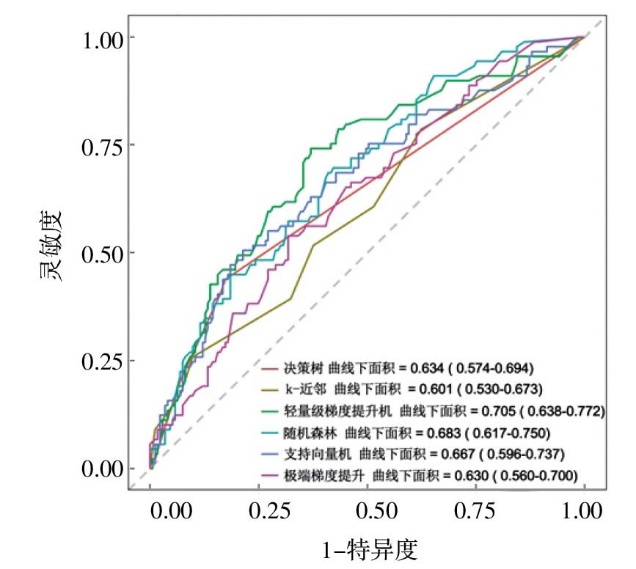
图1 6种模型在验证组的ROC曲线
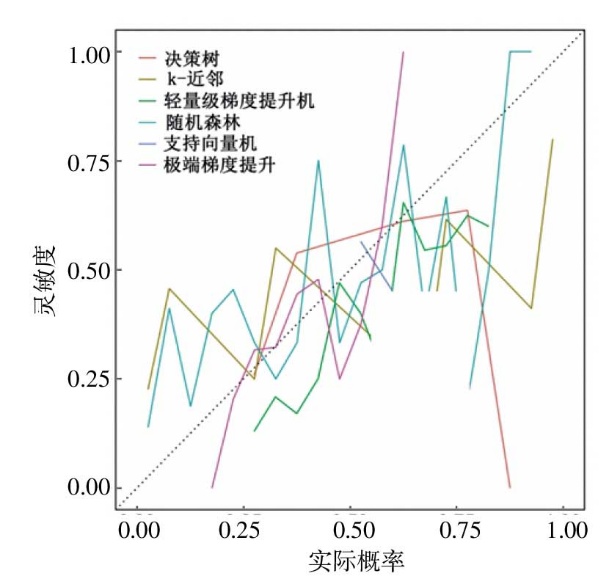
图2 6种模型在验证组的校准曲线
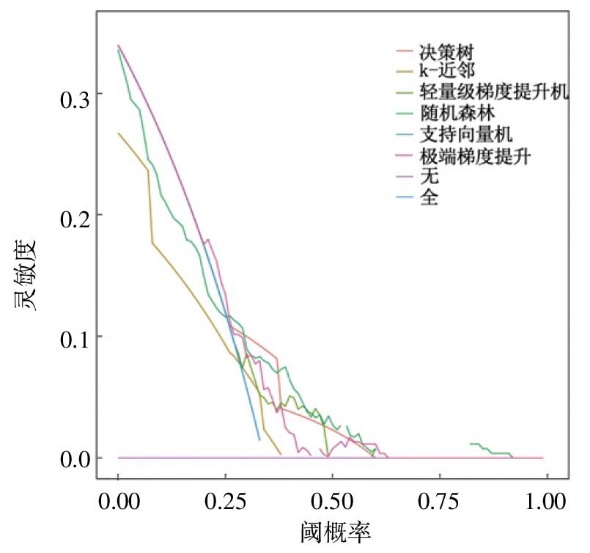
图3 6种模型在验证组的决策曲线
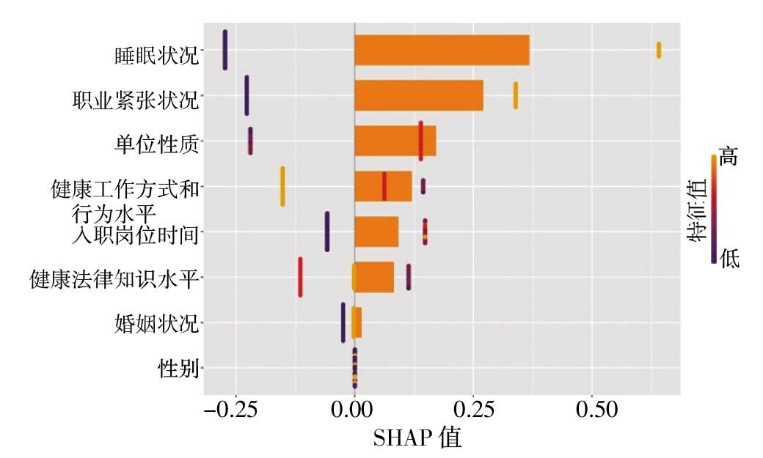
图4 SHAP特征重要性排序及摘要
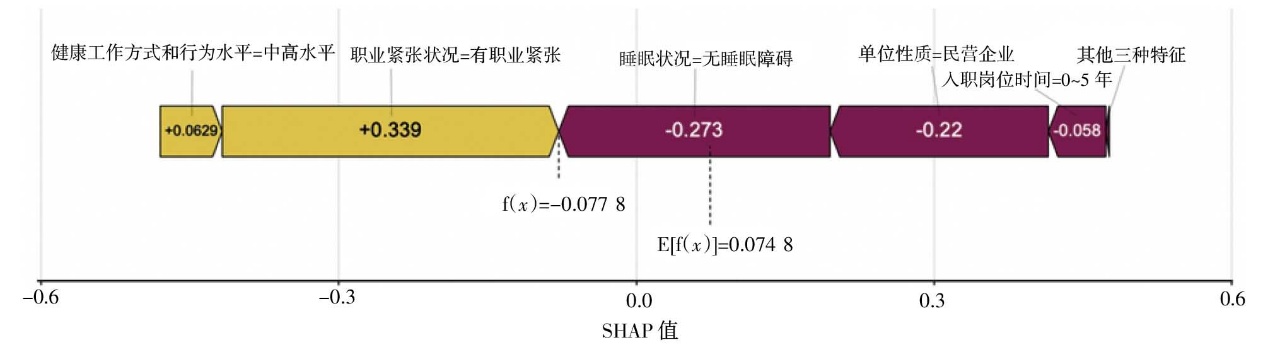
图5 预测结果解释
| [1] | 唐婧. 健康对劳动供给的影响研究进展[J]. 经济学动态, 2023(8):133-147. |
| [2] | 马恒芬, 张阔, 常敏, 等. 焦虑对注意控制过程中抑制加工的影响[J]. 西安交通大学学报(医学版), 2018, 39(6):927-931,935. |
| [3] | 程远玲, 赵艺寻, 隋晶晶, 等. 抑郁、焦虑在老年科冠心病心衰患者中发生率及其影响因素[J]. 国际精神病学杂志, 2016, 43(5):857-859,862. |
| [4] | 马炜钰, 谭夏优, 何易楠, 等. 广州某汽车制造企业作业人员职业紧张、职业倦怠和抑郁症状的关系[J]. 环境与职业医学, 2022, 39(12):1359-1365. |
| [5] |
VIRTANEN M, STANSFELD A S, FUHRER R, et al. Overtime work as a predictor of major depressive episode:A 5-year follow-up of the Whitehall II study[J]. PLoS One, 2017, 7(1):e30719.
DOI URL |
| [6] |
EVANGELIA D. Job demands-resources theory:Taking stock and looking forward[J]. J Occup Health Psychol, 2017, 22(3):273-285.
DOI URL |
| [7] |
TÖRES T, ANNE H, GUNNAR A, et al. A systematic review including meta-analysis of work environment and depressive symptoms[J]. BMC Public Health, 2015, 15(1):738.
DOI URL |
| [8] |
NIXON E A, MAZZOLA J J, BAUER J, et al. Can work make you sick? A meta-analysis of the relationships between job stressors and physical symptoms[J]. Work & Stress, 2011, 25(1):1-22.
DOI URL |
| [9] | 李霜, 孙彦彦, 孙新. 2022年全国重点人群职业健康素养监测技术方案介绍[J]. 中国职业医学, 2023, 50(2):189-193. |
| [10] | 中国疾病预防控制中心职业卫生与中毒控制所.关于印发《全国重点人群职业健康素养监测与干预技术方案》的通知:中疾控职科便函[2022]49号)[Z]. 北京: 中国疾病预防控制中心职业卫生与中毒控制所, 2022. |
| [11] | 中国疾病预防控制中心职业卫生与中毒控制所.关于印发《2022年重点人群职业健康素养水平计算标准》的通知(中疾控职科便函[2023]5号)[Z]. 北京: 中国疾病预防控制中心职业卫生与中毒控制所, 2023. |
| [12] | 王瑾, 张巧耘, 陈惠清, 等. 中国职业人群职业紧张测量核心量表编制[J]. 中华预防医学杂志, 202, 54(11):1184-1189. |
| [13] |
NAKATA A, HARATANI T, TAKAHASHI M, et al. Job stress,social support,and prevalence of insomnia in a population of Japanese daytime workers[J]. Soc Sci Med, 2004, 59(8):1719-1730.
DOI URL |
| [14] | 中国疾病预防控制中心职业卫生与中毒控制所. 全国重点人群职业健康素养监测-身心健康状况评分标准[Z/OL]. (2023-05-17)[2025-10-21]. https://book.yunzhan365.com/qxzua/msqm/mobile/index.html. |
| [15] | 张润, 王永滨. 机器学习及其算法和发展研究[J]. 中国传媒大学学报(自然科学版), 2016, 23(2):10-18,24. |
| [16] | 曹玉茹, 高洋洋. 基于SHAP值惩罚特征的集成分类方法研究[J]. 统计与决策, 2023, 39(6):21-26. |
| [17] |
刘天畅, 王雷, 朱庆华. 基于SHAP解释方法的智慧居家养老服务平台用户流失预测研究[J]. 数据分析与知识发现, 2024, 8(1):40-54.
DOI |
| [18] |
李兴洋, 孙婉琪, 尹孟洁, 等. 慢性阻塞性肺疾病患者睡眠质量和焦虑抑郁情况及其影响因素:一项多中心横断面研究[J]. 中国全科医学, 2024, 27(20):2437-2444.
DOI |
| [19] | 程玉莲, 郭佩佩. 上海市青年男男性行为人群焦虑现状及影响因素分析[J]. 中国卫生事业管理, 2024, 41(2):199-202. |
| [20] | 高耀, 曹连喆, 许丹东. 专业硕士的焦虑来源及其影响因素[J]. 学位与研究生教育, 2024(1):49-56. |
| [21] | 潘文, 朱雯娱. 初产妇产前焦虑抑郁现状及影响因素分析[J]. 实用预防医学, 2024, 31(1):53-57. |
| [22] |
LU R, LING H, HUANG Z, et al. Development of a prediction model for lower limb deformity in patients with hereditary multiple exostoses based on interpretable models and nomogram[J]. BMC Med Inform Decis Mak, 2025, 25(1):355-355.
DOI |
| [23] | 郭佩佩, 高凯, 姜茂敏, 等. 高校教师焦虑状况及其与工作-家庭冲突和领悟社会支持的关系[J]. 中国心理卫生杂志, 2023, 37(7):610-615. |
| [24] | 王诗妍, 杨晓霞, 李彦雷, 等. 534名医务人员心理健康状况分析及对策探讨[J]. 宁夏医学杂志, 2024, 46(3):262-267. |
| [25] | 周雪松, 许艳丹, 许明佳. 上海市石油化工产业工人心理健康状况及影响因素[J]. 职业与健康, 2023, 39(11):1491-1495. |
| [26] | 陈林, 陆海瑛, 王泽华, 等. 融合LightGBM和SHAP的井漏类型判断及主控因素分析[J]. 钻井液与完井液, 2023, 40(6):771-777. |
| [27] | 汪祖民, 王恺锋, 李艳志, 等. 基于LightGBM和SHAP的云南省森林火灾预测研究[J]. 消防科学与技术, 2023, 42(11):1567-1571. |
| [28] | 石磊, 王媛, 任飞. 职业倦怠对某部军人睡眠质量与职业压力关系的中介效应[J]. 职业与健康, 2023, 39(3):289-292. |
| [29] | 马悦, 杨跃新, 姚建华, 等. 苏州市第二产业员工职业紧张和心理健康状况分析[J]. 中国工业医学杂志, 2024, 37(1):24-28. |
| [30] | 石呈, 陈旭鹏, 汪娜, 等. 2014-2019年南京市不同文化程度人群健康素养水平变化趋势分析[J]. 江苏预防医学, 2021, 32(6):771-773,776. |
| [31] | 潘丽萍, 王文彩, 李娜, 等. 南京市某企业健康促进干预措施及效果评价[J]. 中国工业医学杂志, 2022, 35(2):181-183. |
| [32] | 陈娜, 李静芸, 张忠彬. 规范高效开展用人单位职业健康培训工作[J]. 劳动保护, 2023(4):76-77. |
| [33] | 孙彦彦, 孙新, 万霞, 等. 我国2022年重点人群职业健康素养水平及其影响因素[J]. 中国职业医学, 2023, 50(3):241-247. |
| [1] | 王淑玉, 阮坛凤, 陈浩, 黄奕平, 刘浩中. 广东省某市基层公共卫生人员职业紧张现状及影响因素分析[J]. 职业与健康, 2026, 42(9): 1168-1173. |
| [2] | 胡月. 四川省6所三级甲等医院规范化培训护士职业认同现状及影响因素分析[J]. 职业与健康, 2026, 42(9): 1213-1219. |
| [3] | 张世晴, 杨秀木, 邓曼, 徐雪君. 社区老年慢性病患者自我管理积极度现状及影响因素分析[J]. 职业与健康, 2026, 42(9): 1225-1230. |
| [4] | 张思怡, 马少伟, 白伟, 宋珈斌, 宋美勤. 基于健康信念模式的男医学生HPV疫苗接种意愿及影响因素分析[J]. 职业与健康, 2026, 42(9): 1250-1254. |
| [5] | 温小苗, 张瑛, 杨晓. 骨科护士情绪调节及心理灵活性对职业倦怠的影响[J]. 职业与健康, 2026, 42(8): 1020-1024. |
| [6] | 顾蒙, 陈凤, 曹云. 三级甲等综合医院急诊科护士工作-家庭增益、心理资本对职业倦怠的影响[J]. 职业与健康, 2026, 42(8): 1030-1034. |
| [7] | 董洁, 尤芮可, 张昱. 基于扎根理论构建天津市公立医院行政管理人员职业倦怠影响因素的理念框架[J]. 职业与健康, 2026, 42(8): 1035-1039. |
| [8] | 秦怡, 孙璐, 钱蕾, 许洁, 达婧. 老年科护士角色宽度自我效能、职业生涯韧性对职业倦怠的影响[J]. 职业与健康, 2026, 42(8): 1040-1044. |
| [9] | 戴桃芳, 陆高峰, 汤海英, 袁媛. 上海市奉贤区医务人员症状自评量表评分现况及影响因素分析[J]. 职业与健康, 2026, 42(8): 1087-1093. |
| [10] | 李夕然, 胡琛, 樊文彬, 朱峰. 中医药院校本科护理新生专业认同现状及影响因素分析[J]. 职业与健康, 2026, 42(8): 1138-1142. |
| [11] | 王豪, 崔楠, 陈祥华. 山东省三级公立医院全科专业住院医师规范化培训学员付出回报失衡和职业倦怠的关系分析[J]. 职业与健康, 2026, 42(7): 881-886. |
| [12] | 刘鹏, 原晓华, 蒙美旭, 赵娜, 籍小溪. 2019和2023年天津市河东区居民健康素养水平及影响因素分析[J]. 职业与健康, 2026, 42(7): 983-987. |
| [13] | 黄文俊, 米莎莎, 吴超, 王丽霞, 裴迎新. 新疆生产建设兵团预防接种工作人员职业倦怠现状及影响因素分析[J]. 职业与健康, 2026, 42(6): 726-732. |
| [14] | 张文隽, 崔悦, 曹冬, 王旭阳. 复杂基质水中砷能力验证结果与分析[J]. 职业与健康, 2026, 42(6): 757-761. |
| [15] | 张茜, 刘娜, 梁艳, 刘阳, 贾娜, 孟海超. 介入康复科护士非工作时间电子沟通、情绪耗竭对工作时间侵占行为的影响[J]. 职业与健康, 2026, 42(6): 772-776. |
| 阅读次数 | ||||||
|
全文 |
|
|||||
|
摘要 |
|
|||||
 津公网安备12010202000831号 津ICP备11005889号-6
