职业与健康 ›› 2025, Vol. 41 ›› Issue (24): 3389-3394.

• 论著 • 上一篇    下一篇

金融从业人员自我效能感和心理韧性在压力感知与心理健康状态间的链式中介效应

张静1,2, 樊春雷1, 陶婷1, 王利刚1, 高文斌1()   

  1. 1 中国科学院心理研究所北京 100101
    2 中国科学院大学心理学系北京 100049
  • 收稿日期:2025-02-02 修回日期:2025-03-03 出版日期:2025-12-15 发布日期:2026-01-22
  • 通信作者: 高文斌,研究员,E-mail:gaowb@psych.ac.cn
  • 作者简介:张静,女,在读硕士研究生,研究方向为健康心理学。

Chain mediation effect of financial practitioners' self-efficacy and mental toughness on perceived stress and mental health status

ZHANG Jing1,2, FAN Chunlei1, TAO Ting1, WANG Ligang1, GAO Wenbin1()   

  1. 1 Institute of PsychologyCASBeijing 100101, China
    2 Department of PsychologyUniversity of Chinese Academy of SciencesBeijing 100049, China
  • Received:2025-02-02 Revised:2025-03-03 Online:2025-12-15 Published:2026-01-22
  • Contact: GAO Wenbin,Researcher,E-mail:gaowb@psych.ac.cn

摘要:

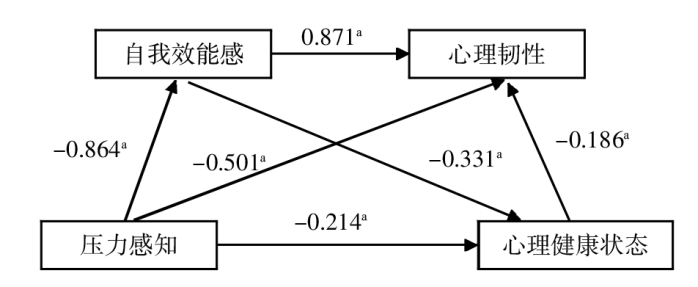
目的 了解金融从业人员压力感知以及抑郁、焦虑、躯体化和寝食等心理健康状态的现状,考察金融从业人员自我效能感和心理韧性在压力感知和心理健康状态间的影响机制,为金融机构从业人员压力应对和心理健康水平提升提供决策依据。方法 2024年9—10月招募国内金融行业344名在职员工,使用压力感知量表(stress perception scale,PSS)、一般自我效能感量表(general self-efficacy scale,GSES)、心理韧性量表(Connor-Davidson resilience scale,CD-RISC)、症状自评量表(symptom check-list,SCL-90)和自编受访者基本信息表进行问卷调查,采用SPSS AU进行统计分析和中介效应检验。结果 344名金融从业人员压力感知总分为(1.725±0.649)分,其中,失控感因子为(1.564±0.803)分,紧张感因子为(1.887±0.885)分。SCL-90症状自评维度得分:抑郁为(1.970±0.848)分,焦虑为(1.759±0.798)分,躯体化为(1.589±0.662)分,其他(睡眠、饮食情况)为(1.836±0.765)分,以上维度总分为(1.788±0.716)分。自我效能感得分为(2.550±0.809)分,心理韧性得分为(2.445±1.185)分,其中韧性因子为(2.437±1.176)分、力量因子为(2.437±1.176)分、乐观因子为(2.365±1.314)分。抑郁、焦虑、躯体化、其他(睡眠、饮食)各维度及总得分均与压力感知呈正相关,与自我效能感、心理韧性呈负相关(均P<0.01)。用Bootstrap法进行中介效应分析,自我效能感和心理韧性在压力感知与心理健康状态间的链式中介效应路径存在(95%CI:0.089~0.170)。结论 金融从业人员压力感知处于较高水平,压力感知和心理健康状态因性别、地域、从业年限、机构类型、职位及收入等因素存在差异,压力感知对金融从业人员心理健康状态有显著正向预测作用,自我效能感和心理韧性在压力感知与心理健康状态间起链式中介作用。

关键词: 金融从业人员, 压力感知, 自我效能感, 心理韧性, 心理健康状态

Abstract:

Objective To understanding the perceived stress and mental health status of financial professionals,including their situation in depression,anxiety,somatization,and sleep and diet,and to explore the influence mechanisms of self-efficacy and mental toughness on the relationship between perceived stress and mental health status among financial practitioners,providing decision-making basis for stress coping and improving mental health level of employees in financial institutions. Methods From September to October 2024,344 in-service employees in the domestic financial industry were recruited to conduct a questionnaire survey using the stress perception scale(PSS),general self-efficacy scale(GSES),Connor-Davidson resilience scale(CD-RISC),symptom check-list scale(SCL-90) and self-designed basic information table of respondents. SPSS AU was used to conduct statistical and mediating effect test. Results The total perceived stress score of 344 financial practitioners was (1.725±0.649)points,including loss of control factor(1.564±0.803)points and tension factor(1.887±0.885)points. In SCL-90 symptom self-report scale,depression was (1.970±0.848)points,anxiety was (1.759±0.798)points,somatization was (1.589±0.662)points,other(sleep,diet) was (1.836±0.765)points,and the total scores of the above dimensions was (1.788±0.716)points. The self-efficacy score was (2.550±0.809)points. Mental toughness score was (2.445±1.185)points,including toughness factor(2.437±1.176)points,strength factor(2.437±1.176)points,optimism factor(2.365±1.314)pints.The mental health status,including depression,anxiety,somatization and other dimensions(sleep,diet),were positively correlated with stress perception(all P<0.01),and negatively correlated with self-efficacy and mental toughness(all P<0.01). The results of mediation effect analysis using Bootstrap method showed that self-efficacy and mental toughness had a chain mediation effect path between stress perception and mental health status(95%CI:0.089-0.170). Conclusion The perceived stress of financial practitioners is at a high level,and the perceived stress and mental health status are different due to gender,region,working years,institution type,position,income and other factors. Perceived stress has a significant positive predictive effect on the mental health status of financial practitioners,and self-efficacy and mental toughness play a chain intermediary role between the perceived stress and mental health status.

Key words: Financial practitioners, Perceived stress, Self-efficacy, Mental toughness, Mental health status

中图分类号: