


OCCUPATION AND HEALTH ›› 2026, Vol. 42 ›› Issue (8): 1050-1056.
• Treatise • Previous Articles Next Articles
CHENG Yu, LIU Yan( )
)
Received:2025-06-12
Revised:2025-07-07
Online:2026-04-15
Published:2026-05-18
Contact:
LIU Yan,E-mail:500234azjy6.cdb@sina.cn
CLC Number:
CHENG Yu, LIU Yan. Therapeutic effect of total flavonoids from Ginkgo biloba on secretory otitis media in rats after occupational noise exposure and the impact on the cochlear TLR9-Nrf2 signaling pathway. [J]OCCUPATION AND HEALTH, 2026, 42(8): 1050-1056.
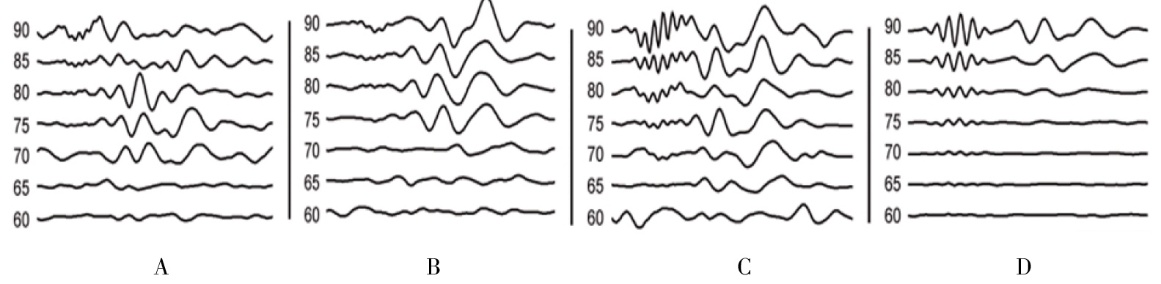
| 组别 | 只数 | ABR阈值(dBSPL) |
|---|---|---|
| 银杏总黄酮高剂量组 | 10 | 114.53±2.18ab |
| 银杏总黄酮低剂量组 | 10 | 121.74±3.22a |
| 噪声暴露组 | 10 | 137.53±4.29c |
| 正常对照组 | 10 | 90.04±3.23 |
| F值 | 65.328 | |
| P值 | 0.000 |
| 组别 | 只数 | ABR阈值(dBSPL) |
|---|---|---|
| 银杏总黄酮高剂量组 | 10 | 114.53±2.18ab |
| 银杏总黄酮低剂量组 | 10 | 121.74±3.22a |
| 噪声暴露组 | 10 | 137.53±4.29c |
| 正常对照组 | 10 | 90.04±3.23 |
| F值 | 65.328 | |
| P值 | 0.000 |
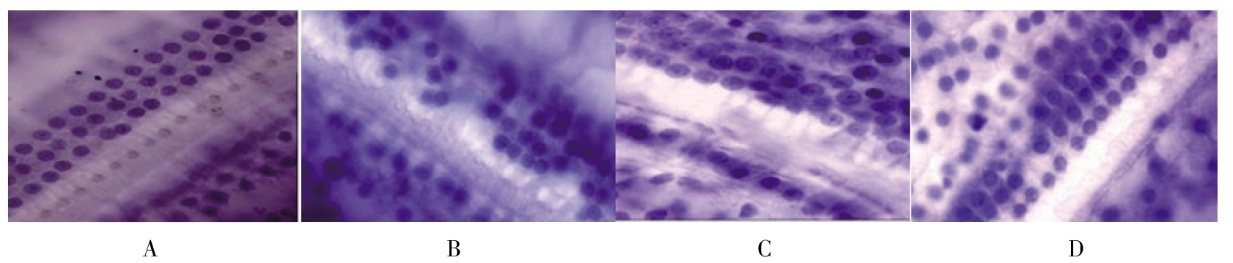
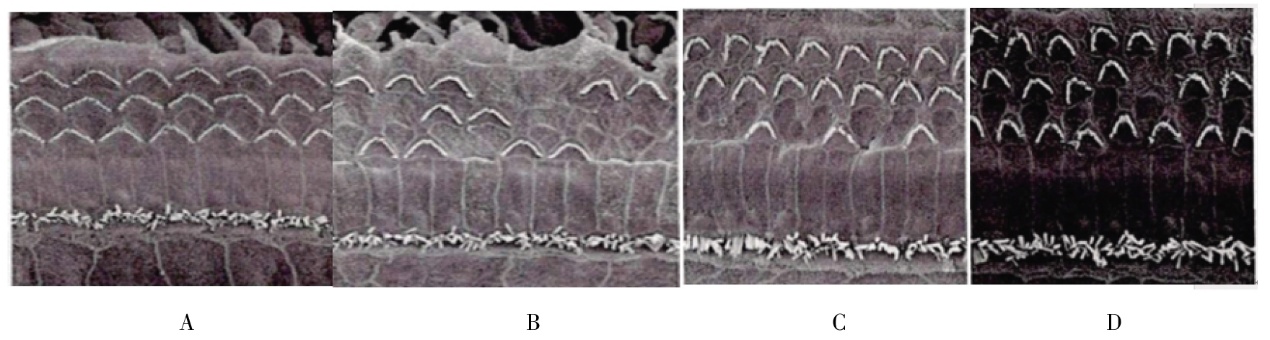
| 组别 | 只数 | IL-6 | TNF-α | ROS | MDA |
|---|---|---|---|---|---|
| 银杏总黄酮高剂量组 | 10 | 232.25±30.22ab | 208.25±23.33ab | 426.39±38.54ab | 469.55±44.94ab |
| 银杏总黄酮低剂量组 | 10 | 421.35±35.21a | 320.02±36.25a | 625.21±54.25a | 712.21±63.21a |
| 噪声暴露组 | 10 | 687.21±53.21c | 459.56±40.00c | 841.20±65.22c | 925.32±85.25c |
| 正常对照组 | 10 | 96.25±9.56 | 129.54±15.33 | 269.66±23.01 | 187.63±17.55 |
| F值 | 236.415 | 185.652 | 119.329 | 210.365 | |
| P值 | 0.000 | 0.000 | 0.000 | 0.000 |
| 组别 | 只数 | IL-6 | TNF-α | ROS | MDA |
|---|---|---|---|---|---|
| 银杏总黄酮高剂量组 | 10 | 232.25±30.22ab | 208.25±23.33ab | 426.39±38.54ab | 469.55±44.94ab |
| 银杏总黄酮低剂量组 | 10 | 421.35±35.21a | 320.02±36.25a | 625.21±54.25a | 712.21±63.21a |
| 噪声暴露组 | 10 | 687.21±53.21c | 459.56±40.00c | 841.20±65.22c | 925.32±85.25c |
| 正常对照组 | 10 | 96.25±9.56 | 129.54±15.33 | 269.66±23.01 | 187.63±17.55 |
| F值 | 236.415 | 185.652 | 119.329 | 210.365 | |
| P值 | 0.000 | 0.000 | 0.000 | 0.000 |
| 组别 | 只数 | TLR9 mRNA | Nrf2 mRNA |
|---|---|---|---|
| 银杏总黄酮高剂量组 | 10 | 1.63±0.29ab | 2.63±0.44ab |
| 银杏总黄酮低剂量组 | 10 | 2.32±0.42a | 1.38±0.23a |
| 噪声暴露组 | 10 | 3.19±0.53c | 0.47±0.09c |
| 正常对照组 | 10 | 0.38±0.07 | 3.38±0.62 |
| F值 | 85.365 | 125.690 | |
| P值 | 0.000 | 0.000 |
| 组别 | 只数 | TLR9 mRNA | Nrf2 mRNA |
|---|---|---|---|
| 银杏总黄酮高剂量组 | 10 | 1.63±0.29ab | 2.63±0.44ab |
| 银杏总黄酮低剂量组 | 10 | 2.32±0.42a | 1.38±0.23a |
| 噪声暴露组 | 10 | 3.19±0.53c | 0.47±0.09c |
| 正常对照组 | 10 | 0.38±0.07 | 3.38±0.62 |
| F值 | 85.365 | 125.690 | |
| P值 | 0.000 | 0.000 |
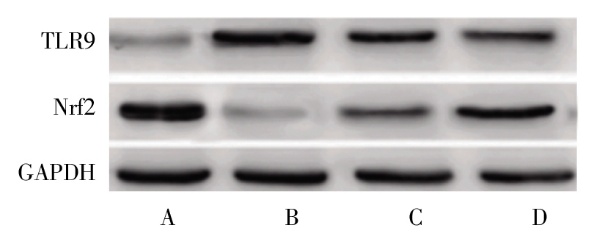
| 组别 | 只数 | TLR9蛋白 (/GAPDH) | Nrf2蛋白 (/GAPDH) |
|---|---|---|---|
| 银杏总黄酮高剂量组 | 10 | 0.56±0.04ab | 0.86±0.07ab |
| 银杏总黄酮低剂量组 | 10 | 0.89±0.07a | 0.49±0.05a |
| 噪声暴露组 | 10 | 1.25±0.12c | 0.20±0.03c |
| 正常对照组 | 10 | 0.12±0.02 | 1.25±0.08 |
| F值 | 163.654 | 145.208 | |
| P值 | 0.000 | 0.000 |
| 组别 | 只数 | TLR9蛋白 (/GAPDH) | Nrf2蛋白 (/GAPDH) |
|---|---|---|---|
| 银杏总黄酮高剂量组 | 10 | 0.56±0.04ab | 0.86±0.07ab |
| 银杏总黄酮低剂量组 | 10 | 0.89±0.07a | 0.49±0.05a |
| 噪声暴露组 | 10 | 1.25±0.12c | 0.20±0.03c |
| 正常对照组 | 10 | 0.12±0.02 | 1.25±0.08 |
| F值 | 163.654 | 145.208 | |
| P值 | 0.000 | 0.000 |
| [1] |
BASU S, AGGARWAL A, DUSHYANT K, et al. Occupational noise-induced hearing loss in India:A systematic review and meta-analysis[J]. Indian J Community Med, 2022, 47(2):166-171.
DOI URL |
| [2] |
NATARAJAN N, BATTS S, STANKOVIC K M. Noise-induced hearing loss[J]. J Clin Med, 2023, 12(6):2347.
DOI URL |
| [3] | ZHANG M, GAO X, MURPHY W J, et al. Estimation of occupational noise-induced hearing loss using kurtosis-adjusted noise exposure levels[J]. Ear Hear, 2022, 43(6):1881-1892. |
| [4] |
ELSHAER N, MELEIS D, MOHAMED A. Prevalence and correlates of occupational noise-induced hearing loss among workers in the steel industry[J]. J Egypt Public Health Assoc, 2023, 98(1):11.
DOI PMID |
| [5] |
LIU Y, GU D, ZHAO H, et al. Influence of different noise types on hearing function in patients treated for mild otitis media[J]. Noise Health, 2024, 26(121):231-234.
DOI PMID |
| [6] |
ABDEL-RAZEK O, AUDLIN J, POE D S, et al. Surfactant proteins and innate immunity of otitis media[J]. Innate Immun, 2022, 28(7-8):213-223.
DOI URL |
| [7] |
LEICHTLE A, KURABI A, LEFFERS D, et al. Immunomodulation as a protective strategy in chronic otitis media[J]. Front Cell Infect Microbiol, 2022, 12:826192.
DOI URL |
| [8] |
KURABI A, LEE J, PAK K, et al. Essential role of the innate immune adaptor RIP2 in the response to otitis media[J]. Front Genet, 2022, 13:893085.
DOI URL |
| [9] |
FAN W, XU H, CHEN F, et al. The expression of Nrf2 and TLRs in ear effusion in children with different types of otitis media and their relationship with inflammatory factors[J]. Int Immunopharmacol, 2024, 126:111152.
DOI URL |
| [10] |
TREVINO M, ZANG A, LOBARINAS E. The middle ear muscle reflex:Current and future role in assessing noise-induced cochlear damage[J]. J Acoust Soc Am, 2023, 153(1):436-445.
DOI URL |
| [11] |
GUO J, WANG Y, LI J, et al. Overview and recent progress on the biosynthesis and regulation of flavonoids in Ginkgo biloba L[J]. Int J Mol Sci, 2023, 24(19):14604.
DOI URL |
| [12] |
LI F, BOATENG I D, CHEN S, et al. Pulsed light irradiation improves degradation of ginkgolic acids and retainment of ginkgo flavonoids and terpene trilactones in Ginkgo biloba leaves[J]. Ind Crops Prod, 2023, 204:117297.
DOI URL |
| [13] |
ZHOU M, ZHANG M, DING Y, et al. Biosynthesis and characterization of flavonoids by Ginkgo biloba endophytic Rhodococcus sp.FY-5[J]. Microchem J, 2024, 204:111115.
DOI URL |
| [14] | AL-FATLAWI M M H, AL-AMMAR M H, AL-MANSSORI Y L H. Study of gene expression of Cytokine Genes(TLR-4,NOD-2) in patients with Otitis Media in Al-Najaf Governorate,Iraq[C]//BIO Web Conf.BIO Web Conf, 2024, 84:03019. |
| [15] |
KIM B G, CHOI D Y, KIM M G, et al. Effect of angiogenesis and lymphangiogenesis in diesel exhaust particles inhalation in mouse model of LPS-induced acute otitis media[J]. Front Cell Infect Microbiol, 2022, 12:824575.
DOI URL |
| [16] |
SAKAMOTO T, PAK K, CHAVEZ E, et al. HB-EGF plays a pivotal role in mucosal hyperplasia during otitis media induced by a viral analog[J]. Front Cell Infect Microbiol, 2022, 12:823714.
DOI URL |
| Viewed | ||||||
|
Full text |
|
|||||
|
Abstract |
|
|||||
 津公网安备12010202000831号 津ICP备11005889号-6
