职业与健康 ›› 2026, Vol. 42 ›› Issue (15): 2032-2037.

• 论著—职业卫生与职业相关疾病 • 上一篇    下一篇

心理弹性在山西省火力发电行业一线劳动者职业紧张与抑郁症状间的中介效应研究

靳佳辉1, 郭支喜1,2(), 马效东3, 秦文彦3   

  1. 1 山西医科大学公共卫生学院山西 太原 030001
    2 山西省卫生健康委监督检查中心山西 太原 030045
    3 山西省疾病预防控制中心山西 太原 030012
  • 收稿日期:2025-09-09 修回日期:2025-10-08 出版日期:2026-08-01 发布日期:2026-07-16
  • 通信作者: 郭支喜
  • 作者简介:靳佳辉,男,在读硕士研究生,研究方向为职业卫生。

Study on the mediating effect of psychological resilience between occupational stress and depressive symptoms in front-line workers in thermal power generation industry in Shanxi Province

JING Jiahui1, GUO Zhixi1,2(), MA Xiaodong3, QIN Wenyan3   

  1. 1 School of Public HealthShanxi Medical University,TaiyuanShanxi 030001, China
    2 Supervision and Inspection Center of Shanxi Provincial Health CommissionTaiyuanShanxi 030045, China
    3 Shanxi Provincial Center for Disease Control and PreventionTaiyuanShanxi 030012, China
  • Received:2025-09-09 Revised:2025-10-08 Online:2026-08-01 Published:2026-07-16
  • Contact: GUO Zhixi
  • About author:GUO Zhixi,E-mail:1390536024@qq.com

摘要:

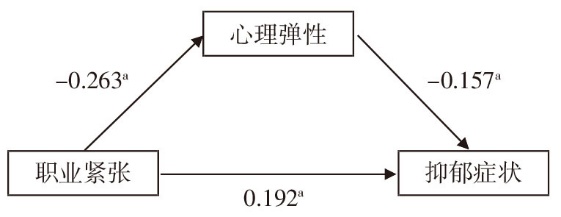
目的 了解山西省火力发电行业一线劳动者心理弹性、职业紧张与抑郁症状情况,分析心理弹性在职业紧张与抑郁症状间的中介效应,为改善一线劳动者的身心健康提供参考依据。方法 2023—2024年,按照多阶段抽样方法,使用心理弹性量表(10-item Connor-Davidson resilience scale,CD-RISC-10)、职业紧张测量核心量表(core occupational stress scale,COSS)、患者健康问卷(patient health questionnaire,PHQ-9)对山西省火力发电行业中2家大型企业、4家中型企业及12家小型企业的一线899名劳动者进行问卷调查,并对数据进行分析。结果 899名调查对象心理弹性得分[MP25P75)]为29(23,33)分。职业紧张得分[MP25P75)]为40(36,47)分,职业紧张检出率为16.69%(150/899);抑郁症状得分为6(4,9)分,抑郁症状检出率为66.52%(598/899),其中轻度48.16%(433/899)、中度13.46%(121/899)、中重度4.12%(37/899)、重度0.78%(7/899)。不同性别、实际平均月收入(元)、呼吸系统症状(如咳嗽、胸痛、气短等)情况、主动获取健康知识情况、每周体育锻炼情况、单位福利满意程度情况的一线劳动者心理弹性得分比较,差异均有统计学意义(均P<0.05);不同性别、实际平均月收入(元)、平均每周工作时间(h)、上夜班情况、轮班情况、呼吸系统症状(如咳嗽、胸痛、气短等)情况、主动获取健康知识情况、单位福利满意程度情况的一线劳动者职业紧张检出率比较,差异均有统计学意义(均P<0.05);不同文化程度、平均每周工作时间(h)、饮酒情况、呼吸系统症状(如咳嗽、胸痛、气短等)情况、主动获取健康知识情况、每周体育锻炼情况、单位福利满意程度情况的一线劳动者抑郁症状检出率比较,差异均有统计学意义(均P<0.05)。火力发电行业一线劳动者心理弹性与职业紧张呈负相关(r=-0.301,P<0.01),心理弹性与抑郁症状呈负相关(r=-0.434,P<0.01),职业紧张与抑郁症状呈正相关(r=0.475,P<0.01)。火力发电行业一线劳动者心理弹性在职业紧张和抑郁症状间中介效应显著,中介效应值为0.041,占总效应的17.60%。结论 山西省火力发电行业一线899名劳动者抑郁症状检出率较高,心理弹性在一线劳动者职业紧张和抑郁症状间存在部分中介作用。可以从心理弹性的角度考虑改善火力发电行业一线劳动者的职业紧张和抑郁症状情况。

关键词: 火力发电行业, 心理弹性, 职业紧张, 抑郁症状, 中介效应, 一线劳动者

Abstract:

Objective To understand the level of psychological resilience,occupational stress and depression symptoms of front-line workers in the thermal power generation industry in Shanxi Province,analyze the mediating effect of psychological resilience between occupational stress and depression symptoms,so as to provide a scientific basis for improving the physical and mental health of workers. Methods From 2023 to 2024,according to a multi-stage sampling method,a cross-sectional survey was conducted among 899 frontline workers from 2 large enterprises,4 medium-sized enterprises,and 12 small-sized enterprises in the thermal power generation industry in Shanxi Province using the Connor-Davidson resilience scale(CD-RISC-10),the core occupational stress scale(COSS),and the patient health questionnaire(PHQ-9),and the data were analyzed. Results The psychological resilience score[MP25P75)] of 899 survey subjects was 29(23,33)points. The occupational stress score[MP25P75)] was 40(36,47)points,and the detection rate of occupational stress was 16.69%(150/899). The score of depressive symptoms was 6(4,9)points,and the detection rate of depressive symptoms was 66.52%(598/899),consisting of mild cases accounting for 48.16%(433/899),moderate 13.46%(121/899),moderate-severe 4.12%(37/899) and severe 0.78%(7/899). The psychological resilience scores of frontline workers with different genders,actual average monthly income(yuan),respiratory symptoms(such as cough,chest pain,shortness of breath,etc.),proactive acquisition of health knowledge,weekly physical exercise,and satisfaction with unit welfare were compared,and the differences were statistically significant(all P<0.05). The comparison of the detection rates of occupational stress among frontline workers of different genders,actual average monthly income(yuan),average weekly working hours(h),night shift work,shift work,respiratory symptoms(such as cough,chest pain,shortness of breath,etc.),proactive acquisition of health knowledge,and satisfaction with unit welfare showed statistically significant differences(all P<0.05). The differences in the detection rates of depression symptoms among frontline workers with different education levels,average weekly working hours(h),alcohol consumption,respiratory symptoms(such as cough,chest pain,shortness of breath,etc.),active access to health knowledge,weekly physical exercise,and satisfaction with unit welfare were statistically significant(all P<0.05). The psychological resilience of front-line workers in the thermal power generation industry was negatively correlated with occupational stress(r=-0.301,P<0.01),psychological resilience was negatively correlated with depressive symptoms(r=-0.434,P<0.01),and occupational stress was positively correlated with depressive symptoms(r=0.475,P<0.01). The psychological resilience of front-line workers in the thermal power generation industry had a significant mediating effect on occupational stress and depressive symptoms,with a mediating effect value of 0.041,accounting for 17.60% of the total effect. Conclusion The detection rate of depressive symptoms in front-line workers in the thermal power generation industry in Shanxi Province is high,and psychological resilience has a partial mediating effect between occupational stress and depressive symptoms. Improving the psychological resilience level of frontline workers in the thermal power generation industry can help reduce their occupational stress and depression symptoms.

Key words: Thermal power generation industry, Psychological resilience, Occupational stress, Depressive symptoms, Mediation effect, Frontline workers

中图分类号: