职业与健康 ›› 2026, Vol. 42 ›› Issue (20): 2783-2789.

• 论著—食品安全与营养 • 上一篇    下一篇

贵州省农村居民食品安全与营养健康知信行现状调查

曾慧1,2, 王芸1, 陆昭叶1, 张晔3, 邓海3, 陈慧娟1,2()   

  1. 1 贵州医科大学公共卫生与健康学院环境污染与疾病监控教育部重点实验室贵州 贵阳 561113
    2 贵州省疾病预防控制中心贵州 贵阳 550004
    3 贵州省卫生健康宣传教育中心贵州 贵阳 550004
  • 收稿日期:2025-11-18 修回日期:2026-01-19 出版日期:2026-10-15 发布日期:2026-09-14
  • 通信作者: 陈慧娟,E-mail:1724263938@qq.com
  • 作者简介:曾慧,女,在读硕士研究生,研究方向为健康教育与健康促进。
  • 基金资助:
    国家卫健委办公厅2024年食品安全与营养健康高质量发展资政项目(国卫办食品函2024255号)

Survey on the current status of knowledge,attitude,and practice of food safety and nutritional health among rural residents in Guizhou Province

ZENG Hui1,2, WANG Yun1, LU Zhaoye1, ZHANG Ye3, DENG Hai3, CHEN Huijuan1,2()   

  1. 1 School of Public HealthKey Laboratory of Environmental Pollution Monitoring and Disease Control,Guizhou Medical University,GuiyangGuizhou 561113, China
    2 Guizhou Center for Disease Control and PreventionGuiyangGuizhou 550004, China
    3 Guizhou Health Promotion and Education CenterGuiyangGuizhou 550004, China
  • Received:2025-11-18 Revised:2026-01-19 Online:2026-10-15 Published:2026-09-14
  • Contact: CHEN Huijuan,E-mail:1724263938@qq.com

摘要:

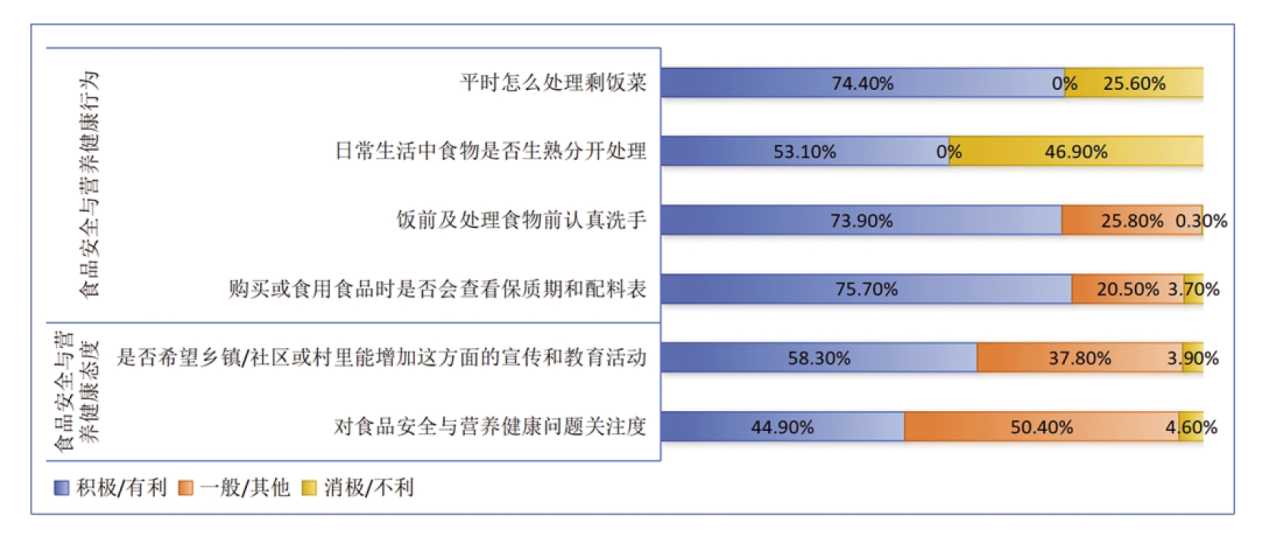
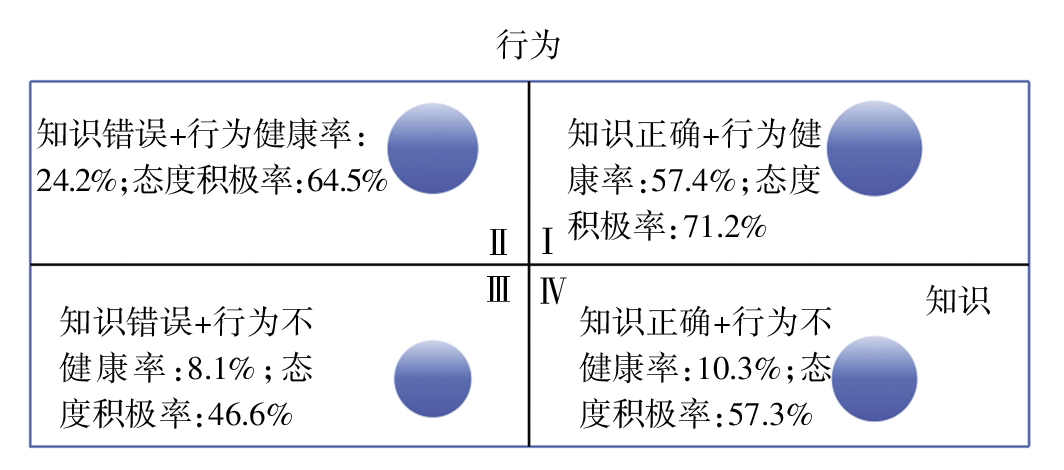
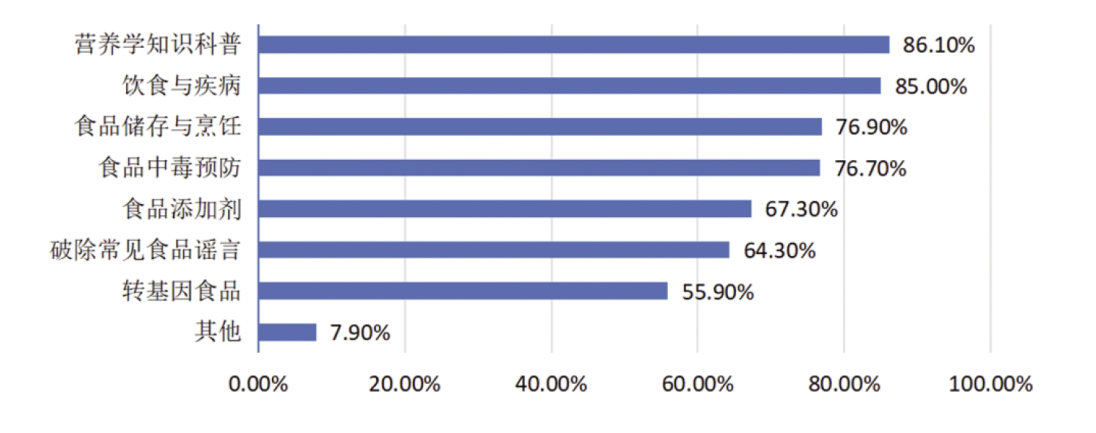
目的 了解贵州省农村居民食品安全与营养健康知信行(knowledge-attitude-practice,KAP)水平状况及其影响因素,确定重点健康教育对象,为后续开展食品安全与营养健康教育、引导农村居民合理膳食提供参考依据。方法 采用方便抽样于2024年10月—2025年1月,使用问卷星平台对贵州省7 239名农村居民开展食品安全与营养健康知识问卷调查。采用二分类Logistic回归分析农村居民食品安全与营养健康知信行现状的影响因素。结果 最终纳入7 075名农村居民,其获取食品安全与营养健康知识的主要渠道是网络,以短视频形式最受欢迎,最希望获得营养学科普知识内容。农村居民食品安全与营养健康知识合格率为67.7%,态度积极率为66.2%,行为健康率为81.6%。Logistic回归分析显示,以初中及以下学历为参照,高中/职高/中职、大专、本科及以上文化程度的居民食品安全与营养健康知识得分情况较好,OR值分别为1.405(95%CI:1.108~1.780)、1.766(95%CI:1.399~2.229)和1.787(95%CI:1.404~2.274);以0~<1万元为参照,1~<3、3~<5和≥5万元的居民食品安全与营养健康知识得分情况较好,OR值分别为1.357(95%CI:1.178~1.562)、1.309(95%CI:1.122~1.527)和1.389(95%CI:1.164~1.685)。以男性为参照,女性食品安全与营养健康态度不积极,OR值为0.865(95%CI:0.776~0.964);以初中及以下学历为参照,高中/职高/中职、大专、本科及以上文化程度的居民食品安全与营养健康态度较积极,OR值分别为1.476(95%CI:1.187~1.836)、1.544(95%CI:1.264~1.886)和1.700(95%CI:1.387~2.084)。以男性为参照,女性食品安全与营养健康行为较健康,OR值为1.232(95%CI:1.081~1.405)。四象限分析法显示,第I象限(知识好,行为健康)占57.4%,第II象限(知识差,行为健康)占24.2%,第III象限(知识差,行为不健康)占8.1%,第IV象限(知识好,行为不健康)占10.3%。结论 贵州省农村居民食品安全与营养健康KAP水平有待提高,对部分知识知晓与健康行为情况还存在不足。四象限分析法通过评估农村居民KAP现状,确定了健康教育重点人群,相关部门可根据不同人群的薄弱环节及其影响因素采取有针对性的措施,从而科学、有效地提升农村居民健康素养水平。

关键词: 食品安全, 营养健康, 影响因素, 知信行, 居民, 贵州

Abstract:

Objective To understand the knowledge-attitude-practice(KAP) level of rural residents in Guizhou Province and its influencing factors,and to identify the key health education targets,so as to provide a reference basis for the subsequent development of food safety and nutritional health education to guide rural residents to have a reasonable diet. Methods From October 2024 to January 2025,a convenience sampling survey was conducted on 7 239 rural residents in Guizhou Province using the Wenjuanxing platform to investigate their knowledge of food safety and nutritional health.Unconditional binary Logistic regression was used to analyze the influencing factors of rural residents' KAP on food safety and nutritional health. Results Among the 7 075 rural residents finally included in the study,the primary channel for acquiring food safety and nutrition health knowledge was the internet,with short videos being the most preferred format,and nutrition science content being the most desired topic. The pass rate of rural residents' food safety and nutrition health knowledge was 67.7%,the rate of positive attitude was 66.2%,and the rate of healthy behavior was 81.6%. Logistic regression analysis revealed that,compared with those with junior high school education or below,residents with high school/vocational high school/secondary vocational education,college and above education scored better in food safety and nutrition knowledge,with odds ratios(OR) values of 1.405(95%CI:1.108-1.780),1.766(95%CI:1.399- 2.229),and 1.787(95%CI:1.404-2.274),respectively. Compared with those with incomes 0-<10 000 yuan,residents with incomes of 10 000-<30 000,30 000-<50 000,and ≥50 000 yuan demonstrated better scores in food safety and nutrition knowledge,with OR values of 1.357(95%CI:1.178-1.562),1.309(95%CI:1.122-1.527),and 1.389(95%CI:1.164-1.685),respectively. Compared with males,females demonstrated less positive attitudes toward food safety and nutrition health,OR values were 0.865(95%CI:0.776-0.964),0.876(95%CI:0.797-1.012),and 0.917(95%CI:0.897-1.033),respectively. Compared with those with junior high school education or below,residents with senior high school/vocational high school/technical secondary school,college and above education exhibited more positive attitudes toward food safety and nutrition health,with OR values of 1.476(95%CI:1.187-1.836),1.544(95%CI:1.264-1.886),and 1.700(95%CI:1.387-2.084),respectively. Compared with males,females exhibited healthier food safety and nutrition-related behaviors,with OR values of 1.232(95%CI:1.081-1.405).The four-quadrant analysis showed that 57.4% were in Quadrant I(good knowledge and healthy behavior),24.2% were in Quadrant II(poor knowledge and healthy behavior),8.1% were in Quadrant III(poor knowledge and unhealthy behavior),and 10.3% were in Quadrant IV(good knowledge and unhealthy behavior). Conclusion The KAP level of food safety and nutritional health of rural residents in Guizhou Province needs to be improved,and there are still deficiencies in some knowledge and health behaviors. The four-quadrant analysis method identifies the key populations for health education by evaluating the current status of rural residents' KAP,and the relevant departments can take targeted measures according to the weaknesses of different populations and their influencing factors,so as to scientifically and effectively improve the health literacy level of rural residents.

Key words: Food safety, Nutritional health, Influencing factors, Knowledge-attitude-practice, Resident, Guizhou

中图分类号: