职业与健康 ›› 2026, Vol. 42 ›› Issue (21): 2881-2885.

• 论著—职业卫生与职业相关疾病 •    下一篇

皮肤科护士工作-非工作边界渗透、工作-家庭冲突对职业倦怠的影响及路径分析

黄生会1, 刘霞1, 汪瑶1, 廖小娅2, 任敏3, 杨波4   

  1. 1 简阳市人民医院四川 成都 641400
    2 重庆市武隆区人民医院重庆 408500
    3 重庆医科大学附属第二医院重庆 400010
    4 西安市北方医院陕西 西安 710043
  • 收稿日期:2025-09-09 修回日期:2025-10-29 出版日期:2026-11-01 发布日期:2026-09-04
  • 作者简介:黄生会,女,主管护师,主要从事皮肤科护理工作。

Impact of work-non-work boundary penetration and work-family conflict on occupational burnout among dermatology nurses and its path analysis

HUANG Shenghui1, LIU Xia1, WANG Yao1, LIAO Xiaoya2, REN Min3, YANG Bo4   

  1. 1 Jianyang People's HospitalChengduSichuan 641400, China
    2 Chongqing Wulong District People's HospitalChongqing 408500, China
    3 The Second Affiliated Hospital of Chongqing Medical UniversityChongqing 400010, China
    4 Xi'an North HospitalXi'anShaanxi 710043, China
  • Received:2025-09-09 Revised:2025-10-29 Online:2026-11-01 Published:2026-09-04

摘要:

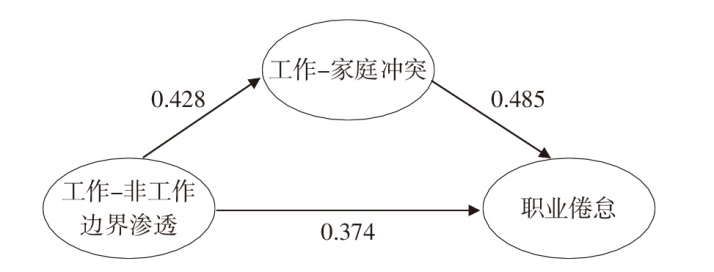
目的 调查皮肤科护士职业倦怠、工作-非工作边界渗透和工作-家庭冲突的现状,研究三者间相互作用,探讨工作-家庭冲突在皮肤科护士中的中介作用,为制定干预措施降低皮肤科护士职业倦怠及提高临床护理工作效率提供参考。方法 2025年4—5月采用随机抽样法,以工作-非工作边界渗透量表、工作-家庭冲突量表和职业倦怠量表对成都市5家综合性三级甲等医院174名皮肤科护士进行调查,并对数据进行分析。结果 皮肤科护士工作-非工作边界渗透得分为(48.83±7.64)分,工作-家庭冲突为(58.74±9.25)分,职业倦怠得分为(60.32±12.54)分。不同职称等级、年龄、平均月夜班频次及平均月收入、婚姻状况的皮肤科护士工作-非工作边界渗透、工作-家庭冲突、职业倦怠得分比较,差异均有统计学意义(均P<0.05)。皮肤科护士工作-非工作边界渗透和职业倦怠呈正相关(r=0.591,P<0.01),工作-家庭冲突和职业倦怠呈正相关(r=0.629,P<0.01),工作-非工作边界渗透和工作-家庭冲突呈正相关(r=0.635,P<0.01)。工作-家庭冲突在皮肤科护士工作-非工作边界渗透和职业倦怠间起部分中介作用,中介效应值为0.208,占总效应的35.74%。结论 皮肤科护士工作-非工作边界渗透、工作-家庭冲突和职业倦怠处于较高水平,其中工作-家庭冲突在工作-非工作边界渗透与职业倦怠间发生部分中介作用。降低皮肤科护士工作-家庭冲突和工作-非工作边界渗透水平有利于改善其职业倦怠状况及提高临床护理工作效率。

关键词: 皮肤科护士, 工作-非工作边界渗透, 工作-家庭冲突, 职业倦怠, 影响因素, 路径分析

Abstract:

Objective To investigate the current status of occupational burnout,work-non-work boundary penetration and work-family conflict among dermatology nurses and study the interaction among the three,explore the mediating role of work-family conflict,and provide a reference for formulating intervention measures to reduce occupational burnout of dermatology nurses and improve clinical nursing work efficiency. Methods From April to May 2025,a random sampling method was used to survey 174 dermatology nurses from 5 grade-A tertiary general hospitals in Chengdu using the work-non-work boundary penetration scale,work-family conflict scale and occupational burnout scale,and the data were analyzed. Results The work-non-work boundary penetration score of dermatology nurses was (48.83±7.64)points,work-family conflict score was (58.74±9.25)points,and occupational burnout score was (60.32±12.54)points. The scores of work-non-work boundary penetration,work-family conflict,and occupational burnout of dermatology nurses with different clinical nursing professional titles,ages,average monthly night shift frequency,average monthly total salary,and marital status were compared,and the differences were statistically significant(all P<0.05). Work-non-work boundary penetration was positively correlated with burnout(r=0.591,P<0.01),work-family conflict was positively correlated with burnout(r=0.629,P<0.01),and work-non-work boundary permeability was positively correlated with work-family conflict(r=0.635,P<0.01). Work-family conflict partially mediated the relationship between work-non-work boundary permeability and burnout among dermatology nurses,with a mediating effect value of 0.208,accounting for 35.74% of the total effect. Conclusion Work-non-work boundary permeability,work-family conflict,and burnout all at relatively high levels among dermatology nurses,and work-family conflict partially mediates the relationship between work-non-work boundary permeability and burnout. Reducing work-family conflict and work-non-work boundary permeability among dermatology nurses can help improve their burnout and enhance clinical nursing efficiency.

Key words: Dermatology nurse, Work-non-work boundary penetration, Work-family conflict, Occupational burnout, Influencing factors, Path analysis

中图分类号: