职业与健康 ›› 2026, Vol. 42 ›› Issue (8): 1030-1034.

• 论著 • 上一篇    下一篇

三级甲等综合医院急诊科护士工作-家庭增益、心理资本对职业倦怠的影响

顾蒙, 陈凤, 曹云   

  1. 南京医科大学附属第一医院江苏 南京 210029
  • 收稿日期:2025-05-18 修回日期:2025-09-23 出版日期:2026-04-15 发布日期:2026-05-18
  • 作者简介:顾蒙,女,护师,主要从事急诊科临床护理工作。

Impact of work family gain and psychological capital on occupational burnout among emergency department nurses in grade-A tertiary comprehensive hospitals

GU Meng, CHEN Feng, CAO Yun   

  1. The First Affiliated Hospital of Nanjing Medical UniversityNanjingJiangsu 210029, China
  • Received:2025-05-18 Revised:2025-09-23 Online:2026-04-15 Published:2026-05-18

摘要:

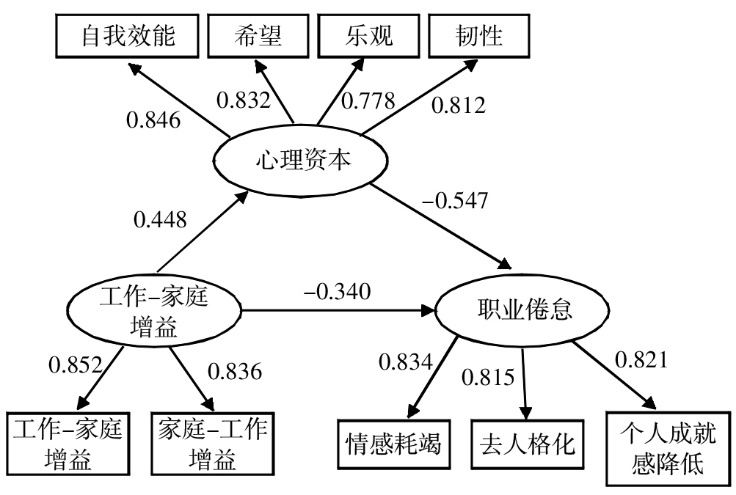
目的 了解三级综合医院急诊科护士工作-家庭增益、心理资本对职业倦怠的影响,并探讨心理资本的中介作用。方法 于2024年9—11月,采用便利抽样法抽取研究对象,使用工作-家庭增益量表、心理资本量表和职业倦怠量表对南京市6所三级甲等综合医院急诊科的196名护士进行问卷调查,并对数据进行分析。结果 调查的196名急诊科护士工作-家庭增益、心理资本和职业倦怠得分分别为(44.64±7.28)、(91.15±18.76)和(60.58±12.52)分。急诊科护士工作-家庭增益的主要影响因素为年龄、工作年限、职称、月收入、每月值夜班频次(均P<0.01),心理资本的主要影响因素为年龄、工作年限、职称、月收入、每月值夜班频次(均P<0.05),职业倦怠的主要影响因素为年龄、工作年限、职称、月收入、每月值夜班频次(均P<0.05)。研究对象的职业倦怠与工作-家庭增益、心理资本均呈负相关(r=-0.608、-0.584,均P<0.01),工作-家庭增益与心理资本呈正相关(r=0.566,P<0.01);心理资本在工作-家庭增益和职业倦怠的关系中发挥部分中介作用,中介效应为-0.245,占比41.88%。结论 急诊科护士职业倦怠处于较高水平,提高急诊科护士工作-家庭增益和心理资本水平,有利于降低急诊科护士职业倦怠水平,改善身心健康。

关键词: 急诊科护士, 工作-家庭增益, 心理资本, 职业倦怠, 影响因素

Abstract:

Objective To investigate the impact of work family gain and psychological capital on occupational burnout among emergency department nurses in grade-A tertiary comprehensive hospitals,and to explore the mediating role of psychological capital. Methods From September to November 2024,a convenience sampling method was used to select survey subjects. A questionnaire survey was conducted on 196 nurses in the emergency departments of six grade-A tertiary comprehensive hospitals in Nanjing City using the work family gain scale,psychological capital scale,and occupational burnout scale,and the data were analyzed. Results The work family gain,psychological capital,and occupational burnout scores of 196 emergency department nurses in this group were (44.64±7.28),(91.15±18.76),and (60.58±12.52)points,respectively. The main influencing factors of work family gain for emergency department nurses were age,years of work experience,professional title,monthly income,and frequency of night shifts per month(all P<0.05). The main influencing factors of psychological capital were age,years of work experience,professional title,monthly income,and frequency of night shifts per month(all P<0.05). The main influencing factors of occupational burnout were age,years of work experience,professional title,monthly income,and frequency of night shifts per month(all P<0.05). The occupational burnout of emergency department nurses was negatively correlated with work family gain and psychological capital(r=-0.608,-0.584,both P<0.01),while work family gain was positively correlated with psychological capital(r=0.566,P<0.01). The psychological capital of emergency department nurses partially mediated the relationship between work family gain and occupational burnout,with a mediation effect value of -0.245,accounting for 41.88%. Conclusion The occupational burnout of emergency department nurses is at a high level. Improving the work family gain and psychological capital level of emergency department nurses is beneficial for reducing their occupational burnout level and improving their physical and mental health.

Key words: Emergency department nurse, Work family gain, Psychological capital, Occupational burnout, Influence factor

中图分类号: