


职业与健康 ›› 2026, Vol. 42 ›› Issue (9): 1186-1193.
哈志云1, 魏美娜1, 吴艳多1, 王波2,3, 马雪2,3, 徐海明2,3( )
)
收稿日期:2025-08-31
修回日期:2025-09-25
出版日期:2026-05-01
发布日期:2026-05-22
通信作者:
徐海明,E-mail:xuhaiming1986@nxmu.edu.cn
作者简介:哈志云,男,公共卫生主治医师,主要从事职业卫生与职业医学研究工作。
基金资助:
HA Zhiyun1, WEI Meina1, WU Yanduo1, WANG Bo2,3, MA Xue2,3, XU Haiming2,3()
Received:2025-08-31
Revised:2025-09-25
Online:2026-05-01
Published:2026-05-22
Contact:
XU Haiming,E-mail:xuhaiming1986@nxmu.edu.cn
摘要:
目的 利用生物信息学方法分析细颗粒物(particulate matter 2.5,PM2.5)对人支气管上皮BEAS-2B细胞基因表达的影响,筛选出差异表达基因(differentially expressed genes,DEGs),为PM2.5所致呼吸系统损伤及机制提供参考依据。方法 从美国国家生物技术信息中心(the National Center for Biotechnology Information,NCBI)的基因表达综合数据库(gene expession omnibus,GEO)中检索PM2.5暴露BEAS-2B细胞相关的数据集(GSE158954),采用R语言对基因表达数据矩阵进行DEGs的筛选、基因本体论(gene ontology,GO)功能富集分析和京都基因与基因组百科全书(kyoto encyclopedia of genes and genomes,KEGG)信号通路分析,同时采用STRING数据库和Cytoscape 3.8.0软件构建蛋白质-蛋白质相互作用网络,MCODE插件筛选关键基因,使用NCBI Gene数据库对DEGs进行相对表达水平分析。结果 GSE158954数据集中,包含6个样本,其中GSM4816385~GSM4816387为对照组,GSM4816388~GSM4816390为PM2.5 暴露组。分析结果表明,DEGs共235个(矫正后P<0.05及|log2FC|≥1),其中上调基因121个,下调基因114个。GO分析结果表明,DEGs显著富集于多个生物学过程、细胞组分及分子功能模块。生物学过程方面,主要涉及巨噬细胞以及中性粒细胞的趋化性等过程,提示其在免疫细胞迁移调控中发挥潜在作用;细胞组分层面,集中定位于细胞膜、细胞质以及胞质溶胶区域,提示 DEGs 可能参与这些亚细胞结构相关的生理活动;分子功能模块显示,DEGs主要发挥蛋白质结合功能,这与其参与众多细胞内信号转导通路及分子间相互作用紧密相关。KEGG分析结果显示,除病毒相关信号通道外,DEGs主要参与PI3K-Akt等信号通路,进一步筛选得到27个关键基因,分别为PTGS2、CXCL8、CCL2、IL1B、TNFSF10、IL1A、JUN、IL-6、TLR3、TRIM21、USP18、IFIT5、MX1、EGFR、CASP1、STAT2、GBP1、SAMD9L、OAS2、PARP9、RTP4、IFI35、MX2、TRIM22、UBE2L6、SP110和CMPK2。多数DEGs相对表达水平在肺组织中较高。结论 本研究揭示PM2.5通过调控PTGS2以及CXCL8等27个关键基因影响PI3K-Akt等信号通路,可能介导呼吸道炎症反应及免疫调节失衡。这些发现为PM2.5致呼吸损伤机制提供了新见解。
中图分类号:
哈志云, 魏美娜, 吴艳多, 王波, 马雪, 徐海明. 基于生物信息学分析PM2.5对人支气管上皮BEAS-2B细胞基因表达的影响. [J]职业与健康, 2026, 42(9): 1186-1193.
HA Zhiyun, WEI Meina, WU Yanduo, WANG Bo, MA Xue, XU Haiming. Analysis of the effects of PM2.5 on gene expression in human bronchial epithelial BEAS-2B cells based on bioinformatics. [J]OCCUPATION AND HEALTH, 2026, 42(9): 1186-1193.
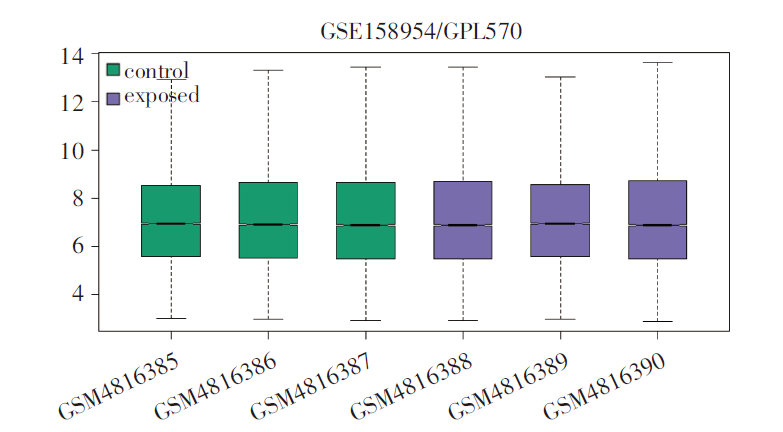
图1 表达矩阵箱式图 注:control和exposed分别表示对照组和PM2.5暴露组。
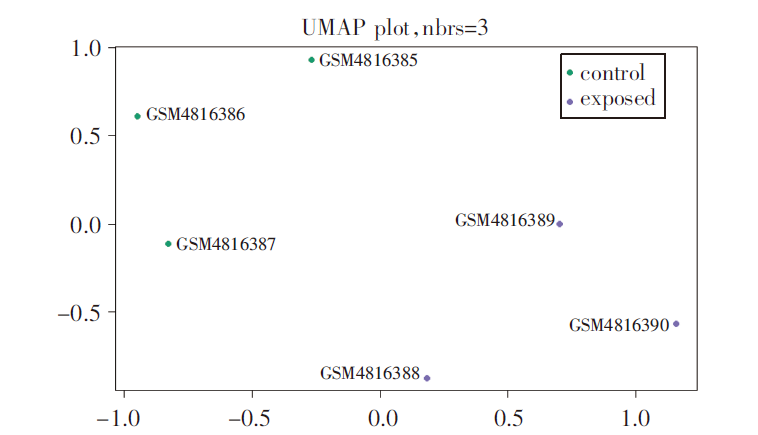
图2 表达矩阵PCA图 注:PCA—主成分分析;control和exposed分别表示对照组和PM2.5暴露组。
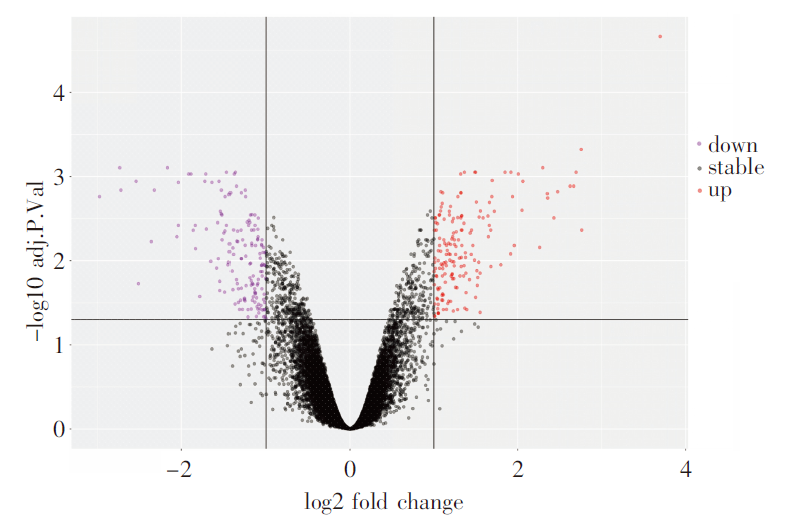
图3 火山图
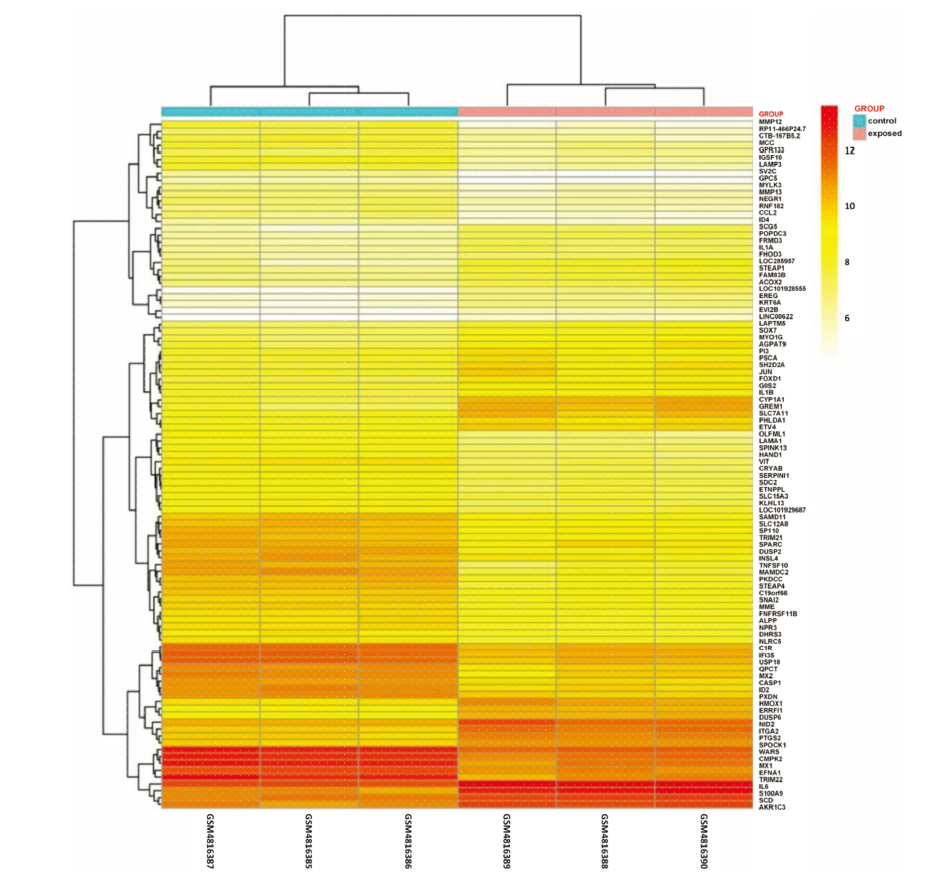
图4 DEGs热图 注:control和exposed分别表示对照组和PM2.5暴露组;DEGs—差异表达基因。
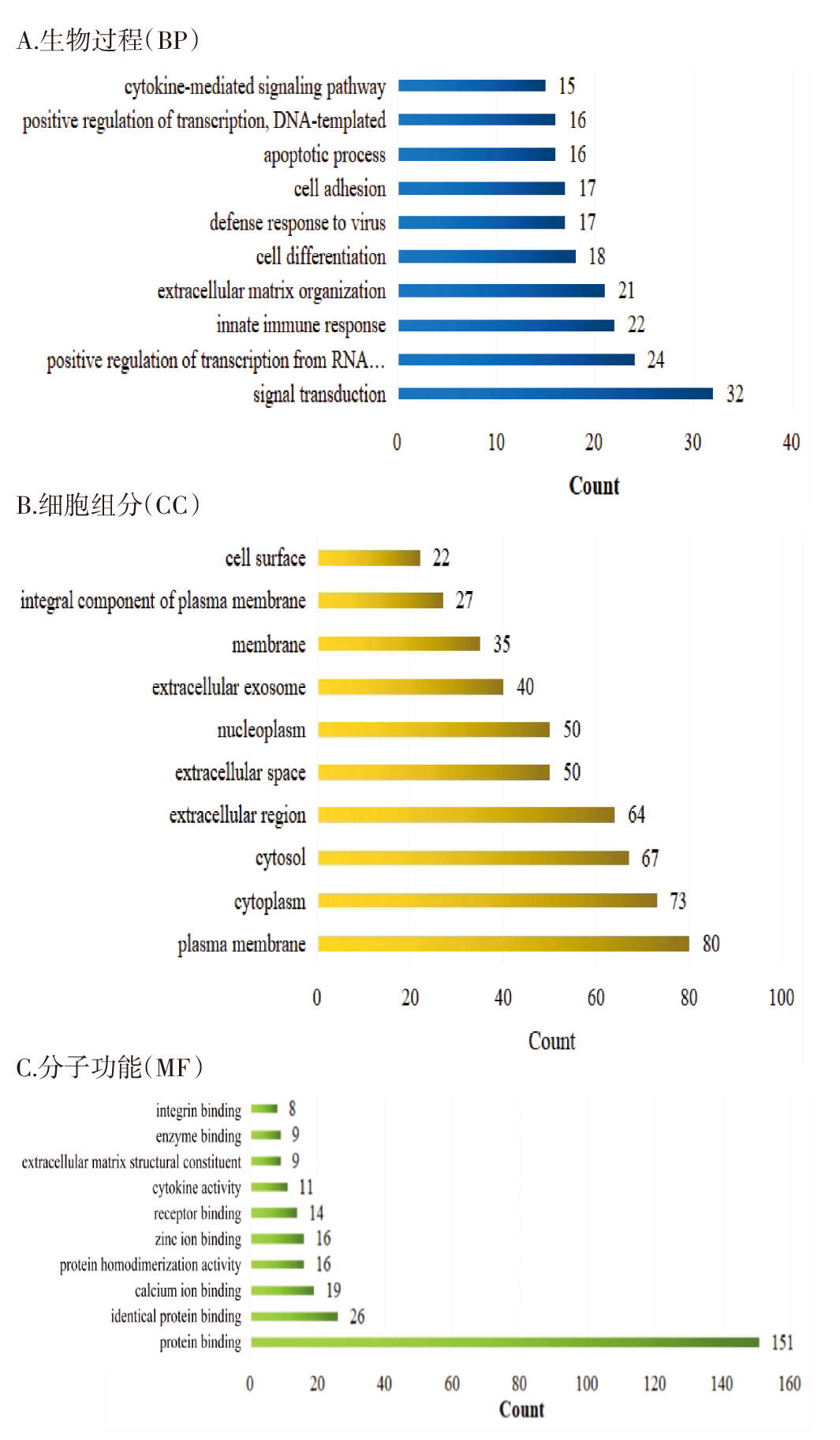
图5 DEGs的GO富集分析结果 注:A.生物过程(BP)中,cytokine-mediated signaling pathway—细胞因子介导的信号通路;positive regulation of transcription,DNA-templated—转录的正向调控(以DNA为模板);apoptotic process—细胞凋亡过程;cell adhesion—细胞粘附;defense response to virus—病毒防御反应;cell differentiation—细胞分化;extracellular matrix organization—细胞外基质组织;innate immune response—固有免疫应答;positive regulation of transcription from RNA polymerase II promoter—RNA聚合酶II启动子转录的正调控;signal transduction—信号转导。B.细胞组分(CC)中,cell surface—细胞表面;integral component of plasma membrane—质膜的组成部分;membrane—膜;extracellular exosome—细胞外外泌体;nucleoplasm—核质;extracellular space—细胞外空间;extracellular region—胞外区;cytosol—胞液;cytoplasm—细胞质;plasma membrane—质膜。C.分子功能(MF)中,integrin binding—整合素结合;enzyme binding—酶结合;extracellular matrix structural constituent—细胞外基质结构成分;cytokine activity—细胞因子活性;receptor binding—受体结合;zinc ion binding—锌离子结合;protein homodimerization activity—蛋白质同源二聚化活性;calcium ion binding—钙离子结合;identical protein binding—同源蛋白结合;protein binding—蛋白质结合。
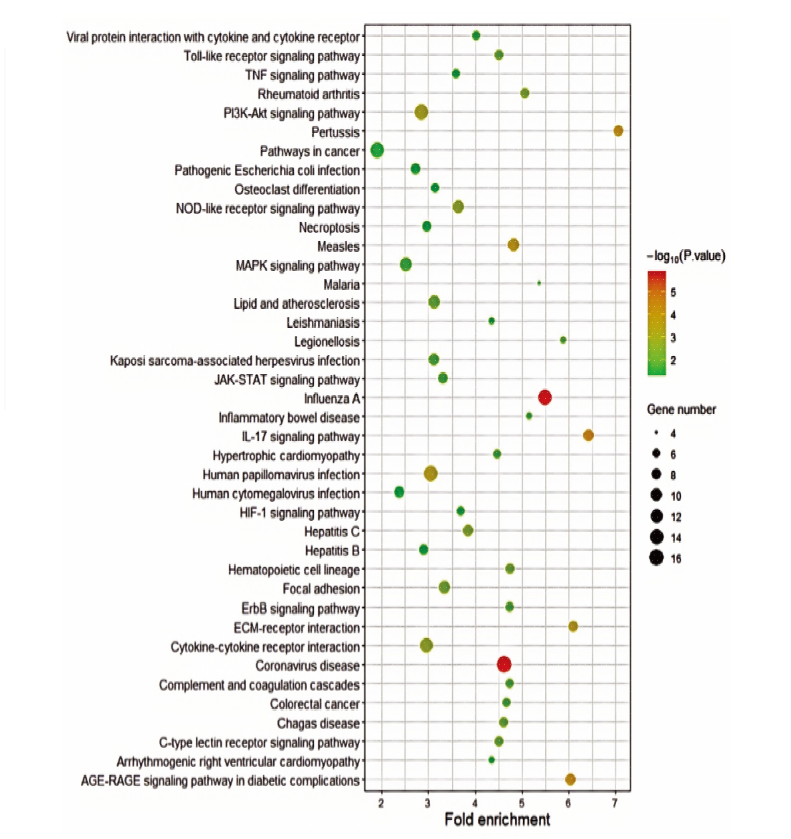
图6 DEGs的KEGG分析结果(气泡图) 注:Viral protein interaction with cytokine and cytokine receptor—病毒蛋白与细胞因子及细胞因子受体的相互作用;Toll-like receptor signaling pathway—Toll样受体信号通路;TNF signaling pathway—TNF信号通路;Rheumatoid arthritis—类风湿性关节炎;PI3K-Akt signaling pathway—PI3K-Akt信号通路;Pertussis—百日咳;Pathways in cancer—癌症相关通路;Pathogenic Escherichia coli infection—致病性大肠杆菌感染;Osteoclast differentiation—破骨细胞分化;NOD-like receptor signaing pathway—NOD样受体信号通路;Necroptosis—坏死性凋亡;Measles—麻疹;MAPK signaling pathway—MAPK信号通路;Malaria—疟疾;Lipid and atherosclerosis—脂质与动脉粥样硬化;Leishmaniasis—利什曼病;Legionellosis—军团病;Kaposi sarcoma-associated herpesvirus infection—卡波济肉瘤相关疱疹病毒感染;JAK-STAT signaling pathway—JAK-STAT信号通路;Influenza A—甲型流感;Inflammatory bowel disease—炎症性肠病;IL-17 signaling pathway—IL-17信号通路;Hypertrophic cardiomyopathy—肥厚型心肌病;Human papillomavirus infection—人乳头瘤病毒感染;Human cytomegalovirus infection—人巨细胞病毒感染;HIF-1 signaling pathway—HIF-1信号通路;Hepatitis C—丙型肝炎;Hepatitis B—乙型肝炎;Hematopoietic cell lineage—造血细胞系;Focal adhesion—黏着斑;ErbB signaling pathway—ErbB信号通路;ECM-receptor interaction—ECM受体相互作用;Cytokine-cytokine receptor interaction—细胞因子-细胞因子受体相互作用;Coronavirus disease—冠状病毒疾病;Complement and coagulation cascades—补体和凝血级联反应;Colorectal cancer—结直肠癌;Chagas disease—恰加斯病;C-type lectin receptor signaling pathway—C型凝集素受体信号通路;Arrhythmogenic right ventricular cardiomyopathy—致心律失常性右心室心肌病;AGE-RAGE signaling pathway in diabetic complications—糖尿病并发症中的AGE-RAGE信号通路。
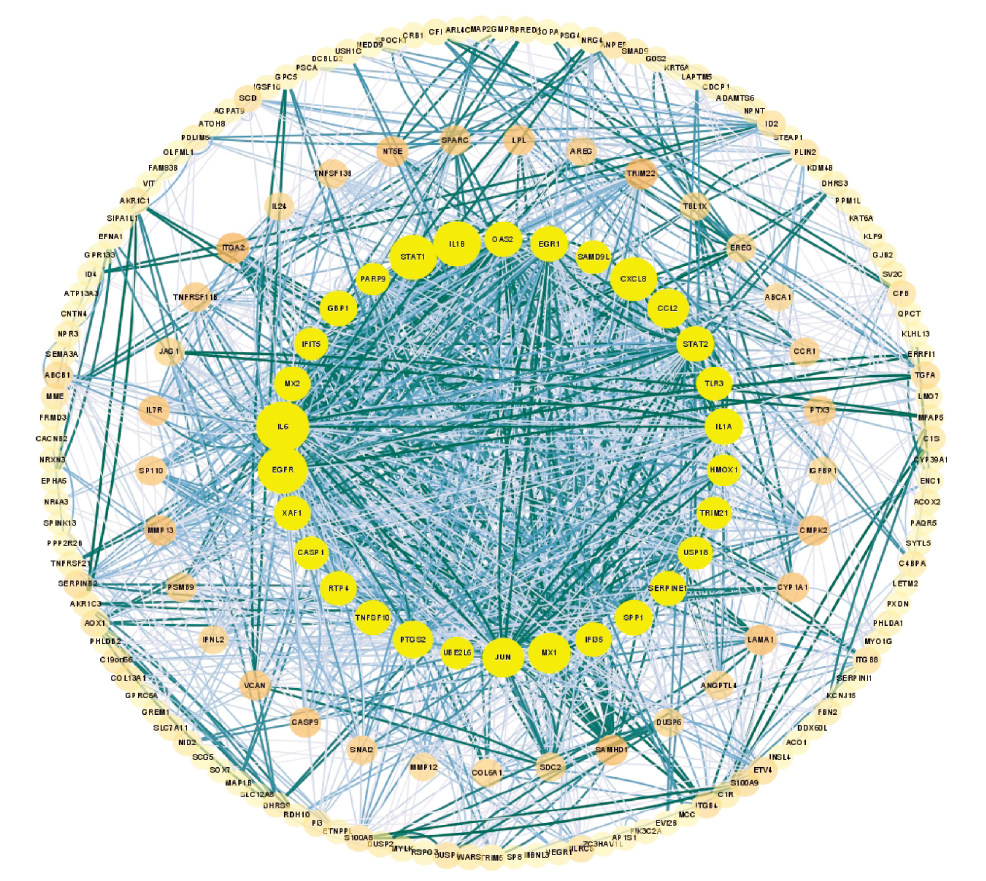
图7 DEGs的PPI网络图 注:DEGs—差异表达基因;PPI—蛋白质-蛋白质相互作用。
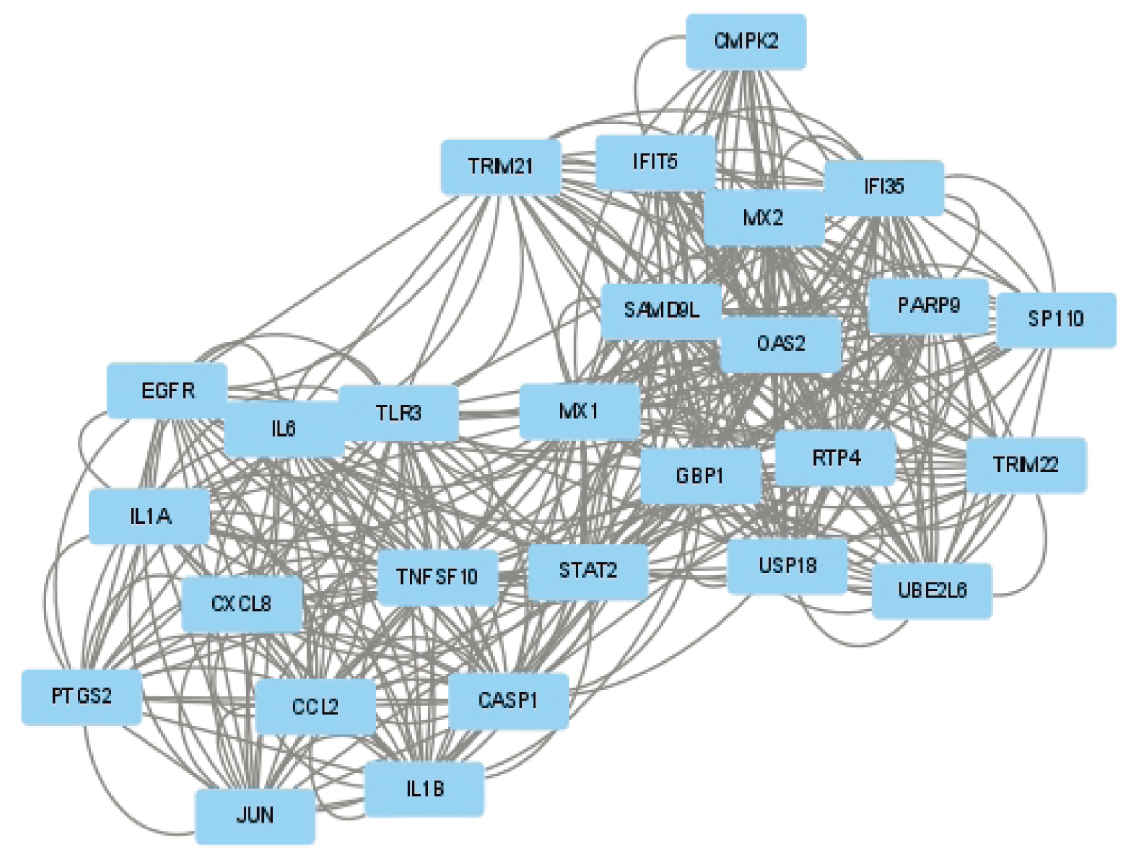
图8 PPI网络图关键基因模块 注:PPI—蛋白质-蛋白质相互作用。
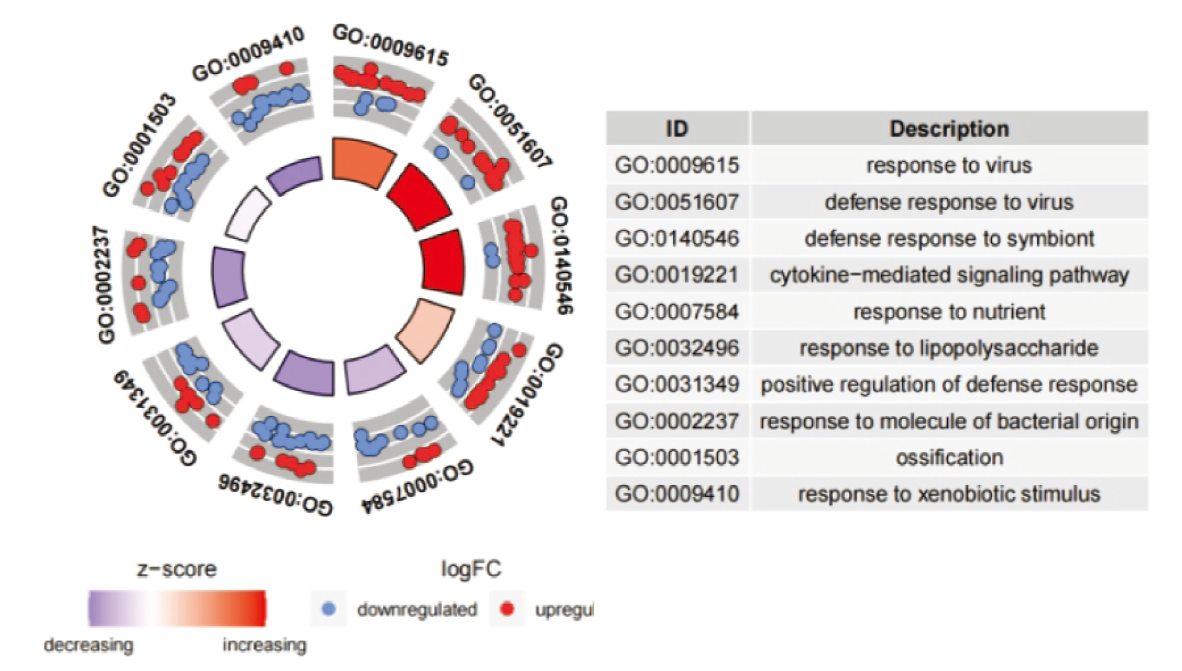
图9 DEGs的GO圈图 注:response to virus—对病毒的反应;defense response to virus—对病毒的防御反应;defense response to symbiont—对共生体的防御反应;cytokine-mediated signaling pathway—细胞因子介导的信号通路;response to nutrient—对营养物质的反应;response to lipopolysacharide—对脂多糖的反应;positive regulation of defense response—防御反应的正向调控;response to molecule of bacterial origin—对细菌来源分子的反应;ossification—骨化;response to xenobiotic stimulus—对外源性刺激的反应;DEGs—差异表达基因;GO—基因本体论。
| 类别 | 关键基因 | 功能(侧重呼吸系统) | 肺组织中相对 表达水平 |
|---|---|---|---|
| 细胞因子类 | CCL2 | 趋化因子是参与免疫调节和炎症过程的一类分泌蛋白的超家族,编码蛋白的表达升高与严重急性呼吸综合征冠状病毒 2(SARS-CoV-2)感染有关。 | 4.93 |
| CXCL8 | 该基因在下呼吸道感染的发病机理中发挥作用,这是由呼吸综合病毒(RSV)引起的常见呼吸道疾病。该促炎蛋白的过量生产被认为会导致与纤维化相关的肺部炎症。 | 18.89 | |
| IL1A | 该细胞因子是一种参与各种免疫反应,炎症过程和造血的多效细胞因子。 | 5.47 | |
| IL1B | 该细胞因子是炎症反应的重要介质,并且参与了各种细胞活性,包括细胞增殖,分化和凋亡。 | 1.72 | |
| IL-6 | 该蛋白主要在急性和慢性炎症部位产生,在病毒感染中发现了升高的编码蛋白水平。 | 12.00 | |
| 肿瘤坏死因子超家族成员 | TNFSF10 | 可诱导肿瘤细胞凋亡,在肺部可能参与对抗肿瘤细胞及调节免疫反应。 | 7.91 |
| 模式识别受体相关基因 | TLR3 | 可识别病毒双链RNA,激活免疫细胞,启动抗病毒免疫反应,在肺部抵御病毒感染中起作用。 | 2.63 |
| 免疫相关基因(干扰素诱导基因) | IFIT5 | 可被干扰素诱导表达,具有抗病毒功能,在肺部抵抗病毒感染中发挥作用。 | 1.78 |
| IFI35 | 可被干扰素诱导,可能在肺部细胞的抗病毒免疫和炎症调节中起作用。 | 4.40 | |
| Mx1 | 主要参与抗病毒防御,可抑制流感病毒等在肺部细胞内的复制。 | 3.39 | |
| Mx2 | 与MX1类似,具有抗病毒功能,有助于肺部抵御病毒感染。 | 1.11 | |
| USP18 | 在干扰素信号通路中起调节作用,影响肺部细胞的抗病毒状态。 | 9.08 | |
| 其他免疫调节基因 | CASP1 | 可将无活性的炎症因子前体切割为有活性的形式,促进肺部炎症反应。 | 3.86 |
| EGFR | 参与肺部上皮细胞的生长、增殖和修复,其异常与肺部肿瘤等疾病相关。 | 1.43 | |
| TRIM21 | 参与细胞内的免疫防御,可能在肺部细胞抗病毒等免疫过程中发挥作用。 | — | |
| TRIM22 | 参与细胞的抗病毒防御和免疫调节,在肺部免疫反应中发挥作用。 | 4.56 | |
| 信号转导相关基因 | JUN | 作为转录因子,可调控许多与肺部炎症、细胞增殖等相关基因的表达。 | — |
| STAT2 | 是干扰素信号通路的关键转录因子,调节肺部细胞的抗病毒、免疫相关基因表达。 | 1.14 | |
| 其他功能基因 | CMPK2 | 参与核苷酸代谢,为细胞的增殖等活动提供原料,在肺部细胞的生长、修复等过程中起作用。 | 2.81 |
| GBP1 | 具有抗病毒、抗菌活性,在肺部感染时可发挥免疫防御作用。 | 4.35 | |
| OAS2 | 在干扰素诱导的抗病毒反应中起作用,可激活RNA酶L来降解病毒RNA。 | 5.87 | |
| PTGS2 | 可催化花生四烯酸生成前列腺素,在肺部炎症反应中起重要作用,参与调节气道平滑肌收缩等。 | 2.83 | |
| PARP9 | 可能参与炎症和免疫调节,在肺部炎症等过程中可能有一定作用。 | 1.80 | |
| RTP4 | 可能参与膜蛋白的转运等过程,在肺部可能与细胞的物质运输和信号转导有关。 | 1.31 | |
| SAMD9L | 可能参与细胞的生长调节和抗病毒反应,在肺部可能与维持细胞正常状态及抗病毒有关。 | 13.33 | |
| SP110 | 可能参与核体的形成和基因转录调控,在肺部可能与免疫相关基因的表达调控有关。 | 1.29 | |
| UBE2L6 | 参与蛋白质的泛素化修饰,可能在肺部细胞的信号转导、免疫调节等过程中起作用。 | 1.71 |
表1 DEGs的功能及其在肺组织中的相对表达水平
| 类别 | 关键基因 | 功能(侧重呼吸系统) | 肺组织中相对 表达水平 |
|---|---|---|---|
| 细胞因子类 | CCL2 | 趋化因子是参与免疫调节和炎症过程的一类分泌蛋白的超家族,编码蛋白的表达升高与严重急性呼吸综合征冠状病毒 2(SARS-CoV-2)感染有关。 | 4.93 |
| CXCL8 | 该基因在下呼吸道感染的发病机理中发挥作用,这是由呼吸综合病毒(RSV)引起的常见呼吸道疾病。该促炎蛋白的过量生产被认为会导致与纤维化相关的肺部炎症。 | 18.89 | |
| IL1A | 该细胞因子是一种参与各种免疫反应,炎症过程和造血的多效细胞因子。 | 5.47 | |
| IL1B | 该细胞因子是炎症反应的重要介质,并且参与了各种细胞活性,包括细胞增殖,分化和凋亡。 | 1.72 | |
| IL-6 | 该蛋白主要在急性和慢性炎症部位产生,在病毒感染中发现了升高的编码蛋白水平。 | 12.00 | |
| 肿瘤坏死因子超家族成员 | TNFSF10 | 可诱导肿瘤细胞凋亡,在肺部可能参与对抗肿瘤细胞及调节免疫反应。 | 7.91 |
| 模式识别受体相关基因 | TLR3 | 可识别病毒双链RNA,激活免疫细胞,启动抗病毒免疫反应,在肺部抵御病毒感染中起作用。 | 2.63 |
| 免疫相关基因(干扰素诱导基因) | IFIT5 | 可被干扰素诱导表达,具有抗病毒功能,在肺部抵抗病毒感染中发挥作用。 | 1.78 |
| IFI35 | 可被干扰素诱导,可能在肺部细胞的抗病毒免疫和炎症调节中起作用。 | 4.40 | |
| Mx1 | 主要参与抗病毒防御,可抑制流感病毒等在肺部细胞内的复制。 | 3.39 | |
| Mx2 | 与MX1类似,具有抗病毒功能,有助于肺部抵御病毒感染。 | 1.11 | |
| USP18 | 在干扰素信号通路中起调节作用,影响肺部细胞的抗病毒状态。 | 9.08 | |
| 其他免疫调节基因 | CASP1 | 可将无活性的炎症因子前体切割为有活性的形式,促进肺部炎症反应。 | 3.86 |
| EGFR | 参与肺部上皮细胞的生长、增殖和修复,其异常与肺部肿瘤等疾病相关。 | 1.43 | |
| TRIM21 | 参与细胞内的免疫防御,可能在肺部细胞抗病毒等免疫过程中发挥作用。 | — | |
| TRIM22 | 参与细胞的抗病毒防御和免疫调节,在肺部免疫反应中发挥作用。 | 4.56 | |
| 信号转导相关基因 | JUN | 作为转录因子,可调控许多与肺部炎症、细胞增殖等相关基因的表达。 | — |
| STAT2 | 是干扰素信号通路的关键转录因子,调节肺部细胞的抗病毒、免疫相关基因表达。 | 1.14 | |
| 其他功能基因 | CMPK2 | 参与核苷酸代谢,为细胞的增殖等活动提供原料,在肺部细胞的生长、修复等过程中起作用。 | 2.81 |
| GBP1 | 具有抗病毒、抗菌活性,在肺部感染时可发挥免疫防御作用。 | 4.35 | |
| OAS2 | 在干扰素诱导的抗病毒反应中起作用,可激活RNA酶L来降解病毒RNA。 | 5.87 | |
| PTGS2 | 可催化花生四烯酸生成前列腺素,在肺部炎症反应中起重要作用,参与调节气道平滑肌收缩等。 | 2.83 | |
| PARP9 | 可能参与炎症和免疫调节,在肺部炎症等过程中可能有一定作用。 | 1.80 | |
| RTP4 | 可能参与膜蛋白的转运等过程,在肺部可能与细胞的物质运输和信号转导有关。 | 1.31 | |
| SAMD9L | 可能参与细胞的生长调节和抗病毒反应,在肺部可能与维持细胞正常状态及抗病毒有关。 | 13.33 | |
| SP110 | 可能参与核体的形成和基因转录调控,在肺部可能与免疫相关基因的表达调控有关。 | 1.29 | |
| UBE2L6 | 参与蛋白质的泛素化修饰,可能在肺部细胞的信号转导、免疫调节等过程中起作用。 | 1.71 |
| [1] | FULLER R, LANDRIGAN P J, BALAKRISHNAN K, et al. Pollution and health:A progress update[J]. Lancet Planet Health, 2022, 6(6):e535-e547. |
| [2] |
MERK R, HE?ELBACH K, OSIPOVA A, et al. Particulate matter(PM2.5) from biomass combustion induces an anti-oxidative response and cancer drμg resistance in human bronchial epithelial BEAS-2B cells[J]. Int J Environ Res Public Health, 2020, 17(21):8193.
DOI URL |
| [3] |
BASU N, LANPHEAR B P. The challenge of pollution and health in Canada[J]. Can J Public Health, 2019, 110(2):159-164.
DOI PMID |
| [4] | LI T, HU R, CHEN Z, et al. Fine particulate matter(PM2.5):The culprit for chronic lung diseases in China[J]. Chronic Dis Transl Med, 2018, 4(3):176-186. |
| [5] | ZANOBETTI A, FRANKLIN M, KOUTRAKIS P, et al. Fine particulate air pollution and its components in association with cause-specific emergency admissions[J]. Environ Health, 2009,8:58. |
| [6] |
GAO J, LEI T, WANG H, et al. Dimethylarginine dimethylaminohydrolase 1 protects PM2.5 exposure-induced lung injury in mice by repressing inflammation and oxidative stress[J]. Part Fibre Toxicol, 2022, 19(1):64.
DOI |
| [7] | 杨洁, 邓建军, 刘靳波, 等. PM2.5的肺毒性机制研究进展[J]. 环境与职业医学, 2016, 33(6):615-619. |
| [8] | 梁爽, 闫冰, 王成硕, 等. 空气细颗粒物通过补体C3a/C3aR轴诱导上皮细胞炎症[J]. 中国耳鼻咽喉头颈外科, 2023, 30(6):377-381. |
| [9] | LI H, ZHAO Z, LUO X S, et al. Insight into urban PM2.5 chemical composition and environmentally persistent free radicals attributed human lung epithelial cytotoxicity[J]. Ecotoxicol Environ Saf, 2022,234:113356. |
| [10] |
QU L, LI Y, CHEN C, et al. Caveolin-1 identified as a key mediator of acute lung injury using bioinformatics and functional research[J]. Cell Death Dis, 2022, 13(8):686.
DOI PMID |
| [11] | Health Effects Institute. State of Global Air 2018:Air pollution a significant risk factor worldwide[EB/OL].(2018-12-31)[2025-05-01]. https://www.stateofglobalair.org/sites/default/files/soga-2018-report.pdf. |
| [12] |
PUN V C, KAZEMIPARKOUHI F, MANJOURIDES J, et al. Long-term PM2.5 exposure and respiratory,cancer,and cardiovascular mortality in older US adults[J]. Am J Epidemiol, 2017, 186(8):961-969.
DOI URL |
| [13] |
CAO Q, RUI G, LIANG Y. Study on PM2.5 pollution and the mortality due to lung cancer in China based on geographic weighted regression model[J]. BMC Public Health, 2018, 18(1):925.
DOI |
| [14] |
HU Y, JI J S, ZHAO B. Deaths attributable to indoor PM2.5 in urban China when outdoor air meets 2021 WHO air quality guidelines[J]. Environ Sci Technol, 2022, 56(22):15882-15891.
DOI URL |
| [15] |
CHEN C Y, HUANG K Y, CHEN CC, et al. The role of PM2.5 exposure in lung cancer:mechanisms,genetic factors,and clinical implications[J]. EMBO Mol Med, 2025, 17(1):31-40.
DOI |
| [16] | SONG X, LIU J, GENG N, et al. Multi-omics analysis to reveal disorders of cell metabolism and integrin signaling pathways induced by PM2.5[J]. J Hazard Mater, 2022, 424(Pt C):127573. |
| [17] |
LIU L, WAN C, ZHANG W, et al. MiR-146a regulates PM1-induced inflammation via NF-κB signaling pathway in BEAS-2B cells[J]. Environ Toxicol, 2018, 33(7):743-751.
DOI URL |
| [18] |
FARZAN S F, LI Z, KORRICK S A, et al. Infant infections and respiratory symptoms in relation to in utero arsenic exposure in a U.S. cohort[J]. Environ Health Perspect, 2016, 124(6):840-847.
DOI URL |
| [19] |
LEE J, JEONG J S, KIM S Y, et al. Titanium dioxide nanoparticles oral exposure to pregnant rats and its distribution[J]. Part Fibre Toxicol, 2019, 16(1):31.
DOI PMID |
| [20] |
LI T, YU Y, SUN Z, et al. A comprehensive understanding of ambient particulate matter and its components on the adverse health effects based from epidemiological and laboratory evidence[J]. Part Fibre Toxicol, 2022, 19(1):67.
DOI PMID |
| [21] |
FAJGENBAUM D C, JUNE C H. Cytokine storm[J]. N Engl J Med, 2020, 383(23):2255-2273.
DOI URL |
| [22] |
SPANDAU U H, TOKSOY A, VERHAART S, et al. High expression of chemokines Gro-alpha(CXCL-1),IL-8(CXCL-8),and MCP-1(CCL-2) in inflamed human corneas in vivo[J]. Arch Ophthalmol, 2003, 121(6):825-831.
DOI URL |
| [23] |
CHYUAN I T, HSU P N. TRAIL regulates T cell activation and suppresses inflammation in autoimmune diseases[J]. Cell Mol Immunol, 2020, 17(12):1281-1283.
DOI |
| [24] | MITCHELL J P, CARMODY R J. NF-κB and the transcriptional control of inflammation[J]. Int Rev Cell Mol Biol, 2018,335:41-84. |
| [25] |
SURESH M V, DOLGACHEV V A, ZHANG B, et al. TLR3 absence confers increased survival with improved macrophage activity against pneumonia[J]. JCI Insight, 2019, 4(23):e131195.
DOI URL |
| [26] |
HONKE N, SHAABANI N, ZHANG D E, et al. Multiple functions of USP18[J]. Cell Death Dis, 2016, 7(11):e2444.
DOI |
| [27] |
GAO S P, MARK K G, LESLIE K, et al. Mutations in the EGFR kinase domain mediate STAT3 activation via IL-6 production in human lung adenocarcinomas[J]. J Clin Invest, 2007, 117(12):3846-3856.
DOI PMID |
| [28] | HABERZETTL P, MCCRACKEN J P, BHATNAGAR A, et al. Insulin sensitizers prevent fine particulate matter-induced vascular insulin resistance and changes in endothelial progenitor cell homeostasis[J]. Am J Physiol Heart Circ Physiol, 2016, 310(11):H1423-H1438. |
| [29] | KAPPLUSCH F, SCHULZE F, RABE-MATSCHEWSKY S, et al. CASP1 variants influence subcellular caspase-1 localization,pyroptosome formation,pro-inflammatory cell death and macrophage deformability[J]. Clin Immunol, 2019,208:108232. |
| [1] | 宋文颉, 闫帅, 王玉江, 张来颖. 2017—2022年北京市丰台区PM2.5中PAHs的污染特征及来源分析[J]. 职业与健康, 2026, 42(1): 54-59. |
| [2] | 宋全全, 柳淑琴, 孙武, 王秀珍, 李倩, 张书余. 温度和PM2.5暴露对小鼠肺泡巨噬细胞影响的实验研究[J]. 职业与健康, 2025, 41(7): 899-903. |
| [3] | 骆善彩, 孙中明, 徐梦颖, 吴鑫宇, 张雯, 葛恒康. 2017—2021年淮安市大气PM2.5对死亡健康影响及超额死亡风险评估[J]. 职业与健康, 2025, 41(2): 249-253. |
| [4] | 程萱, 姚艳, 王堃, 张思羽, 张智栋, 孟涛. 炭黑颗粒遗传毒性及其机制的研究进展[J]. 职业与健康, 2025, 41(11): 1563-1568. |
| [5] | 李奕奉, 万博宇, 马建新, 李文静. 2019—2023年北京市某区PM2.5污染特征分析[J]. 职业与健康, 2025, 41(1): 97-101. |
| [6] | 周婧, 代永慧, 史建勇, 王琛琛, 张玲, 吴顺华. 妊娠早期PM2.5多重环境暴露对孕妇甲状腺激素水平的影响[J]. 职业与健康, 2024, 40(8): 1102-1105. |
| [7] | 尤安琦, 肖叶, 黄雁林, 陈朝琼, 谢辉, 于力力. 持续控制大气PM2.5浓度的人群健康收益评估[J]. 职业与健康, 2024, 40(4): 443-446. |
| [8] | 易仁玲, 陈志永, 王珂, 陈小岳. 苏南某市大气污染物O3、PM2.5对呼吸系统门诊量的时间序列分析[J]. 职业与健康, 2024, 40(24): 3416-3421. |
| [9] | 张靖伟, 雷晓毅, 许明佳, 李伟, 许艳丹. 上海市某郊区大气PM2.5中金属及类金属元素污染特征及健康风险评价[J]. 职业与健康, 2024, 40(20): 2822-2827. |
| [10] | 贾艳丰, 杨天智, 王丽, 李峰, 高艳荣. 2020年包头市大气颗粒物PM2.5中多环芳烃的污染特征及健康风险评估[J]. 职业与健康, 2024, 40(2): 229-234. |
| [11] | 闫爱云, 张海燕, 蔡宇, 图雅, 王谱钧. 2020—2022年呼和浩特市城区大气PM2.5中5种水溶性离子污染特征分析[J]. 职业与健康, 2024, 40(17): 2400-2404. |
| [12] | 高伟, 焦柯影, 何新蕾, 郝瀚. 应用生物信息学从铁死亡角度筛选治疗矽肺病的天然药物成分[J]. 职业与健康, 2024, 40(14): 1889-1894. |
| [13] | 李盛, 王金玉, 王先良, 王冰洁, 郑艳妮. 兰州市榆中县农村住宅室内环境颗粒物水平及影响因素调查[J]. 职业与健康, 2023, 39(7): 945-949. |
| [14] | 陈翔, 倪蓉, 梁卫玖. 大气PM2.5中汞及其他19种元素的L-半胱氨酸直接加入-超声混酸提取-电感耦合等离子体质谱同时测定法[J]. 职业与健康, 2023, 39(5): 613-619. |
| [15] | 杨小波, 杨财平, 李琴娜, 万思丽. 2017—2021年宜昌市两区大气PM2.5中12种金属和类金属监测分析[J]. 职业与健康, 2023, 39(4): 515-518. |
| 阅读次数 | ||||||
|
全文 |
|
|||||
|
摘要 |
|
|||||
 津公网安备12010202000831号 津ICP备11005889号-6
