职业与健康 ›› 2026, Vol. 42 ›› Issue (17): 2421-2427.

• 卫生管理与研究 • 上一篇    下一篇

基于层次分析法的实验室生物安全多级评价体系构建与区域实证研究

冀云倩, 王栋, 臧长海()   

  1. 山西省临床检验中心山西 太原 030000
  • 收稿日期:2025-06-17 修回日期:2025-11-12 出版日期:2026-09-01 发布日期:2026-08-14
  • 通信作者: 臧长海 E-mail:596645915@qq.com
  • 作者简介:冀云倩,女,主管技师,主要从事生物安全管理与卫生管理工作。
  • 基金资助:
    山西省卫生健康委员会科研课题(2021120)

Construction of multi-level evaluation system for laboratory biosafety and regional empirical research based on analytic hierarchy process

JI Yunqian, WANG Dong, ZANG Changhai()   

  1. Shanxi Center for Clinical LaboratoryTaiyuanShanxi 030000, China
  • Received:2025-06-17 Revised:2025-11-12 Online:2026-09-01 Published:2026-08-14
  • Contact: ZANG Changhai E-mail:596645915@qq.com

摘要:

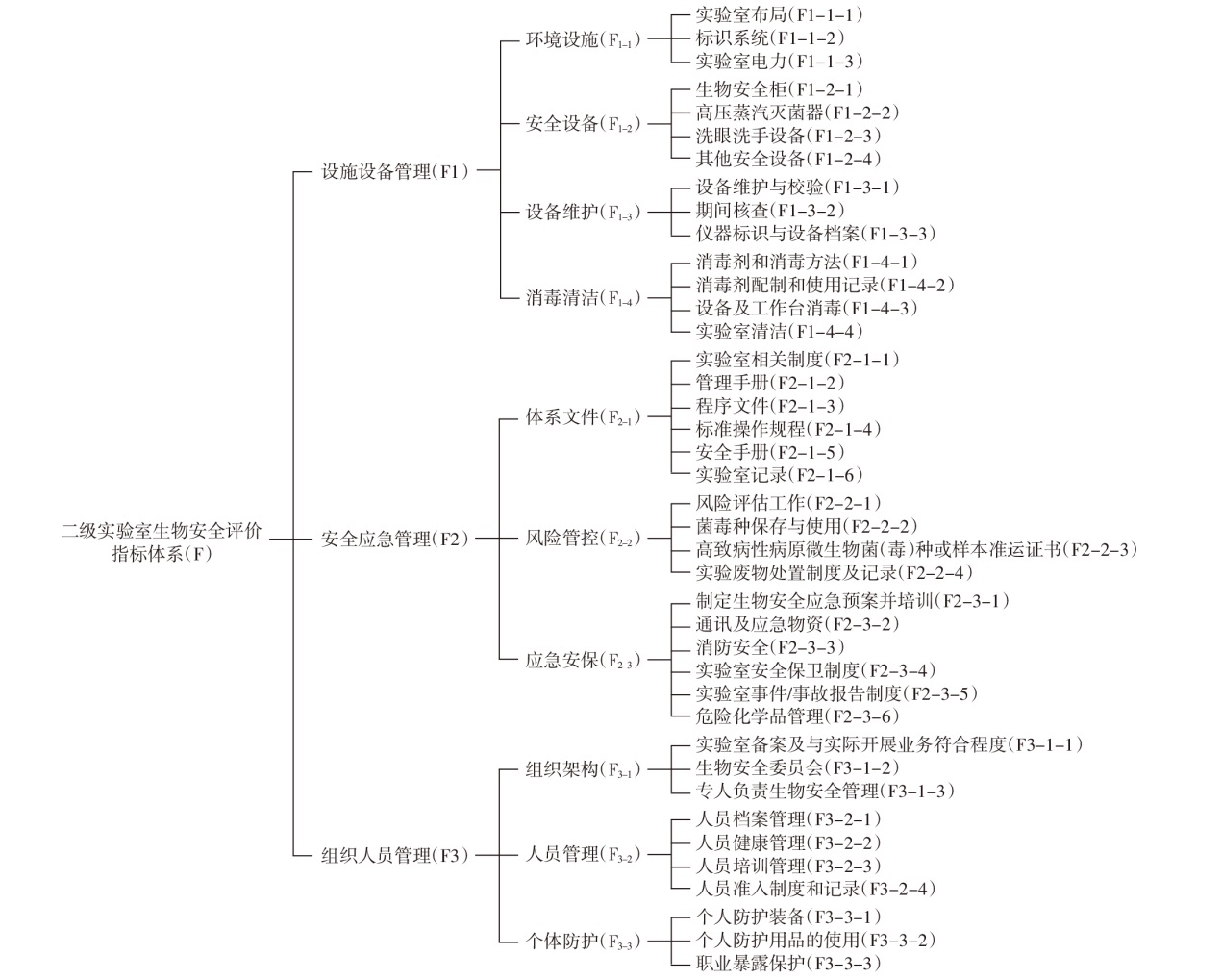
目的 通过构建科学、合理的实验室生物安全管理评价体系,分析不同地区生物安全管理水平差异,并提出系统性改进策略,提升实验室生物安全治理效能。方法 采用层次分析法(analytic hierarchy process,AHP)构建评价指标体系,体系共分为3级,包含3个一级指标、10个二级指标和40个三级指标,通过系统分解、两两比较矩阵和一致性检验确定指标权重,确保评价体系的科学性和适用性。2025年4月9—15日,采用该体系评估山西省11个地市实验室的生物安全管理现状,识别主要短板及影响因素。结果 研究证实层次分析法可构建出科学、合理的实验生物安全管理评价指标体系。实证分析显示,不同地区实验室生物安全管理工作发展不平衡,各地市实验室生物安全管理综合评分在76.52~92.70分间波动。其中,设施设备管理指标各地市表现相对均衡且整体水平较高,但安全应急管理、组织人员管理等指标得分差异显著,呈现“重硬件、轻管理”现象。进一步分析发现,风险管控、人员管理等体现管理能力的二级指标及高致病性病原微生物菌(毒)种或样本准运证书、人员培训等三级指标区域差异突出,暴露出制度执行、日常管理等方面的缺陷。结论 AHP方法适用于实验室生物安全评价,但需注意决策者主观认知可能带来的偏差。针对管理短板,建议强化标准化体系建设、完善风险评估与应急机制、优化人员管理及健康监测,并创新监督与区域协同机制。未来研究应加大实地调研比重,进一步细化评价指标,深入探讨改进策略的实施效果,构建更完善的生物安全管理体系。

关键词: 层次分析法, 病原微生物实验室, 生物安全管理, 指标体系, 区域差异, 实证研究

Abstract:

Objective To establish a scientific and reasonable evaluation system for laboratory biosafety management,analyze the differences in biosafety management levels among different regions,and propose systematic improvement strategies to enhance the governance efficiency of laboratory biosafety. Methods The analytic hierarchy process(AHP) was adopted to construct an evaluation index system,which was divided into 3 levels,including 3 first-level indicators,10 second-level indicators,and 40 third-level indicators. The weights of the indicators were determined through system decomposition,pairwise comparison matrices,and consistency check(CI) to ensure the scientificity and applicability of the evaluation system. From April 9th to 15th,2025,this system was used to assess the current status of biosafety management in laboratories of 11 cities in Shanxi Province,identifying the main shortcomings and influencing factors. Results The study confirmed that the AHP method could construct a scientific and reasonable evaluation index system for laboratory biosafety management. Empirical analysis showed that the development of biosafety management in laboratories in different regions was unbalanced,with the comprehensive scores of laboratory biosafety management in various cities ranging from 76.52 to 92.70. Among them,the management of facilities and equipment was relatively balanced and at a relatively high level across all cities,but there were significant differences in the scores of safety emergency management,personnel management,and other indicators,showing a phenomenon of "emphasizing hardware over management". Further analysis revealed that the regional differences in second-level indicators reflecting management capabilities,such as risk control and personnel management,and third-level indicators such as high-pathogenicity pathogen strain or sample transportation certificates and personnel training were prominent,exposing deficiencies in the implementation of systems and daily management. Conclusion The AHP method is suitable for laboratory biosafety evaluation,but attention should be paid to the possible bias caused by the subjective cognition of decision-makers. In response to management shortcomings,it is recommended to strengthen the construction of a standardized system,improve risk assessment and emergency mechanisms,optimize personnel management and health monitoring,and innovate supervision and regional collaboration mechanisms. Future research should increase the proportion of field investigations,further refine evaluation indicators,and deeply explore the implementation effects of improvement strategies to build a more comprehensive biosafety management system.

Key words: Analytic hierarchy process, Pathogenic microorganism laboratory, Biosafety management, Index system, Regional differences, Empirical research

中图分类号: