职业与健康 ›› 2026, Vol. 42 ›› Issue (19): 2654-2659.

• 论著——流行病学与预防保健 • 上一篇    下一篇

四川省8所三级综合医院急诊科护士工作家庭冲突与组织支持对职业退缩行为的作用路径研究

田青1, 颜源均2, 雍亚兰3, 杨楠1   

  1. 1 首都医科大学附属北京安贞医院南充医院南充市中心医院四川 南充 637000
    2 川北医学院附属医院四川 南充 637000
    3 南充市嘉陵区人民医院四川 南充 637000
  • 收稿日期:2025-09-25 修回日期:2025-11-06 出版日期:2026-10-01 发布日期:2026-08-17
  • 作者简介:田青,女,主管护师,主要从事急诊护理工作。

Study on the role path of work-family conflict and organizational support in occupational withdrawal behavior of emergency department nurses in 8 tertiary general hospitals in Sichuan Province

TIAN Qing1, YAN Yuanjun2, YONG Yalan3, YANG Nan1   

  1. 1 Beijing Anzhen Hospital Affiliated to Capital Medical UniversityNanchong Hospital(Nanchong Central Hospital),NanchongSichuan 637000, China
    2 The Affiliated Hospital of North Sichuan Medical CollegeNanchongSichuan 637000, China
    3 Nanchong Jialing District People’s HospitalNanchongSichuan 637000, China
  • Received:2025-09-25 Revised:2025-11-06 Online:2026-10-01 Published:2026-08-17

摘要:

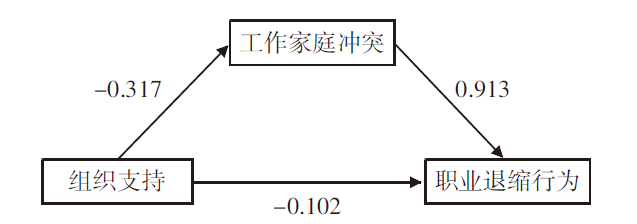
目的 了解四川省三级综合医院急诊科护士职业退缩行为现状并分析影响因素,同时分析工作家庭冲突在组织支持与职业退缩行为间的中介作用,为进一步降低护士职业退缩行为提供参考依据。方法 2025年5—6月,采取随机抽样的方式选取已编号的四川省8所三级综合医院356名急诊科护士作为调查对象,采取一般资料问卷、组织支持量表、工作家庭冲突量表及职业退缩行为量表对调查对象进行调查,并对数据进行分析。结果 四川省三级综合医院356名急诊科护士组织支持得分为(49.46±10.31)分,工作家庭冲突得分为(36.50±6.72)分,职业退缩行为得分为(35.63±7.76)分;相关分析显示,四川省三级综合医院急诊科护士组织支持得分与工作家庭冲突得分呈负相关(P<0.05)、与职业退缩行为得分呈负相关(P<0.05),工作家庭冲突得分与职业退缩行为得分呈正相关(P<0.05);多因素分析结果显示,是否经历过职业场所暴力、是否编制、周夜班次数、个人月均收入、组织支持、工作家庭冲突均是职业退缩行为的主要影响因素(均P<0.05);工作家庭冲突在组织支持及职业退缩行为间起部分中介作用,中介效应值为-0.289,占总效应的73.9%。结论 四川省三级综合医院356名急诊科护士组织支持、工作家庭冲突及职业退缩行为处于中等偏上水平,周夜班次数较多、不在编、收入较低、经历过职业场所暴力的急诊科护士职业退缩行为越明显,工作家庭冲突在组织支持及职业退缩行为间起部分中介作用。管理者可以根据不同人口学特征,结合工作家庭冲突与组织支持对职业退缩行为的关系采取有特异性的干预措施,以提升护士感知组织支持、减少工作家庭冲突,降低其职业退缩行为。

关键词: 急诊科, 护士, 组织支持, 工作家庭冲突, 职业退缩行为, 中介作用, 影响因素

Abstract:

Objective To investigate the current status of career withdrawal behavior among emergency nurses in tertiary general hospitals of Sichuan Province and analyze the influencing factors,and to explore the mediating effect of work-family conflict between organizational support and career withdrawal behavior,so as to provide evidence for reducing nurses' career withdrawal behavior. Methods From May to June 2025,356 emergency nurses from eight tertiary general hospitals in Sichuan Province were recruited by random sampling. General information questionnaire,organizational support scale,work-family conflict scale,and career withdrawal behavior scale were used to investigate the survey subjects,and the data were analyzed. Results The organizational support score of 356 emergency department nurses from tertiary general hospitals in Sichuan Province was (49.46±10.31)points,the work-family conflict score was (36.50±6.72)points,and the career withdrawal behavior score was (35.63±7.76)points. Correlation analysis revealed that organizational support was negatively correlated with work-family conflict and career withdrawal behavior(all P<0.05),whereas work-family conflict was positively correlated with career withdrawal behavior(all P<0.05). Multivariate analysis indicated that exposure to workplace violence,employment status,weekly night-shift frequency,monthly personal income,organizational support,and work-family conflict were the main influencing factors of career withdrawal behavior(all P<0.05). Work-family conflict partially mediated the relationship between organizational support and career withdrawal behavior, with a mediation effect value of -0.289,accounting for 73.9% of the total effect. Conclusion The organizational support,work-family conflict,and career withdrawal behavior of 356 emergency department nurses in tertiary general hospitals in Sichuan Province are at a moderate to high level. Career withdrawal behavior is more pronounced among nurses who work more night shifts,are not on permanent contracts,have lower incomes,or have experienced workplace violence. Work-family conflict partially mediates the relationship between organizational support and career withdrawal behavior. Managers should implement targeted interventions based on demographic characteristics,combined with the relationship between work-family conflict and organizational support on career withdrawal behavior,to enhance nurses' perceived organizational support and reduce work-family conflict,thereby decreasing their career withdrawal behavior.

Key words: Emergency department, Nurse, Organizational support, Work-family conflict, Career withdrawal behavior, Mediating effect, Influencing factors

中图分类号: