职业与健康 ›› 2026, Vol. 42 ›› Issue (19): 2683-2687.

• 论著——学校卫生 • 上一篇    下一篇

攀枝花市米易县农村饮用水安全的成效评估与康养旅游的时空扰动分析

崔莎莎1, 陈颖1, 宋务露1, 胡长江2()   

  1. 1 攀枝花市米易县疾病预防控制中心四川 攀枝花 617200
    2 攀枝花市米易县人民医院四川 攀枝花 617200
  • 收稿日期:2025-10-09 修回日期:2026-04-11 出版日期:2026-10-01 发布日期:2026-08-17
  • 通信作者: 胡长江,E-mail:15182708173@163.com
  • 作者简介:崔莎莎,女,主管检验技师,主要从事环境卫生检测工作。

Effectiveness evaluation of rural drinking water safety and spatiotemporal disturbance analysis of wellness tourism in Miyi County of Panzhihua City

CUI Shasha1, CHEN Ying1, SONG Wulu1, HU Changjiang2()   

  1. 1 Panzhihua Miyi County Center for Disease Control and PreventionPanzhihuaSichuan 617200, China
    2 Panzhihua Miyi County People's HospitalPanzhihuaSichuan 617200, China
  • Received:2025-10-09 Revised:2026-04-11 Online:2026-10-01 Published:2026-08-17
  • Contact: HU Changjiang,E-mail:15182708173@163.com

摘要:

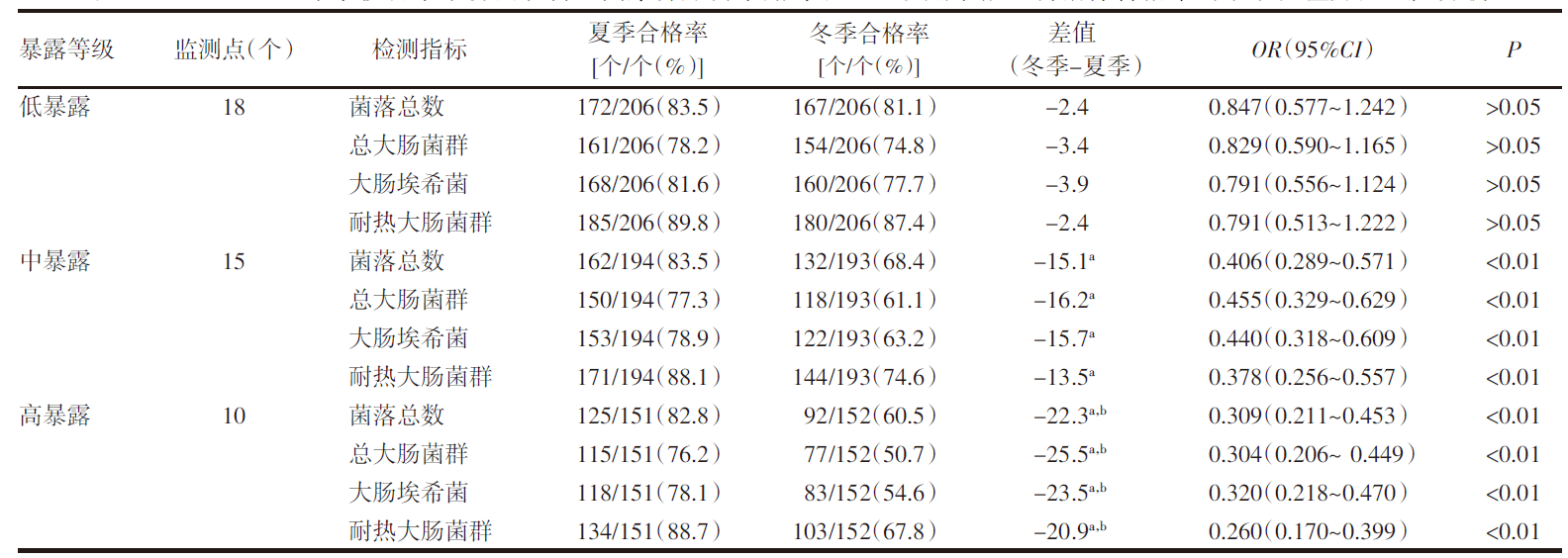
目的 基于菌落总数、总大肠菌群、耐热大肠菌群及大肠埃希菌4项关键微生物指标的监测数据,评估乡村振兴战略对攀枝花市米易县农村饮用水安全的改善成效,并探讨康养旅游发展带来的时空扰动效应。方法 于2017—2024年每年夏季和冬季,在米易县12个乡镇固定监测点采集1 102份饮用水样品,依据相应版本的GB/T 5750《生活饮用水标准检验方法》检测菌落总数、总大肠菌群、耐热大肠菌群及大肠埃希菌。采用χ2检验、 χ2趋势检验及多元Logistic回归模型进行数据分析。结果 乡村振兴政策实施期间,饮用水微生物指标综合合格率由2017年的50.5%显著上升至2024年的81.0%,项次合格率由59.9%上升至89.3%。康养旅游导致显著时空扰动,高暴露地区冬季各微生物指标合格率均较夏季显著降低,总大肠菌群不合格风险在冬季显著增加(OR=0.304,95%CI:0.206~0.449)。此外,饮用水安全存在显著的区域结构性差异,薄弱区微生物综合合格率(60.5%)显著低于巩固区(69.5%,P<0.01)。结论 乡村振兴政策显著提升了米易县农村饮用水安全水平,但康养旅游的季节性压力与薄弱区以分散式供水为主要特征的风险结构共同构成了新挑战。需建立水质-旅游负荷联动预警机制,并重点攻坚薄弱区,实施以管网延伸与分散式供水点改造为核心的综合提升工程。

关键词: 乡村振兴, 饮用水安全, 微生物污染, 康养旅游, 分散式供水

Abstract:

Objective To evaluate the improvement effect of the Rural Revitalization Strategy on rural drinking water safety in Miyi County of Panzhihua City based on monitoring data of four key microbial indicators,including standard plate-count bacteria,total coliforms,thermotolerant coliform bacteria,and Escherichia coli,and explore the spatiotemporal disturbance effects induced by the development of wellness tourism. Methods From 2017 to 2024,a total of 1 102 drinking water samples were collected annually during the summer and winter from fixed monitoring sites in 12 townships of Miyi County. The samples were tested for standard plate-count bacteria,total coliforms,thermotolerant coliform bacteria,and Escherichia coli in accordance with the corresponding versions of GB/T 5750 "Standard Examination Methods for Drinking Water". Data were analyzed using χ2 tests,χ2 test for trend,and multivariate Logistic regression models. Results During the implementation of the Rural Revitalization policy,the comprehensive pass rate of microbial indicators in drinking water significantly increased from 50.5% in 2017 to 81.0% in 2024,and the item-based pass rate rose from 59.9% to 89.3%. Wellness tourism caused significant spatiotemporal disturbances.The pass rates for all microbial indicators in high-exposure areas during winter were significantly lower than those during summer,and the risk of total coliform non-compliance significantly increased in winter(OR=0.304,95%CI:0.206-0.449). Furthermore,there were significant regional structural disparities in drinking water safety,with the comprehensive microbial pass rate in high-risk zones (60.5%) being significantly lower than that in consolidated zones(69.5%)(P<0.01). Conclusion The Rural Revitalization Strategy has significantly improved the safety of rural drinking water in Miyi County. However,the seasonal pressure from wellness tourism,coupled with the risk structure in vulnerable zones characterized primarily by decentralized water supply,together constitute a new challenge. It is imperative to establish a water quality-tourism load linkage early warning mechanism,prioritize interventions in vulnerable zones,and implement comprehensive improvement projects focused on pipe network extension and the upgrading of decentralized water supply points.

Key words: Rural revitalization, Drinking water safety, Microbial contamination, Wellness tourism, Decentralized water supply

中图分类号: