职业与健康 ›› 2026, Vol. 42 ›› Issue (4): 522-526.

• 论著 • 上一篇    下一篇

2013—2024年长春市肾综合征出血热流行特征及趋势分析

任治兴, 吴卉, 周玉祥, 阴媛()   

  1. 长春市疾病预防控制中心(长春市卫生监督所),吉林 长春 130018
  • 收稿日期:2025-08-18 修回日期:2025-11-03 出版日期:2026-02-15 发布日期:2026-02-13
  • 通信作者: 阴媛,E-mail:46166983@qq.com
  • 作者简介:任治兴,男,副主任医师,主要从事传染病防控工作。

Epidemiological characteristics and trend analysis of hemorrhagic fever with renal syndrome in Changchun City from 2013 to 2024

REN Zhixing, WU Hui, ZHOU Yuxiang, YIN Yuan()   

  1. Changchun Centre for Disease Control and Prevention(Changchun Institute of Public Health Supervision),Changchun,Jilin 130018,China
  • Received:2025-08-18 Revised:2025-11-03 Online:2026-02-15 Published:2026-02-13
  • Contact: YIN Yuan,E-mail:46166983@qq.com

摘要:

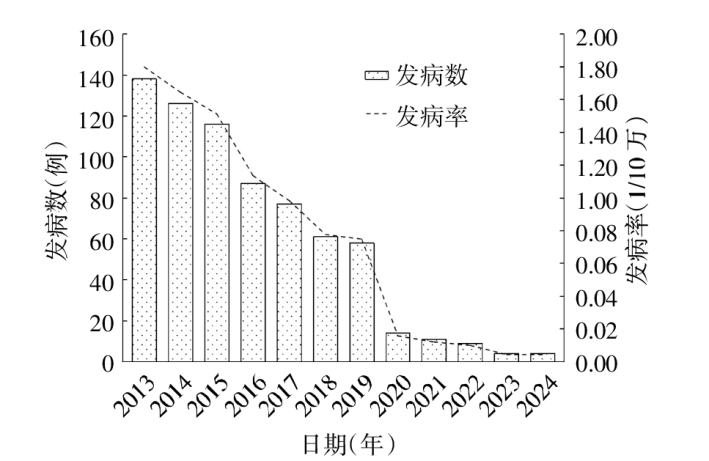
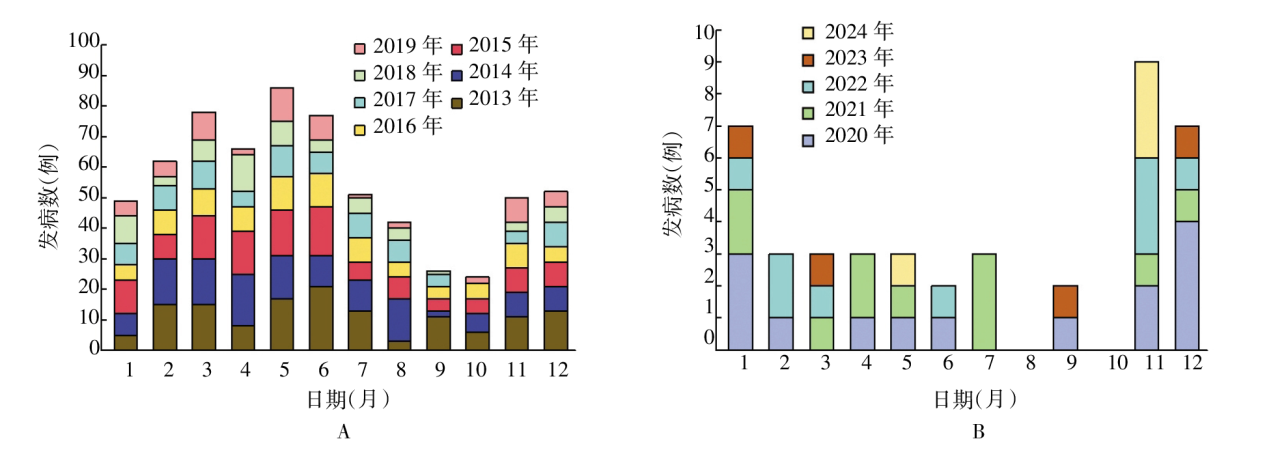
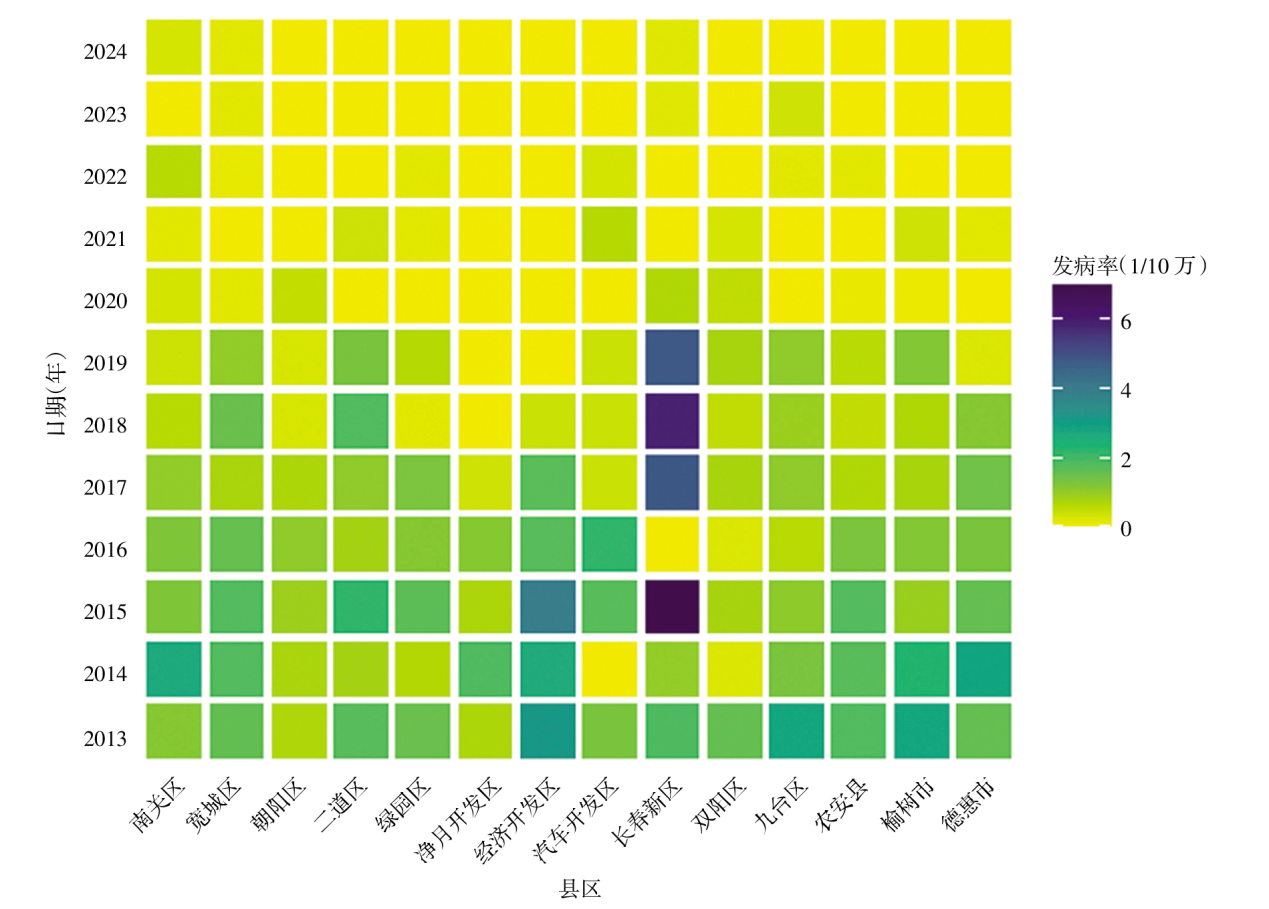
目的 通过分析长春市肾综合征出血热(hemorrhagic fever with renal syndrome,HFRS)流行病学特征及长期发病趋势,了解疾病发展规律,为下一步调整防控提供科学依据。方法 通过中国疾病预防控制信息系统收集2013—2024年长春市HFRS病例资料,以描述流行病学研究方法分析流行特征。采用Joinpoint回归模型对2013—2024年长春市HFRS发病率变化趋势进行分析。结果 2013—2024年长春市累计报告HFRS病例705例,死亡1例,年平均报告发病率0.71/10万,发病呈季节性双峰分布特征。男性发病数多于女性,男女性别比4.04 ∶ 1,以25~<60岁(占77.16%)的农民和家务及待业人员(占77.45%)发病为主。各县(市、区)均有病例报告,主要集中在榆树市、农安县、德惠市、九台区和南关区,占发病总数的60.03%。Joinpoint回归分析结果显示,2013—2024年长春市HFRS报告发病率呈下降趋势,2020年为年发病率趋势变化转折点,2013—2020年呈小幅波动下降趋势(β1=-0.253,P<0.01),2020—2024年呈平稳下降趋势(β2=-0.038,P<0.01),差异均有统计学意义。男性女性年发病均呈下降趋势,且变化速度不一致,男性高于女性。以45~<50岁为年龄组年平均报告发病率趋势变化转折点,0~<20岁至45~<50岁年龄组发病呈上升趋势(β1=0.024,P<0.01),45~<50岁至≥60岁年龄组发病呈下降趋势(β2=-0.047,P<0.05),差异均有统计学意义。结论 2013—2024年长春市HFRS发病呈下降趋势,呈春秋两季双峰分布,外县发病高于城区,且有向城区发展的趋势,中老年为主要发病人群。今后相关部门应加强肾综合征出血热监测预警工作,有针对性调整防控措施,保持发病呈低发平稳态势。

关键词: 肾综合征出血热, 流行特征, 趋势分析, 发病率, Joinpoint回归模型

Abstract:

Objective To analyze the epidemic characteristics and long-term trends of hemorrhagic fever with renal syndrome(HFRS) in Changchun,understand its development patterns and provide a scientific basis for adjusting future prevention and control strategies. Methods Data on individual HFRS cases in Changchun City from 2013 to 2024 were collected from the China Disease Prevention and Control Information System,and analyze the epidemiological characteristics using descriptive epidemiological methods. Joinpoint regression model was used to analyze the incidence trend of HFRS in Changchun from 2013 to 2024. Results From 2013 to 2024,a total of 705 HFRS cases and the one fatal case were reported in Changchun,and the average annual incidence rate was 0.71/100 000,the incidence showed a seasonal bimodal distribution. The number of male cases was more than that of female ones,with a male to female ration of 4.04 ∶ 1. The cases mainly occurred in farmers and the unemployed(77.45%) aged 25-<60 years(77.16%). The cases were reported in all counties(city,district),mainly concentrated in Yushu City,Nongan County,Dehui City,Jiutai District and Nanguan District,accounting for 60.03% of the total number of cases. The Joinpoint regression analysis revealed a declining trend in HFRS cases incidence rate reported in Changchun from 2013 to 2024,2020 was the turning point among the trend change of the average annual incidence rate,2013-2020 showed a slight fluctuation downward trend(β1=-0.253,P<0.01),and 2020-2024 showed a stable downward trend(β2=-0.038,P<0.01),with statistically significant differences. The annual incidence of diseases in both males and females showed a downward trend,and the rate of change was not consistent,with males being higher than females. Taking 45-<50 years old as the turning point among the trend change of average annual reported incidence rate,the incidence of 0-<20 years old to 45-<50 years old group showed an upward trend(β1=0.024,P<0.01),and the incidence of 45-<50 years old to ≥60 years old group showed a downward trend(β2=-0.047,P<0.05),with statistically significant differences. Conclusion The incidence of HFRS in Changchun City showed a downward trend and a bimodal distribution in spring and autumn from 2013 to 2024. The incidence of HFRS in counties was more than that in urban areas,and geographical trend for the disease includes a notable shift from counties to urban areas. Middle aged and elderly people are the main affected population. In the future,relevant departments should strengthen the monitoring and early warning work of HFRS,adjusted prevention and control measures in a targeted manner,and maintained the incidence of HFRS at a low and stable level.

Key words: Hemorrhagic fever with renal syndrome, Epidemiological characteristics, Trend analysis, Incidence rate, Joinpoint regression model

中图分类号: