职业与健康 ›› 2026, Vol. 42 ›› Issue (15): 2085-2091.

• 论著—流行病学与预防保健 • 上一篇    下一篇

基于无结核社区试点的无锡市公众结核病防治核心信息知晓率基线调查

李倩, 高嵩, 陈善辉, 朱悦, 许祝平()   

  1. 无锡市疾病预防控制中心(南京医科大学附属无锡疾病预防控制中心)江苏 无锡 214023
  • 收稿日期:2025-08-05 修回日期:2025-12-02 出版日期:2026-08-01 发布日期:2026-07-16
  • 通信作者: 许祝平
  • 作者简介:李倩,女,主管医师,主要从事慢性传染病防治工作。
  • 基金资助:
    无锡市医学发展学科项目(FZXK2021010);无锡市科技发展资金“太湖之光”科技攻关计划基础研究项目(K20231045)

Baseline survey on the awareness rate of core information on tuberculosis prevention and control among the public in pilot communities for zero tuberculosis community in Wuxi City

LI Qian, GAO Song, CHEN Shanhui, ZHU Yue, XU Zhuping()   

  1. Wuxi Center for Disease Control and Prevention(Wuxi Center for Disease Control and Prevention Affiliated to Nanjing Medical University)WuxiJiangsu 214023, China
  • Received:2025-08-05 Revised:2025-12-02 Online:2026-08-01 Published:2026-07-16
  • Contact: XU Zhuping
  • About author:XU Zhuping,E-mail:138963696@qq.com

摘要:

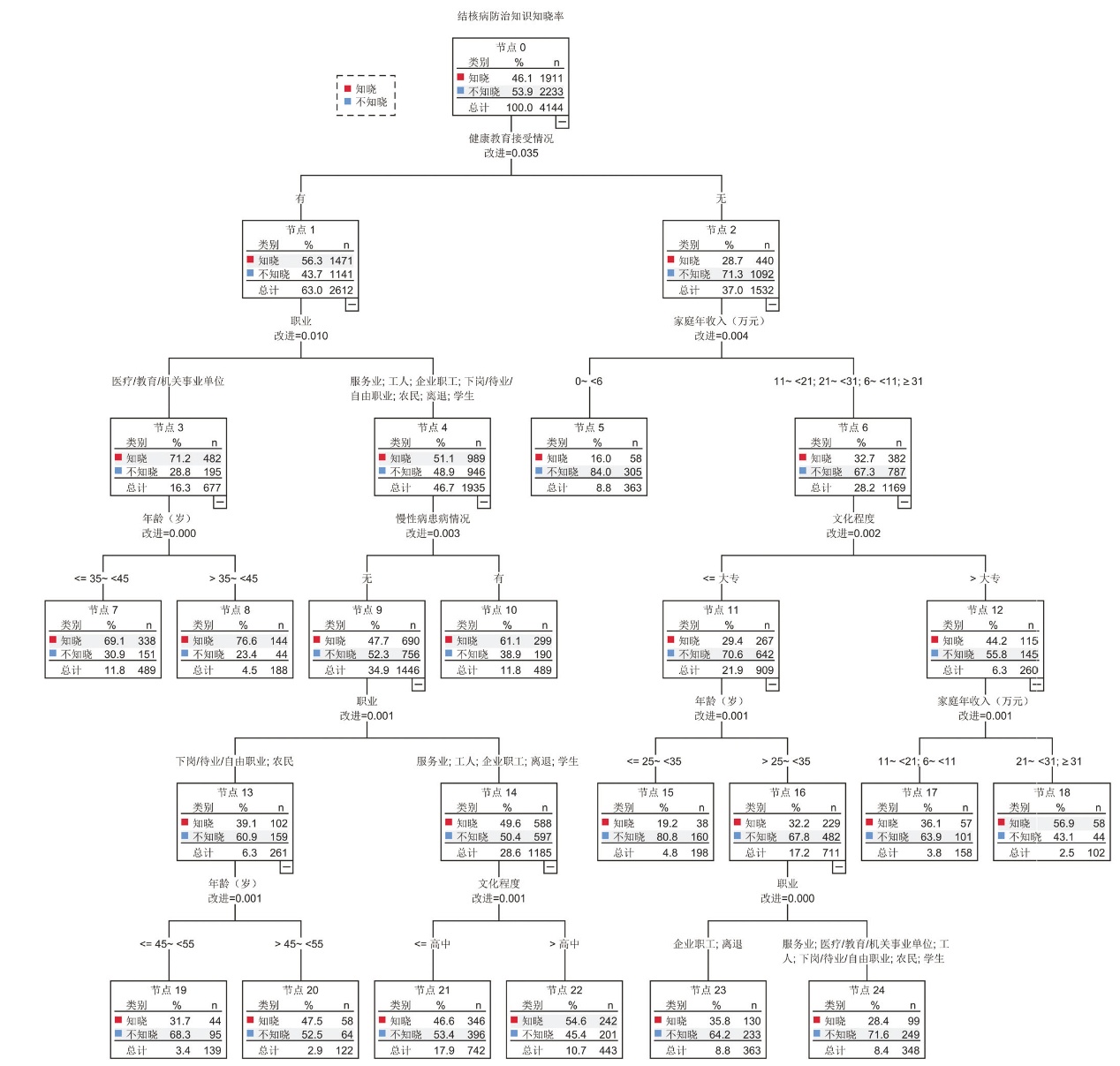
目的 评估无锡市无结核社区建设试点社区≥15岁居民结核病防治知识知晓率、健康教育接受情况和结核病防治信念和行为现状,为进一步优化基层结核病防控策略提供参考。方法 2024年3—5月,采用多阶段随机抽样法对无锡市无结核社区试点地区≥15岁的居民开展问卷调查,内容涵盖社会人口学特征、慢性病患病情况、结核病防治核心信息及接受健康教育情况等信息。采用χ2检验对知晓率进行单因素分析,多因素Logistic回归模型和决策树模型分析影响知晓情况的相关因素。结果 结核病防治信息总知晓率为55.97%,其中结核病传播途径(80.38%)、肺结核可疑症状(88.30%)和结核病定点医疗机构(81.85%)单一知晓率较高,而预防肺结核传播方法知晓率仅7.07%。单因素结果显示,性别、年龄、文化程度、家庭年收入、职业、慢性病史及健康教育均影响居民健康知识知晓率(χ2=45.997、14.832、128.799、80.229、183.812、9.020和295.942,均P<0.05)。多因素Logistic回归分析显示,女性、≥35岁、小学及以上学历、家庭年收入≥6万元、医疗/教育/机关事业单位/离退休人员、患有慢性病及接受过健康教育是知晓情况的保护因素(均P<0.05)。决策树模型显示,健康教育是影响知晓情况的最主要因素,除此之外年龄、文化程度、职业、收入及慢性病也是影响知晓情况的相关因素。59.18%的调查对象接受过健康教育,主要途径为电视(62.10%)、报刊杂志(52.30%)和广播(47.05%);希望获得健康教育途径主要为广播/电视/电影/音像材料等(56.75%)、网站/微信/微博/短视频APP等(41.87%)和张贴画/宣传栏/板报/展板/墙体标语等(41.03%)。无锡市居民整体结核病防治信念和行为正确率为75.94%,最低为“结核病不可怕”(35.39%),最高为“患有结核病以后按照医生进行规范治疗”(87.40%)。结论 无锡市无结核试点社区≥15岁居民结核病防治信息总知晓率尚未达到无结核社区建设目标,需针对低龄、低收入、低学历及工人/服务业/农民人群强化精准宣教,结合传统媒体与新媒体拓宽覆盖面,同步消除疾病歧视,以加速无结核社区建设进程。

关键词: 无结核社区, 结核病, 知晓率, 决策树模型, 健康教育, 信念和行为

Abstract:

Objective To assess the awareness rate of tuberculosis(TB) prevention and control knowledge,the acceptance of health education,and the current status of TB-related beliefs and behaviors among residents aged 15 and above in pilot communities for Zero Tuberculosis Community in Wuxi City,and provide references for further optimizing grassroots TB prevention and control strategies. Methods From March to May 2024,a questionnaire survey was conducted among residents aged 15 and above in pilot area of Zero Tuberculosis Community in Wuxi City using a multistage random sampling method. The questionnaire covered sociodemographic characteristics,chronic disease prevalence,core knowledge of tuberculosis prevention and control,and health education participation. Single factor analysis was conducted on the awareness rate using a chi square test,multivariate Logistic regression models and decision tree models were employed to analyze factors influencing the awareness rate. Results The overall awareness rate of tuberculosis prevention and control information was 55.97%. Awareness of TB transmission routes(80.38%),TB suspicious symptoms(88.30%) and designated TB medical institutions(81.85%) showed relatively higher single-item awareness rates, while awareness of TB transmission prevention methods was only 7.07%. The univariate analysis revealed that gender,age,educational level,annual household income,occupation,history of chronic diseases,and health education were all associated with residents' health knowledge awareness rate(χ2=45.997,14.832,128.799,80.229,183.812,9.020,295.942,all P<0.05). Multivariate Logistic regression analysis showed that female gender,age ≥35 years,educational attainment at primary school level or above,annual household income ≥60 000 yuan,healthcare,education,government employees or retirees,presence of chronic diseases,and received health education were protective factors for awareness(all P<0.05). Decision tree models showed that health education was the most significant factor affecting awareness,in addition to age,education level,occupation,income,and chronic diseases,which were also related factors affecting awareness. 59.18% of respondents had received health education,mainly through television(62.10%),and print media(52.30%),and radio(47.05%). Preferred health education channels included radio/television/movies/audiovisual materials(56.75%),websites/WeChat/Weibo/short video apps(41.87%),and posters/bulletin boards/blackboard newspapers/display boards/wall slogans(41.03%). The overall correct rate of belief and behavior regarding TB prevention and control among residents in Wuxi City was 75.94%,with the lowest being "TB is not frightening"(35.39%),and the highest being "standardized treatment compliance after diagnosis"(87.40%). Conclusion The overall awareness rate of TB prevention and control information among residents aged 15 and above in pilot communities for Zero Tuberculosis Community in Wuxi City has not yet met the targets for establishing Zero Tuberculosis Community. Targeted health education interventions should be intensified for populations with younger age,lower income,limited education,and occupational groups including workers/service sector employees/agricultural workers. It is recommended to expand coverage through both traditional and new media platforms,while simultaneously addressing disease-related stigma to accelerate the construction of Zero Tuberculosis Community.

Key words: Zero tuberculosis community, Tuberculosis, Awareness rate, Decision tree models, Health education, Beliefs and behaviors

中图分类号: